

Business Operation · 2025
In this section22 topics
- Corporate Information4 items
- Dividend Policy2 items
- Major Shareholders1 item
- Business Strategies Overview5 items
- Material Changes & Developments1 item
- Use of Proceeds from Securities Offerings3 items
- Commitments Made in the Registration Statement2 items
- Group Operating-Structure Policy1 item
- Companies Where the Company Holds ≥10%1 item
- Shareholders with Potential Conflict of Interest1 item
- Relationships Among Major Shareholders1 item
- Shareholders' Agreement1 item
- Shareholding Diagram (Group Structure)3 items
- Income Structure3 items
- Product / Service Characteristics2 items
- Research & Development2 items
- Assets Used in the Business3 items
- Marketing Policy & Competition2 items
- Procurement of Products & Services2 items
- Projects Under Construction1 item
- Debentures & Bills of Exchange2 items
- Convertible Securities1 item
Corporate Information
Company Name
PRECIOUS SHIPPING PUBLIC COMPANY LIMITED
Telephone
0-2696-8800
Website
www.preciousshipping.com
ir@preciousshipping.com
Dividend Policy
Dividend Policy
The Company’s dividend policy approved by the Annual General Meeting of Shareholders No. 1/2004 dated 30th April 2004 is to pay out not less than 25% of Net Profits after taxes and appropriation to any reserves required by law. Upon approval by the Board of Directors, the annual dividend payout is to be presented to the shareholders’ annual general meeting for approval. As regards the interim dividend, however, the Board is authorised to pay it and then report the payout at the next shareholders’ general meeting.
Historical Dividend Payments
| This Year | Last Year | 2 Years Ago | 3 Years Ago | 4 Years Ago | Metric | Description |
|---|---|---|---|---|---|---|
| 2.74 | 0.94 | 0.46 | 3.11 | 2.87 | Net profit per share (Baht : Share) | Net profit per share (baht : share) |
| 0.4 | 0.4 | 0.25 | 1.75 | 1.75 | Dividend per share (Baht : Share) | Dividend per share (baht : share) |
| 0 | 0 | 0 | 0 | 0 | Dividend stock ratio (Number of original shares: dividend shares) | Ratio of stock dividend payment (existing share : stock dividend) |
| 0 | 0 | 0 | 0 | 0 | Dividend share value per share (Baht : Share) | Value of stock dividend per share (baht : share) |
| 0.4 | 0.4 | 0.25 | 1.75 | 1.75 | Total dividend payment value (Baht : Share) | Total dividend payment (baht : share) |
| 146 | 43 | 54 | 56 | 61 | Dividend payout ratio to net profit (%) | Dividend payout ratio compared to net profit (%) |
Business Strategies Overview
Chairman's Message
BOARD OF DIRECTORS’ REPORT
TO THE SHAREHOLDERS:
The directors are pleased to present the 37th Annual Report of the Company along with the Audited Financial Statements as on 31 December 2025.
4th Quarter 2025/Annual Financial Performance (US Dollar Terms)
The results, audited by EY Office Ltd., show you the latest financial position of Precious Shipping Public Company Limited and its subsidiaries (“the Company”). The earnings per day per ship during Q4 came in at USD 14,301, bringing the annual figure to USD 11,948. Please look at the Market Segmentation report that shows you the relative performance of the PSL fleet’s earnings per day per ship compared to the Index ships.
In the current quarter, daily operating costs for ships were USD 5,503, higher than the annual target of USD 5,400. The full-year 2025 average was USD 5,338, lower than the target, although higher than the USD 5,293 recorded during the prior year.
The EBITDA for Q4 was USD 26.45 million, resulting in a full year figure of USD 69.49 million. In Q4, we achieved a net profit of USD 10.77 million, with earnings per share of Baht 0.23. For the year 2025, we recorded a net profit of USD 13.09 million, with earnings per share of Baht 0.27.
THE HARD FACTS | 2025 | 2024 | Q4 2025* | Q4 2024* |
Highest earnings per day per ship in USD | 22,171 | 27,210 | 22,171 | 16,655 |
Average earnings per day per ship in USD | 11,948 | 12,700 | 14,301 | 12,177 |
Av. earnings per day per Small Handysize ship (excluding 4 cement carriers) in USD | 8,677 | 10,412 | 10,721 | 10,879 |
Av. earnings per day per Large Handysize ship in USD | 11,739 | 12,294 | 14,587 | 10,976 |
Av. earnings per day per Supramax ship in USD | 11,516 | 12,983 | 13,571 | 11,920 |
Av. earnings per day per Ultramax ship in USD | 14,280 | 15,102 | 17,044 | 14,329 |
Operating cost per day per ship in USD | 5,338 | 5,293 | 5,503 | 5,382 |
EBITDA in million USD | 69.49 | 82.60 | 26.45 | 19.50 |
Net Profit (Loss) in million USD excluding exchange gain (loss) and non-recurring items | 16.28 | 36.03 | 11.64 | 6.63 |
Net Profit (Loss) in million USD | 13.09 | 41.31 | 10.77 | 7.33 |
Earnings (Loss) Per Share in Thai Baht excluding exchange gain (loss) and non-recurring items | 0.34 | 0.82 | 0.25 | 0.15 |
Earnings (Loss) Per Share in Thai Baht | 0.27 | 0.94 | 0.23 | 0.16 |
*Derived numbers
**Average Earnings per day are calculated based on ship availability for commercial operation and exclude technical downtime, including periods for dry-docking. Further, they are reported on a gross basis, before netting off 5% commission.
Financial Highlights (Thai Baht Terms) and Review of the Year:
During the year under review, the Company recorded a net profit of Baht 413.85 million, compared to Baht 1,468.28 million in 2024. Total revenues amounted to Baht 5,335.62 million, as opposed to Baht 6,267.15 million reported in 2024. The shareholders’ equity amounted to Baht 14,981.81 million, compared to Baht 16,863.53 million in 2024. Total assets were Baht 25,832.97 million, while in 2024, total assets stood at Baht 26,208.28 million. In 2025, the Company operated an average of 40.12 vessels, compared to 37.81 vessels in 2024.
In 2025, the net vessel operating income (net of voyage disbursements and bunker consumption) measured in Thai Baht was 13% lower than the previous year, primarily due to the weak freight market experienced during the first half of 2025. The vessel running expenses was 3% lower than the previous year primarily due to the appreciation of the Thai Baht against the US Dollar.
In 2025, Company gained Baht 33.09 million from the sale of three vessels.
Administrative expenses (including management remuneration) for the year 2025 is Baht 89.75 million lower than the same period last year, due to a decrease in variable compensation expenses and the appreciation of the Thai Baht against the US Dollar.
The strong Thai Baht contributed to Thai Baht 138.41 million foreign exchange losses during the year. That said, these are principally unrealized notional figures which reflect movement in the USD value of our Thai Baht 1,360 million bond liabilities which mature in 2029 and 2034.
Finance costs for the year 2025 were Baht 48.22 million higher than the same period last year, due to an increase in loans arising from our fleet rejuvenation plan.
In 2025, 22 vessels completed dry-docking and special surveys, with an average technical downtime of 17 days per vessel. The unusually high number of vessels undergoing surveys in 2025 is the main contributor to the lower-than-expected earnings. 2026 will be a much more ‘normal’ year as we will have just 11 ships undergoing surveys.
We conducted an ‘in-house’ exercise again this year to determine the total return to shareholders, calculated over the 32 years that we have been operating as a listed entity. Based on the closing share price of Baht 7.30 per share on 16 September 2025 (our first day of trading on the SET was 16 September 1993) and assuming you had subscribed at the IPO, at the end of 32 years, you would have obtained a 15.65% IRR on your initial investment. This return does not assume any re-investment of the dividends into shares or any interest on the dividends received.
We present PSL's annual net profit or loss from recent years for context.
Year | 2016 | 2017 | 2018 | 2019 | 2020 | 2021 | 2022 | 2023 | 2024 | 2025 |
Av. BDI | 673 | 1,145 | 1,353 | 1,353 | 1,066 | 2,943 | 1,934 | 1,378 | 1,755 | 1,681 |
Net Profit (loss) $m | (75.61) | (3.76) | 14.10 | (7.25) | (40.80) | 136.96 | 138.61 | 20.35 | 41.31 | 13.09 |
Av. No. of Ships | 40.29 | 36.02 | 36 | 36 | 36 | 36 | 36.99 | 38 | 37.81 | 40.12 |
Net Profit (loss) / Ship $m | (1.88) | (0.10) | 0.39 | (0.20) | (1.13) | 3.80 | 3.75 | 0.54 | 1.09 | 0.33 |
During the abysmally low market period of 2015 and 2016, we managed to keep costs under tight control; raised about USD 65 million from our shareholders via a rights offering in early 2015; raised USD 100 million from a 5 year unsecured bond in January 2016; raised USD 55 million from a 3.5 year unsecured bond in December 2016; reduced finance costs by prepaying many of our secured loans coming due in 2018 and 2019; sold our older and inefficient ships to raise further cash (15 ships recycled in 2015 - 2016 and 2 older ships sold in 2016 - 2017 for further trading). In 2018, we fully prepaid one loan facility, thereby releasing three vessels from their mortgages. In 2019, we fully prepaid another loan facility and released two more vessels from their mortgages. To mitigate the deleterious impact of Covid-19 in 2020, we extended USD 124 million of indebtedness on our two outstanding bonds by 1.5 years, received USD 40.5 million through a settlement agreement with Sainty Shipyard, and received ~USD 26.55 million of gross proceeds through a 12-month advance charter-hire agreement with a customer. In 2021, we redeemed our two outstanding bonds well before the amended maturity dates and raised USD 133.45 million through the signing of three new loan facilities. In 2022, we raised USD 17.10 million through the signing of a new loan facility and prepaid two loan facilities, thereby releasing two vessels from their mortgages. Total loan repayments for the year were USD 69.44 million. In 2023, we signed six loan agreements for a total of USD 244.05 million. We prepaid and repaid loans of USD 67.74 million. In 2024, we signed four loan agreements for a total of USD 70.58 million, prepaid and repaid loans of USD 67.80 million and became the first Asian Shipping Company to issue Sustainability-Linked Bonds in Thai Baht 1,360 million (equivalent to USD 40.76 million on issuance date). In 2025, we signed five loan agreements for a total of USD 157.95 million, prepaid and repaid loans of USD 46.68 million. As of 31 December 2025, the Company has undrawn loans aggregating USD 151.23 million, with availability periods of up to 21 months.
At the end of 2025, our fleet comprised 40 ships on the water - 11 Ultramax, 7 Supramax, 18 Handysize and 4 Cement carriers - with an aggregate capacity of 1,816,351 DWT, averaging 45,409 DWT per ship and an average age of about 12 years. In addition, we took delivery of two newbuilding Ultramax resale vessels in January 2026, and we have four Ultramax vessels under construction scheduled for delivery between 2026 and January 2027. One old Handysize and one old Supramax, which were sold in Q4 2025, were delivered to the new buyers in January 2026.
Joint Venture:
International Seaports (Haldia) Pvt Ltd: The company has an investment in International Seaports (Haldia) Pvt Ltd, which operates a dry-bulk port terminal at Haldia. The company provides cargo handling, berth hire, and related port services under a concession agreement with Haldia Dock Complex. Its operations are centered on efficient throughput management and maintaining service standards in a competitive environment, with revenue streams derived from terminal charges, royalty, and cargo handling income. The concession is valid until 2032. If not renewed/extended, all assets revert to the port authority.
In 2025, the Board of International Seaports (Haldia) Pvt. Ltd. approved a proposal to buy back up to 25% of its outstanding shares. Shareholders holding an aggregate 9,830,000 shares, representing 22.31% of total outstanding shares, tendered their shares under the buyback offer. The shares repurchased by International Seaports (Haldia) Pvt. Ltd. were cancelled on 5 January 2026. PSL did not participate in this buyback, and as a result, its stake increased from 22.4% of total capital to 28.83% on 5 January 2026.
This JV continues to operate very well, and we have to date received total dividends of USD 6.74 million, which works out to about 331% of our original Investment made in the years 2002-2003.
Nusantara Maritime Sdn. Bhd.: In 2025, the Company entered a joint venture, Nusantara Maritime Sdn. Bhd., which will be engaged in the energy transportation sector. In 2025, the joint venture had no revenue.
Awards and Honors:
During the third quarter of 2025, the company received recognition from the Stock Exchange of Thailand and the Singapore Management University for its employee ESG education initiatives
Achieved the second recertification under Thailand’s Collective Action against Corruption (CAC) program, which will remain valid for three years (2025 – 2028). PSL has maintained continuous membership since November 2018.
Received Climate Action Leaders Recognition Certificate from Dr. Natcha Likhitkitvorakul, Advisor to the Minister of Natural Resources and Environment, at the Climate Action Forum, hosted at the United Nations Office, Thailand, on 27 March 2025.
Achieved an ESG score of 4.2 out of 5 and ranked in the top 11th percentile within the Industrial Goods & Services sector for 2025, as assessed by FTSE Russell ESG Scores
Ranked in the top 8% of Morningstar’s ESG Risk Rating Ranking of global listed Shipping Companies in 2025.
Ranked in the top 9% of global listed transportation companies in the S&P Corporate Sustainability Assessment (CSA) rankings in 2025.
Won Best Sustainability-Linked Bond – Transportation at The Asset Triple A Sustainable Finance Awards 2025
Achieved AA rating in the Stock Exchange of Thailand’s ESG Rating exercise for the twoconsecutive year (2024 – 2025).
Included in the Stock Exchange of Thailand's Thailand Sustainability Investment (THSI) list for the fourth consecutive year (2022 – 2025).
Classified as a company with “Excellent” Corporate Governance for 16 consecutive years (2010–2025) by Thailand’s Institute of Directors & the National Corporate Governance Committee.
Earned a perfect 100 AGM assessment score for eightconsecutive years (2018–2025) by the Thai Investors Association (TIA).
Received Carbon Neutral certification from TGO for third consecutive year (2022 – 2024).
Received Carbon Footprint for Organization certification from TGO for the third consecutive year (2022 – 2024).
Market Segmentation for 2025:
During 2025, the Baltic Handysize Index (BHSI) averaged 662 points, corresponding to an average Time Charter (TC) rate of USD 11,910 per day. Our nine existing (excluding 4 cement carriers) and two sold Small Handysize Vessels earned an average of USD 8,677 per day, underperforming the BHSI TC rate by 27.15%. Our nine large Handysize vessels earned an average of USD 11,739 per day, underperforming the BHSI TC rate by 1.44%. The Baltic Supramax Index (BSI58) averaged 1,129 points, corresponding to an average TC rate of USD 12,241 per day. Our seven existing and one sold Supramax vessels earned an average of USD 11,516 per day, underperforming the BSI58 TC rate by 5.92%. The Baltic Supramax Index (BSI63) derived an average TC rate of USD 14,275 and in comparison, our eleven Ultramax vessels earned USD 14,280 per day, outperforming the BSI63 TC rate by 0.04%. Please note that our Small Handysize and Supramax ships are rated 15% below the standard index ships.
Long Term versus short term Charters:
The long-term charters, of about 1 year, are shown in the chart below. As can be seen, our forward four-year rolling book is currently at the 23.2% level with a visible revenue stream of USD 258.10 million.
Year | 2025 | 2026 | 2027 | 2028 | 2029 |
Total Available Days | 14,644 | 14,601 | 14,600 | 14,640 | 14,600 |
Fixed T/C Days* | 5,939 | 3,818 | 3,539 | 1,870 | 1,819 |
%age Fixed T/C Days | 41% | 26% | 24% | 13% | 12% |
| 14,124 | 15,661 | 16,268 | 15,458 | 15,359 |
Contract value in | 83.89 | 59.79 | 57.57 | 28.91 | 27.94 |
* This comprises seven ships on fixed rate time charter and 18 ships on variable rate time charter
** Average T/C Rate/Day for the variable rate charters is estimated based on rates prevailing in January 2026 for future earnings and actual earnings for past earnings.
It is our intention to continue to charter our ships on long-term contracts whenever practical and economically viable.
The next SET Opportunity Day will be virtually held at 15:15 hours on the 23rd of February 2026 via the SET live web casts. We hope that many of you will attend this event electronically where the Company will get a chance to thoroughly discuss Q4 results and 2025 Annual Performance. The number of online participants attending PSL’s live presentation for Q3 2025 results on 12th of November 2025 were 136 on YouTube.
We are excited to announce the launch of our new investor alerts service! Stay informed of the latest developments at PSL by signing up here today.
Disruptive Shipping Chokepoints:
According to Clarksons, 24% of world trade passes via the Malacca Straits; 11% via the Straits of Hormuz; 9% via the Suez Canal; 4% via the Danish straits/entrance to the Baltic Sea; 3% via the Bosphorus in Turkey to enter the Black Sea; and 3% via the Panama Canal. As geopolitics and climate change have an even greater impact than ever before, it will be important to keep a close watch on these disruptive chokepoints.
Crystal Ball Gazing, 2026 and Beyond:
At every conference, every seminar, every meeting within the shipping community in the last few months of 2025, we hear everyone singing from the same sheet – ‘the freight market is going to do very well in 2026!’ That would be, at least for us, a cautionary red flag when you have unanimity in describing the prospects of the dry bulk shipping markets. Besides, the events of early January, and the pronouncements that have followed by the Trump administration, have raised our expectations that 2026 will be impacted to a much greater degree by geopolitics than even the heavily impacted 2025. Geopolitics can enhance supply-demand economics at any time due to their disruptive nature, as disruptions are always increasing ton-mile demand. However, the two caveats aside, reading the various global research reports that we come across, we get the impression that the major economies of US, EU, China, India, the Middle East, Southeast Asia, and Japan will all fare better in 2026 than they did in 2025. The IMF has upgraded its forecast on 19 January for global GDP growth in 2026 to 3.3% (from 3.1% in October), with favorable fiscal conditions and investment in technology (e.g., AI) expected to offset trade policy headwinds. Inflation has refused to go lower than 3% for two whole years (2024-2025), and sticky inflation may be here to stay so long as there is no recession. According to the IMF, inflation rates are expected to decline from 4.1% in 2025 to 3.8% in 2026 and to 3.4% in 2027. As a result, interest rates will continue to dip (3 rate cuts of 25bps each from the Fed in 2025), whereafter we might see a possible hike in interest rates from the Fed by the end of 2026 or in FH of 2027, all dependent on how sticky inflation is in the future. All the news on global economics suggests that demand for shipping dry bulk commodities would remain strong during 2026, as suggested by the various shipping conferences during the second half of 2025.
On the demand side, the biggest mover is what is being described as the ‘Pilbara Killer’, the Simandou iron ore mines of Guinea. We have confirmation that as of 6 November, the first load of iron ore had already completed the 600KM journey on twin track train lines from the mine head in Guinea to the port, Morebaya, from where this cargo was shipped to China. The ship, a Newcastlemax owned by Winning, finally sailed out on 2 December taking almost a month to complete loading the first shipment of about 200K iron ore from the Simandou mines for China reaching there on 17 January 2026 to discharge the cargo. Winning, Singapore, a part of the Chinese consortium that owns the Simandou mines, has ordered a total of sixteen 325K-DWT-Guaibamax ore carriers for this project. The first two giant ships will be ready to join the rest of Winning’s fleet of Capesize and bigger ships, before the end of 2026, indicating how seriously Winning thinks the Simandou mines will ramp up production. The sailing distance from Guinea to north China and back is 22,700 nautical miles. The corresponding distance from Port Hedland to north China and back is 7,325 nm. Hence the Simandou mines will take 3.1 times longer for each voyage at sea as compared to the shorter sailing distance from Australia’s iron ore ports. This of course does not consider the fact that Simandou exports are just starting out, expected to reach 20-40 MMT by 2026 (according to Rio Tinto, based on their 20% shareholding in Simandou, it should reach 25-50 MMT in 2026), and reach an annual sustainable export total of 120 MMT by 2027. The journey will start with the inevitable teething problems in loading the giant ships at anchorage where, if the Guinea bauxite exports are a guide, will be closer to 17+ days for loading without any teething problems, this should remain above this level during 2026 when the loading capacity will be built up, and then stay around the 17+ days depending on weather, train line efficiency, loading port system efficiency at anchorage, etcetera. This would make the round trip about 3+ tonne miles more intensive than from Australia. That would mean a bonanza for the larger ships, capes and bigger, where they would be employed for more than 105 days per round voyage compared to about 35 days per round voyage from Australia. All this does not even consider that the iron ore quality from Simandou is much better than the best iron ore from Australia or the extremely poor quality (~20% ferrous content) of the annually shrinking quantum of domestic iron ore mined in China. Once the bigger ships start getting tied up in the Guinea cargoes, their rates will shoot up so much so that the Cape cargoes will be split into Kamsarmax sizes, thereby pulling up the Kamsarmax rates, and that will positively impact the rates for the Ultras and Supras, and then flow down into the Handy sizes, too!
The second big event is the one-year truce in the tariff war between US and China, till they can permanently resolve their mutual issues in a manner satisfactory to both sides. We suspect this truce, or pause, will continue till such time as these two countries have finally resolved all mutual issues. The longer this resolution drags on, the better for China as it gives them more time to spread their exports of finished goods away from US to other countries, as they have been attempting to do ever since Trump came back into power at the start of 2025. Last year, China had a record trade surplus of $1.2t, despite reducing the value of goods sold to the US by 29% compared to the same period in 2024. This massive trade surplus does not consider changes in the Services balance nor in the Capital account. It seems that China has boosted sales to the ROW while at the same time reducing sales to the US. Now that the bogey of Trump’s tariffs has been shown up for what it has always been, China’s economy should start firing on all cylinders in 2026, and demand for dry bulk can only pick up, once again, positive for dry bulk shipowners. The other piece of good news in 2025 has been the fact that over all steel production in the ROW (ex-China) has been growing at such a level that overall global steel production growth has been 0.78% in 2025 despite China’s steel production (about 50% of global production) contracting by 4.4% for 2025. This implies that the ROW and their economies are starting to grow once again as steel production in the ROW has increased as China represents slightly more than 50% of global steel production. And then we have the other factors that are adding to the demand side like population growth, increasing urbanization, increasing numbers of people transiting from poverty to the middle-class-income-lifestyle, all adding to growing demand requirements (kindly read the sections on population growth, urbanization, inequality, AIs, EVs, and bitcoin, for a better understanding on how these seemingly disparate areas support growth of dry bulk demand).
The other factor is, as always, the supply-of-ships side of the equation. Here again, it is not because of the intelligence of shipowners that we find ourselves in a uniquely positive situation, where the forward order book of dry bulk ships, over the last 5 years, has been barely running at replacement levels (20-year-old ships.) And this is despite the overexuberance always exhibited by shipowners, without any exception, ordering too many ships in boom times, thereby snatching defeat from the jaws of certain victory. The other unintended consequence is that the existing world fleet is the oldest in the last decade with 20-year-olds at 11.26% of the existing world fleet at the end of 2025. Thankfully, other shipping sectors have been booming in a much bigger way, making shipowners in these booming sectors order ever more ships, like there was no tomorrow. With the growing shipyard capacity via reactivated facilities; increased productivity adding to the nominal capacity; main engine manufacturers not keeping up with the additional shipyard capacity; every other shipping sector producing better returns for the shipyards than dry bulk ships; all this has resulted in shipyards accepting orders from dry bulk shipowners only as a very last resort. Shipyards are, therefore, not lowering their price points, and are giving very late delivery slots, to even consider taking fresh, dry bulk orders from those shipowners brave enough to risk such late deliveries. Dry bulk shipowners, therefore, have not followed the traditional script that has doomed them in every past boom in dry bulk earnings. As an extreme example of this overexuberance, the dry bulk forward order book was 3.7 times the DWT of the 20-year-old dry bulk world fleet at the start of 2009, when the market had collapsed from an all-time high in May 2008 to an all-time low by 5th December 2008. The consequence of such over ordering was a 11-year long depression in dry bulk shipping rates till 2020, and the arrival of the covid pandemic. Since then, disruptions have assisted profitability growth even when demand did not grow as fast as the anemic growth in newly built dry bulk ships. The other factors that have reduced supply side are special surveys and drydocks taking a lot of ships out of circulation leading to a reduction in the supply of geared ships (PSL is only involved in this sector of the dry bulk market) by 1.7% in 2024, 2.2% in 2025 and 2026. To further restrict the supply side, we have the EEXI regulations that have permanently reduced the geared dry bulk fleet by 3.4% in 2025 and onwards till these older gas guzzlers are finally recycled.
As demand growth seems to be on the right track, while shipowners’ traditional overexuberance for ordering too many dry bulk ships has been put on the back burner, not by their actions but by the greater boom in every other shipping segment, elbowing dry bulk ship orders to last place at shipyards, we find the forward orderbook looking manageable. To further assist the reduction of fleet growth we have Special Surveys removing existing capacity by 1.8% in 2024, by 2.3% in 2025 and 2026. To make matters even tighter on the supply side, we have EEXI reducing existing supply by 3.3% of the world fleet in 2025 due to Engine Power Limits applied to all ships built during 2011 or prior that year. Please see the details of the same under the section covered by ‘Supply Side.’
The actions already taken in Venezuela or the impending actions in Iran, telegraphed for 1st February, but nothing has happened till drafting this message, will not have any impact on PSL. There are two reasons, firstly we do not trade our ships to either of these two countries, just as we do not trade our ships via the Reds Sea or the other countries where there is danger for our seafarers, our ships, or our clients’ cargoes entrusted to us. Secondly, both these countries are very small bit players in the dry bulk space, so have zero impact on our earnings.
Based on the above fundamentals, we believe that dry bulk markets will enjoy good times in the next few years with rates challenging what we have experienced in 2021/2022. Please keep in mind that we must contend with black swans emanating from the geopolitical world that could destroy all the fundamentals very quickly, and that will lead to all such predictions being ground into the dust. Time will tell how our reading of the tea leaves plays out.
Dry Bulk Market Conditions:
Global instability and geopolitical tensions directly impact the maritime sector, leaving industry leaders with no shortage of immediate problems that demand their attention. But reacting to the news of the day is only part of the job. Maritime executives must also plan long-term and constantly scan the horizon for new challenges and untapped possibilities for their companies and the sector. Please watch this short videofeaturing a few maritime leaders for their views as obtained at the most recent Global Maritime Forum.
Dallas Fed President Lorie Logan and her Cleveland counterpart, Beth Hammack, said they would have preferred to hold rates steady. Both were speaking at a conference in Dallas, following a statement earlier in the day from Kansas City Fed President Jeff Schmid outlining the reasons for his dissent against (the second) rate cut.
China is seeking to buy US wheatin what would be the first purchase in more than a year, following last week’s trade truce between the two nations. A major grains importer in Asia’s largest economy made inquiries over the weekend for US cargo loading from December to February, according to people familiar with the matter, who asked not to be named as they aren’t authorized to speak to media.
Chinese soybean importers have stepped up purchases of Brazilian cargoesin recent days as South American prices eased on expectations a US-China trade deal will lead to a resumption of US sales to the world's largest soybean importer.
Dubbed the “Pilbara Killer” for its potential impactn Western Australia’s iron ore mines, the arrival of Simandou couldn’t come at a worse time. For the last two decades, China’s demand for iron ore has been insatiable, feeding mills that churn out half the world’s steel. Yet that output has almost certainly peaked. For shipping, however, Simandou iron ore is the longest ton-mile on our planet, and about 3.5 times more ton-mile intensive than iron ore exported from Australia. Hence every ton from Simandou is 3.5 times the ton replaced from Australia, so even though iron ore imports into China may have peaked, the Simandou mine will continue to significantly boost ton mile demand before stabilizing when it reaches its annual peak of 120 MMT of exports.
British finance minister Rachel Reeves paved the way for broad tax risesto avoid a return to "austerity", framing her second annual budget as one of "hard choices" to protect public spending while reducing Britain's debt.
The US, already the world’s biggest LNG exporter, has hit a milestone in gas exportsas LNG carrier rates continued to rise. LSEG data showed that it became the first country to ship out more than 10 MMT of LNG in a month. The 10.1 MMT exported in October was up from 9.1 MMT in September 2025.
China will suspend retaliatory tariffs on US imports, including duties on farm goods, after last week's meeting of the two countries' leaders, Beijing confirmed, but imports of US soybeans still face a 13% tariff. China has begun designing a new rare earth licensing regimethat could speed up shipments, but it is unlikely to amount to a complete rollback of restrictions as hoped by Washington.
Chinese exports unexpectedly fell in Octoberafter months of frontloading US orders to beat Trump's tariffs, in a stark reminder of the manufacturing juggernaut's reliance on American consumers even as it woos buyers elsewhere.
US consumer sentiment slumpedto near a 3-1/2-year low in early November as households across the political spectrum worried about the economic fallout from the longest government shutdownin history.
Donald Trump and his Republican allies were left grappling with a string of Democratic victories in off-year elections, a rare setback for Trump as voters signaled resistance to his agenda. Democratic wins in New Jersey, New York and Virginia were driven in part by cost-of-living concerns.
China has lifted its suspension on soybean purchasesfrom three American suppliers, further easing tensions over agricultural trade between Beijing and Washington. The Asian nation will reinstate soybean export qualifications from Nov. 10 for CHS Inc. and two other US companies that had been halted since March, according to a statement released by China’s Customs.
After almost three decades of waiting, the $23bn Simandou mine in Guinea was finally inaugurated on Tuesday. The world’s biggest mining project could soon tilt the balance of power in the global iron ore market.
Whether AI will prompt a boom, bust or backlash in the coming months is ne of the big questionshanging over 2026. But it is far from the only one. Donald Trump has undermined the rules-based international order, but what will take its place? Can liberal democracy withstand the challengefrom the populist right? Will the trade war cause a global slowdown? Is a bond-market crisis loomingas rich-world governments continue to spend beyond their means? The year is shaping up to be one in which answers to many of these questions start to emerge, and we explore these themes inThe World Ahead 2026, our annual future-gazing annual, which is published with this week’s issue. What lessons can Odysseusffer in these storm-tossed times? What do Labubu dolls revealabout Chinese soft power? What can you expect from the next generation of weight-loss drugs? Has the world reached “peak wine”? We have guest essays from Mark Carney, prime minister of Canada, and Kaja Kallas, the European Union’s foreign-policy chief, among others. (The Economist)
The US stock market has roared past every caution sign on its way to a dizzying 36% surge from April lows. It’s now staring down one favored by investing legend Warren Buffett that suggests equity valuations have become bloated. The “Buffett Indicator” shows the equity market is more than twice the size of the economy, with total market capitalization of US stocks at about $72 trillion.
US consumer durables and personal goods inflation deceleratedin October for the first time in three months, reflecting a slight pickup in the degree of merchant discounting.
Americans have started to increasingly worry about their jobs, with some 55% of employed Americans saying they’re concerned. This follows a drumbeat of recent layoffs at big nameslike Amazon, Target, and Starbucks and the most layoff announcements for any October in more than two decades.
Trump's tariffs are expected to stay in place long term, and the US economy is at risk of a wobbleas lower-income consumers get squeezed.
China is grappling with a glut of soybeans after months of record imports, curbing prospects for US exports despite a recent trade truce that Washington said includes a pledge by Beijing to resume heavy purchases.
Japan's economy shrank almost 2% in Q3, as a drop in exports in the face of US tariffs resulted in the first contraction in six quarters, government data showed. Elsewhere, the euro zone economy is set to grow faster than earlier expectedin 2025, the European Commission said.
China made its biggest daily purchase of American soybeans in two years, in a move that ends a temporary pause and appears to signal a commitment to a trade truce reached late last month. The US Department of Agriculture on Tuesday announced the sale of 792,000 tons of soybeans to China for the 2025-2026 marketing year. That brings China’s total known purchases of US soybeans since early October to just over one million tons.
China bought at least 10 cargoes of US soybeans worth around $300 millionin contracts signed since Tuesday, two traders with knowledge of the deals said, a day after the presidents of both countries spoke on the phone. The purchases of the unusually large volumes extend a surge in Chinese buying after the recent thaw in US-China trade relations.
This year, China’s peak electricity load, or demand, and peak daily gas consumption are both forecast to hit the highest level yet recorded in winter, an official from the National Development and Reform Commission (NDRC) said on Thursday. Electricity demand usually spikes during the winter and summer because of heating and cooling demand
Vietnam's cement and clinker exports grew in both volume and value in October 2025, reinforcing the importance of export activities in balancing the domestic industry's production.
Japanese Prime Minister Sanae Takaichi's cabinet approved a $135 billion economic stimulus package, marking the first major policy initiative under the new leader, who has pledged to pursue expansionary fiscal measures.
India's economy grew 8.2% y-o-y in Jul-Sep, accelerating from the 7.8% growth reported in the previous quarter, as strong consumer spending and manufacturing remained key drivers amid global trade uncertainties.
Americans favored shopping onlineinstead of stepping outside on Black Friday.
China halted soybean imports from five Brazilian plantswned by major global agricultural firms over sanitation concerns, according to Brazil’s Ministry of Agriculture. That compares to a total of more than 2,000 entities registered to export to China, the ministry said, adding that “Brazil maintains a solid and strategic relationship with China.”
Black Friday sales rose from a year earlier, according to Mastercard SpendingPulse, a sign that US consumers are continuing to spenddespite persistent economic concerns. Retailers catering to teens and 20-somethings were standoutsthat drew heavy traffic.
Cyber Monday spending grew more slowly in the US than Europe, a new phenomenon that partly reflects the impact of Donald Trump’s trade war on tariff-stung shoppers. Global online spending increased about 5%, while US spending rose by 2.6%, according to Salesforce. Global Black Friday spending grew twice as fast as US sales, which were still up from a year earlier.
Global growth is holding up better than expectedas an AI investment boom helps ffset some of the shock from US tariff hikes, the OECD said, nudging up its outlook for some major economies.
Paul Krugman breaks down the consequences of tariffs, the AI boom, Cabinet sycophancy, and how Trump is shattering the economic credibility of the US in this short 38-minute video interview.
Thermal coal imports by Asia's heavyweights China and India ticked higher in November, but the accompanying rise in prices may cap further gains in volumes.
Equity traders looking for signs that the blistering stock rally will continue may take their cue from the companies that move goods across America’s roads, rails, and waterways. The Dow Jones Transportation Average has gained for nine consecutive days, a winning streak seen just five other times this century.
India is considering an unprecedented increase in coal power capacity, potentially building new plants until at least 2047. That marks a major shift from current projections that see net additions peaking by 2035.
China's exports topped forecasts in November, driven by a surge in shipments to non-US markets as manufacturers deepen trade ties with the rest of the world in light of Trump's prohibitively high tariffs. Total value of goods traded by China climbed to a record $1t in Jan-Nov even though Value of goods sold to the US dropped by 29% compared to same period in 2024.
US defense technology companies have roughly doubled their share of Pentagon contractsver the past year, but they face growing pains as they try to evolve from hot startups into heavyweights capable of building weapons at scale.
Vietnam exported 3.55 MMT of clinker and cement in November, an increase of 61.9% y-o-y and 2.4% m-o-m, according to Vietnam Customs data released 8 December. Bangladesh remained Vietnam's top export destination in November, receiving 497,188 mt, up 74.96% y-o-y, followed by the Philippines and Malaysia.
US farmers facing steep losses this year welcomed Trump's $12b aid package announced on Monday, but said they would need more than that to fully offset low crop prices and lost export opportunitiesfrom his trade war.
A sharply divided Federal Reserve cut interest ratesbut signaled borrowing costs are unlikely to drop further in the near term as it awaits clarity on the direction of a job marketshowing signs of softening, inflation that "remains somewhat elevated" and an economy it sees picking up steam next year.
Britain's economy shrank unexpectedlyin the three months to October, losing momentum in the fraught run-up to finance minister Rachel Reeves' budget.
Global shipments of thermal coal, burned in power stations, have posted their first annual decline since 2020n the back of lower coal-fired power generation in key Asian markets. Total seaborne exports of steam coal are set to come in at about 945 MMT in 2025, marking a 5% or roughly 50 MMT drop from 2024.
China's factory utput growth slowed to a 15-month low, while retail sales posted their worst performance since the country abruptly ended its draconian "zero-COVID" curbs, highlighting the urgent need for new growth drivers heading into 2026.
British inflation fell much more sharply than forecastin November to 3.2%, its lowest since March, from 3.6% in October, cementing market expectations that the Bank of England will cut interest rates in December.
US unemployment hit 4.6%, a number not seen since the depths of the Covid pandemicas the American labor picture continues to darken.
IEA expects total coal exports to drop between 2025 and 2030, which is expected to impact the dry bulk segment. This year, exports are expected to fall to 4.8% to 1.47 BMT, the IEA said in its Coal 2025 report. Exports are expected to drop in 2027 to 1.4 BMT and in 2030 to 1.3 BMT. But checking via Perplexity gives us IEAs Coal prediction track record: The IEA has repeatedly revised its coaldemand forecasts upwardver the last five years, often failing to predict persistent growth driven by Asia, particularly China and India. In its Coal 2020 report, the IEA forecasted a plateau or decline in 2021, but demand rose instead. Similar predictions of peaking in 2022 (Coal 2021), plateauing through 2025 (Coal 2022), and declining from 2024 (Coal 2023) proved inaccurate as records were set in 2022 (8,415 MMT) and 2024 (8.8 BMT). Critics note at least four consecutive annual peak predictions from 2020-2023 that were wrong each time, with demand remaining flat or growing into 2025 per latest updates.
The good news for the US economy is that consumer sentiment rose in December. The bad news is it rose by less than expected. Then there’s the worse news: Sentiment remains nearly 30% below December 2024, as pocketbook issues continue to dominate consumer views of the economy.
The Trump administration on 23 December announced a sizable expansion of the US economy, at a 4.3% annualized pace during Q3 2025 versus 3.8% in Q3 2024, with a report showing growth at its fastest pace in two years.
Unemployment numbers from the Trump administration Wednesday, like recent GDP and inflation data, came in more positive than predictedby independent economists.
Sixty times the cement of the Hoover Dam, more steel than 116 Empire State Buildings and enough concrete to build a two-lane highway around the Earth five times, that’s what will go into China’s new $167 billion hydropower project in Tibet.
Freezing weather in France has driven up power demand to the highest since February, forcing coal-fired plants to ramp up output. An Arctic airmass brought a wave of unusually cold weather to northern and central Europe.
If forecasters are correct about 2026, stocks are heading for their longest stretch of annual gainssince the lead-up to the global financial crisis.
President Xi Jinping declared China is set to meet its economic targets for 2025, with growth expected to reach “about 5%,” providing an upbeat backdrop to data showing a recoveryin the nation’s manufacturing sector. Beijing also announced initial public spending plans worth a total of $51 billion to boost growth next year.
It was Xi Jinping’s most upbeat New Year’s Eve address in years, coming after China overcame a multitude of challenges to underscore its status as a global superpower.
Heading into 2026, one of the big questions is whether an economic reckoning is in store for the US. The country, after all, has a “runaway debt problem,” as the economist Kenneth Rogoff explained last summer. In 2025, the US national debt surpassed $38 trillion; Washington now spends more money on servicing its debt than it does on defense.
Wheat exports from Ukraine, one of the world’s major grain exporters, tumbled almost 25% in December as Russia stepped up attacks on the country’s port infrastructure that serves as its main export conduit. Corn exports also dropped about 13%, according to data from analysts at agri-market intelligence platform CM Navigator. Total grain exports from Ukraine in December fell by 16% year-on-year
Australian Pilbara iron ore is expected to maintain its competitive positionin China's steel supply chain despite the imminent arrival of iron ore from Guinea's Simandou project, as logistical constraints and a gradual production ramp-up would limit the high-grade African ore's immediate market impact.
Trump’s intervention in Venezuela has sent shivers down the spine of oil buyers in China, not only because of their reliance on Venezuelan crude but because it highlighted Washington’s ability to interfere with larger suppliers, such as Iran. China is one of the world’s biggest importers of crude oil, and about 20% of its purchases come from suppliers subject to sanctions by the US and the West.
China’s trade data reveal that the world is not derisking from Beijing but from Washington. Despite sharply reduced exports to the US, China’s overall exports continue to rise. Its trade surplus surged to nearly $1.2 trillion in 2025, as shipments to Latin America, Africa, Europe and much of Asia expanded rapidly. Tariffs did not wall China off from the world. They encouraged many countries to keep trading with Beijing.
Canada and China have struck an initial trade dealto cut tariffs on electric vehicles and canola, Prime Minister Mark Carney said, as both nations promised to tear down trade barriers while forging new strategic ties.
US firms have become more upbeat about doing business in Chinaafter a trade truce between Trump and Xi.
British inflation rose by more than expected in December, pushed higher by air fares and tobacco prices, but the fastest rate of price growth among the world's big, rich economies is still likely to slow sharply in the coming months.
China is planning to introduce new measures to promote the consumption of services, betting that elderly care, healthcare, and leisure can ffset tepid demand for goods, though analysts say the plan's success hinges on elevating household incomes and social welfare.
Britain and China will aim to revive a "golden era" business dialoguewhen Prime Minister Keir Starmer visits Beijing week starting 26 January.
Trump's contested firing of Federal Reserve Governor Lisa Cook has become a test case in his bid to assert control over the US central bankand his ongoing efforts to push the limits of presidential power. The Supreme Court signals it won’t let Trump fire Fed governor Lisa Cook.
The framework deal on Greenland agreed with Trumpwould require NATO allies to step up on Arctic security and the first results of this will be seen this year.
Asia's factory activity expanded in January as solid global demand lifted export orders, private-sector surveys showed, offering policymakers some assurance that the hit from higher US tariffs has run its course for now.
China's embattled property market has had a recent run of positive headlines, but private real estate developers and analystsalike caution that the sector remains beset by funding challenges and long-declining prices amid soft demand.
India and the European Union have finalized a long-pending landmark trade deal, both sides said, as they seek to hedge against fickle ties with the US.
Vale's iron ore production rose 6% y-o-y in Q4 2025, bringing full year output to 336 MMT, the highest level since the Brumadinho dam collapse; Rio Tinto's output hit a record 90 MMT in Q4 2025, while the company's share of SimFer iron ore production in Guinea reached 1.0 MMT. (Clarksons, SIW, 30 Jan 26)
British Prime Minister Keir Starmer told Chinese President Xi Jinping that he wanted to build a "sophisticated relationship" with Beijing to bolster security and the economy, signaling a reset after years of strained ties.
Trump said it was dangerous for Britain to be getting into business with Beijing, as Prime Minister Keir Starmer lauded the economic benefits of resetting relations with China during a visit there. We look at how Starmer's trip shows the drawbacks of a 'China pivot'.
According to Banchero Costa, during 2025, global shipments of iron ore increased by +2.6% y-o-y to 1,712.7 MMT, from 1,669.2 in 2024. Exports from Australia increased marginally by +1.9% y-o-y in 2025 to 945.2 MMT. From Brazil, exports surged by +5.4% y-o-y to 400.8 MMT. After rebounding in 2024, Ukraine’s iron ore exports collapsed again in 2025, plunging by 79.8% y-o-y to just 2.5 MMT. Volumes fell below 2023 levels and remained far below the 25.2 MMT exported in Jan–Dec 2021, before the outbreak of the full-scale war. Demand has been rebounding in China and India. The EU (27) is the third largest importer of iron ore in the world, after China, and Japan. EU accounts for just 7% of global crude steel production, and 4.5% of global iron ore imports. During 2025, the EU imported 75.6 MMT of iron ore, up by 3.9% y-o-y, from 72.8 MMT imported in 2024. This is still well below the 87.7 MMT imported in 2019 or the 98.2 MMT in 2018.
India’s rice exports surged 19.4% y-o-y to 21.95 MT in 2025, reaching the second-highest level on record and cementing India’s position as the world’s largest rice exporter. This was driven by the government’s removal of all export restrictions, which restored price competitiveness and supported stronger shipment volumes. In contrast, India’s coal imports declined by 5.6% y-o-y to 223.2 MMT in 2025, reflecting softer import demand.
China imported 111.83 MMT of Soybean up 6.5% in 2025 compared to 2024.
China imported 2.65 MMT of corn down 80.6% in 2025 compared to 2024.
China imported 3.98 MMT of wheat down 64.5% in 2025 compared to 2024.
China imported 1,258.7 MMT of iron ore up 1.8% in 2025 compared to 2024.
China imported 490.3 MMT of coal down 9.7% in 2025 compared to 2024.
China produced 960.8 MMT of Steel down 4.4% in 2025 compared to 2024.
China exported 119 MMT of Steel up 7.5% in 2025 compared to 2024.
China’s average PMI index was 49.6 during 2025.
China’s GDP growth was 5.0% during 2025.
Continued containership ordering in 2025 pushed the total orderbook to 11.2 M-TEU at the start of 2026, driving the orderbook-to-fleet ratio up to 34%, compared with 27% at the start of 2025 (Clarksons January 2026 CIM).
The SCFI faced a sharp decline during 2025, plunging by 49% from $3,132 to $1,587 per TEU on China-North Europe and plunging 36% from $3,797 to $2,429 per TEU on China-Med. The SCFI for Transpacific was also down 49% from $4,987 to $2,551 per FEU on China-USWC and was down 42% from $6,463 to $3,723 per FEU on China-USEC.
PSL’s exposure to the smaller geared segments leaves it exposed to moderate net supply growth of c.3.0% in 2025, before supply growth stalls in 2026, according to Clarksons (Dec 2025 DBTO).
Supply Side Developments Including Special Surveys, and EEXI EPL speed reductions:
We started 2025 with 1,029.09 MDWT and have increased to 1,061.38 MDWT (+3.14%) at the start of 2026. If we were to apply slippage of 5% (it was actually 0.04% for 2025) to the scheduled deliveries in 2026 and 2027 and assume recycling reaches 10 MDWT in 2026 and 2027 (it was actually 5.62 MDWT in 2025) we would be left with a net fleet growth of 3.16% (1,061.38 MDWT to 1,094.89 MDWT of which 3.86 MDWT to 4.01 MDWT is for geared sector and 6.75 MDWT to 6.94 MDWT is for gearless sector) by end of 2026 and 2.92% by end of 2027 (1,094.89 MDWT to 1,126.83 MDWT of which 4.01 MDWT to 4.12 MDWT is for geared sector and 6.94 MDWT to 7.15 MDWT is for gearless sector). Congestion, Special surveys, ballasting ships, slowing speeds, especially in 2025 and onwards, due to EEXI/CII regulations, will further assist in supply side tightening, as shown in the paragraphs that follow.
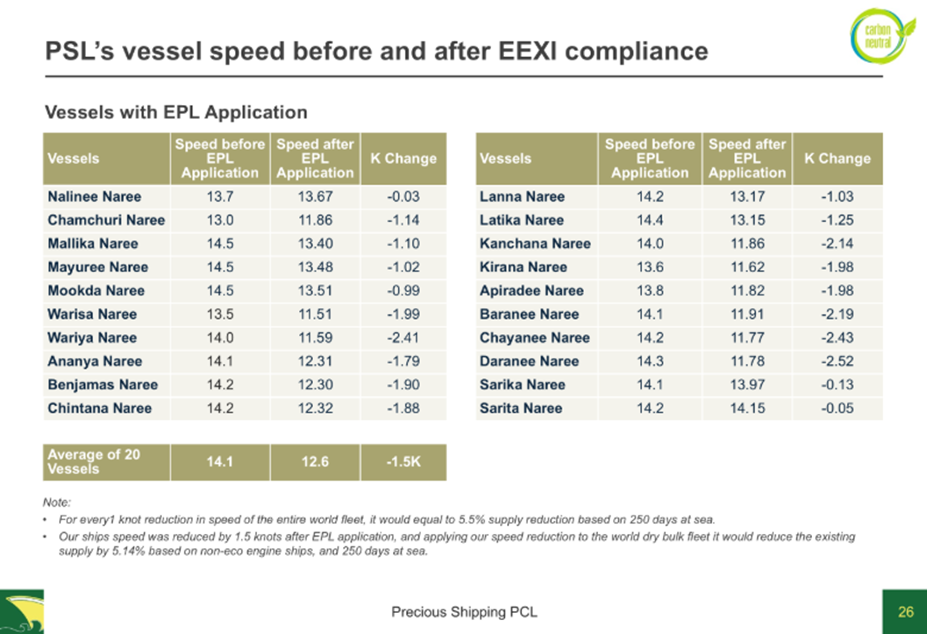
From the above slide you can see that despite the PSL fleet averaging less than the world average age, they have suffered a 1.5K speed reduction via Engine Power Limits (EPL) being placed on our ships.
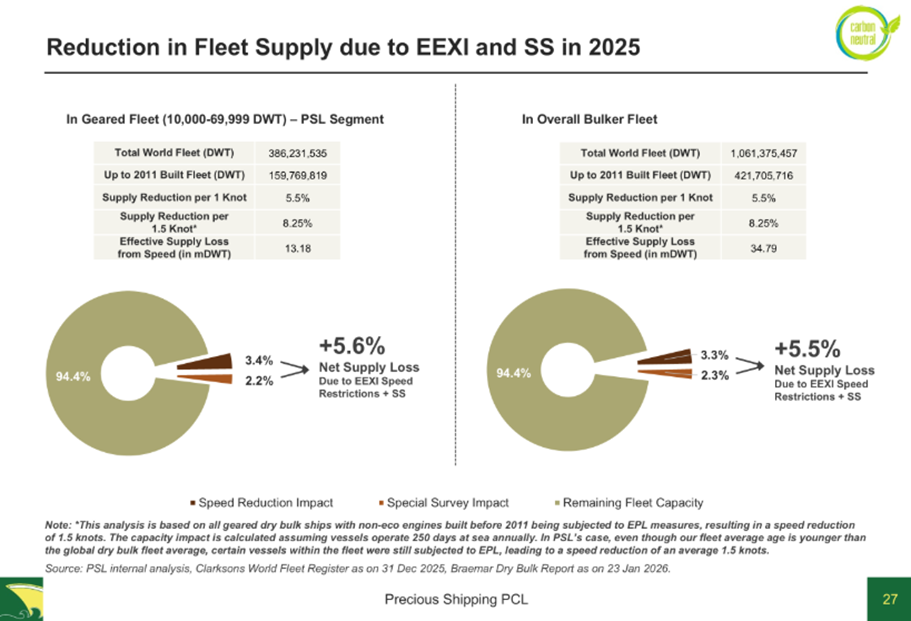
The analysis in the above slide is based on all geared dry bulk ships with non-eco engines built prior or during 2011 being subjected to EPL measures, resulting in a speed reduction of 1.5 knots. The capacity impact is calculated assuming vessels operate 250 days at sea annually.
Special Surveys (SS) are quietly tightening the geared bulk fleet supply:
Vessels aged 5, 10, 15, 20, 25, 30-years undergo mandatory SS causing temporary vessel unavailability. SS periods: 15–40 days depending on vessels age. This does not consider any ballast time or waiting time to enter the drydock. Handysizes recorded the highest average daily number of 64 vessels undergoing SS. Average daily number of Supras/Ultras in SS averaged 84 vessels. The supply of geared bulkers is projected to decline by 2.2% in 2025 and 2026 due to SS. In 2024, geared bulkers experienced a 1.7% loss in supply due to SS. The supply impact is measured from the end of a vessel’s previous laden voyage to its departure after completing SS.
Year of the Fire Horse:
The upcoming Chinese New Year is named the Year of the Horse, specifically the Fire Horse, beginning on 17 February 2026, and lasting until 5 February 2027. The Fire Horse is one of the more dynamic and intense zodiacs in the lunar calendar. Economic Outlook: In 2026, China's GDP growth is expected to stabilize at around 4.5-5%, supported by technology and sustainability sectors, which will make up a significant part of economic growth. The government's "dual circulation" strategy, focusing on domestic consumption balanced with exports, alongside advancements in semiconductor and AI technology, will drive this growth. Major Chinese innovation hubs like the Greater Bay Area will also play a key role in economic expansion. The global demand recovery, especially in EVs, renewables, and electronics, will benefit China, supported by its large trade surplus and Belt and Road investments. Predictions on Wars and Major Events: No direct predictions of wars or major geopolitical conflicts tied specifically to the Chinese New Year, or the Fire Horse are typically made through traditional zodiac lore. However, the Year of the Horse is often associated with energy, movement, and sometimes unpredictability, which can metaphorically relate to dynamic changes or unrest. Contemporary analysis mainly focuses on economic and technological development and geopolitical strategies like self-reliance in critical tech sectors rather than direct war predictions. Cultural and Global Impact: The Lunar New Year will continue to be celebrated worldwide with vibrant festivities, symbolizing family reunion and renewal. Events in 2026 will likely emphasize futuristic themes such as drone and robot shows, aligning with the focus on technology and innovation. This cultural vibrancy often coincides with broader global economic and social trends reflecting China's growing influence. In summary, the Year of the Fire Horse 2026 portends a year of vigorous economic growth centered on technology and sustainability in China, with continued global influence through trade and innovation. While the zodiac's symbolism implies dynamism, modern forecasts emphasize economic stability and innovation rather than conflict predictions. The celebrations and cultural events will reflect high energy and futuristic themes.
PSL’s Fleet Renewal:
We commenced PSLs fleet renewal by selling four of our older and non-eco ships in 2024. We continued that trend and sold another four older and non-eco ships in 2025 (two delivered in 2025 and two delivered in January 2026). We took delivery of five secondhand, younger, larger (almost 40K DWT each) and eco engine ships in 2024. We have purchased 4 Ultramax new build ships from our favored yard, Taizhou Sanfu in China (for delivery between 2026 and January 2027.) These ships will help further reduce our carbon footprint. We have also taken delivery of three modern (less than 5-year-old) Ultramax ships during 2025 (one standard size built in China, and two larger 66K DWT Ultras built in Japan). We have also purchased two new resale 66K DWT Ultras built at Yamic Shipyard in China that were delivered on 15 and 19 of January 2026. What does all this achieve for us, you might well ask. It reduces our average age of ships, it increases the DWT of our handy sized fleet, it reduces our carbon footprint via the removal of the non-eco ships being replaced by the five eco, and larger handy size ships in 2024, the 4 brand new Ultras, that we have purchased (for delivery in 2026-Jan 2027), the three very modern Ultras (two of 66K DWT and one standard size) delivered during 2025, and the two larger 66K DWT Ultra resales delivered on 15 and 19 of January 2026. The smaller, geared ships, that travel to ports that are well off the beaten track, will be the last segment of shipping to decarbonize and shift over to ‘green’ fueled ships of the future. The reason is that the ports that these ships visit are so well off the beaten path that getting green fuels of the future at such ports may be well-nigh impossible. Secondly, the cost of fitting in the new-fangled engines, tanks for the future fuels, pipelines that can remain corrosion proof and withstand the rigors of the future fuels, would increase the capital expenditure by around 30% more than a fossil fuel burning new building ship. With clients who do not want to sign long enough time charter contracts, nor pay any premium over the existing long-term time charter rates of fossil fuel burning ships, adds another economic disincentive for our sector to go green right now. The practical move is to buy less than 10-year-old eco engine ships from the secondhand market, as we have done, to order a few newbuildings, like we have done with the Ultras at Sanfu and the two larger 66K resale Ultras from Yamic, and by selling the older non-eco ships in our fleet into the secondhand market, again as we have done, and continue to do. That way, we will always be in compliance of our regulatory required decarbonization by running our existing and freshly purchased secondhand/newly built ships; wait till the fuels of the future have been crystalized; wait for the regulatory environment to be established for such ‘green’ ships; crew training has been designed to allow for safe management of these future fueled ships; shipyards have got their act together and are able to produce such ships at a price that makes economic sense for the buyers; that is when we will change over our fossil fuel burning ships into ships burning zero carbon fuels of the future. Now that the IMO has postponed, by one year, their decision making on global decarbonization and carbon tax on the final day of their MEPC meeting on 17 October 2025, our implemented strategy, with our hind-sight glasses on, appears very satisfying! Please see the section under ‘IMO and Regulations’ which explains it via news quotes.
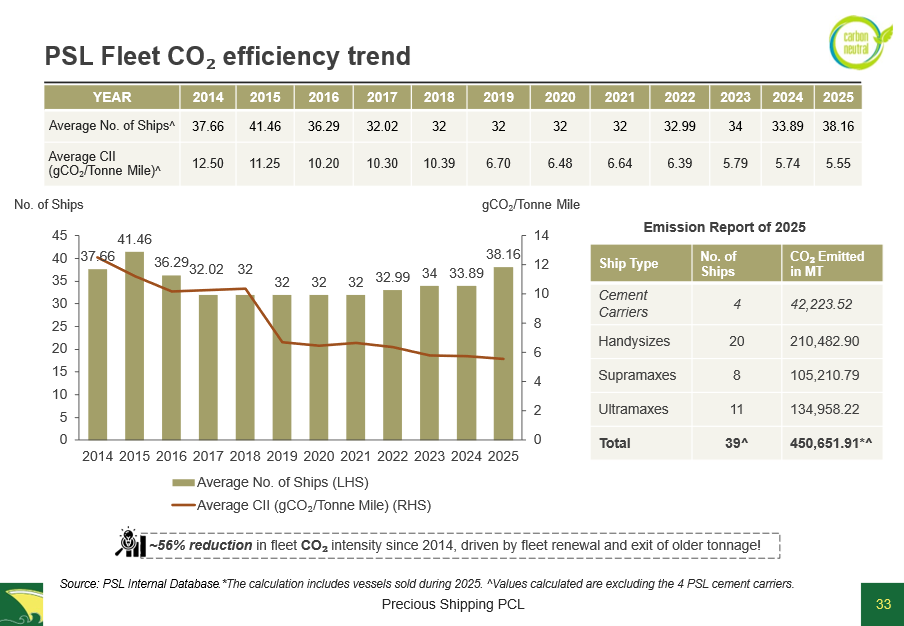
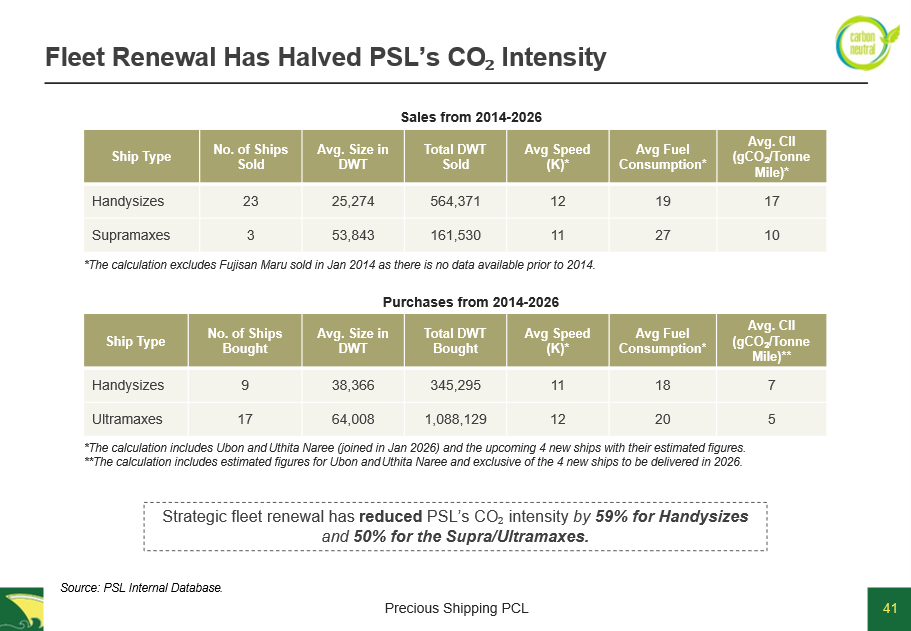
These actions are already delivering measurable results. As shown in the charts above, PSL’s fleet CO2 intensity has steadily declined over the past decade, with average CII improving by around 56% since 2014 (excluding the cement carriers), despite a broadly stable fleet size. This reflects the impact of selling older, less efficient vessels and replacing them with younger, larger, eco-engine ships. The renewal strategy has significantly lowered fuel consumption and CII compared to the vessels sold, resulting in a reduction in CO2 intensity of roughly 59% for Handysizes and 50% for Ultramaxes. Together, these trends demonstrate that PSL’s disciplined fleet renewal is structurally lowering emissions while maintaining operational scale.
Markets in 2003-09, 2010-20, 2021-22, 2023-24 and beyond’
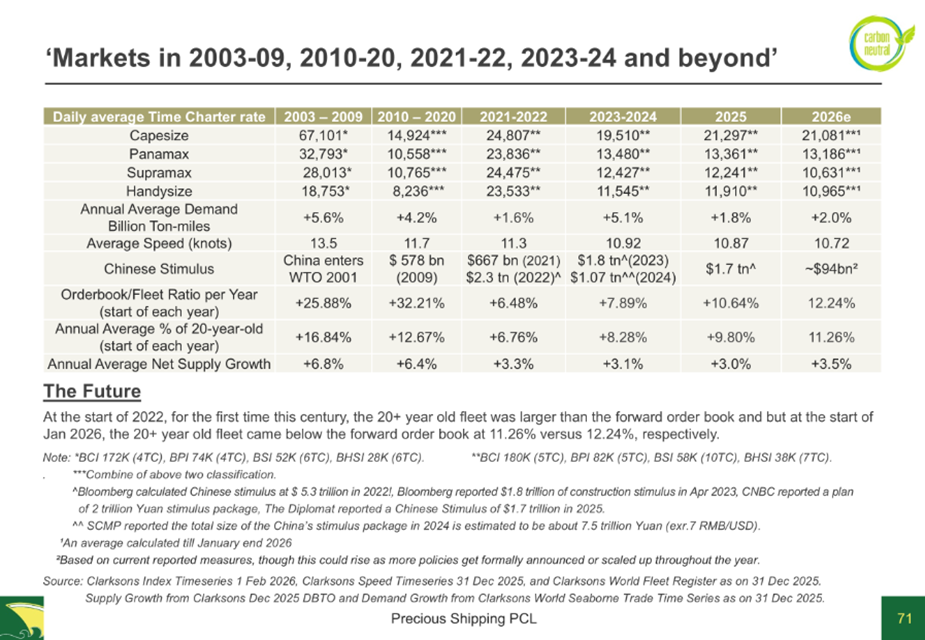
If you look at the time charter rates for the period 2003–2009, they were the highest for Capesize compared to other periods. For Panamax and Supramax, rates in 2003–2009 were nearly 3X higher than in 2010–2020 and considerably higher than in 2021–2022. Handysize rates in 2021–2022 were nearly 3X higher than in 2010–2020 and about 1.25X higher than in 2003–2009. However, demand growth in ton-miles steadily declined across these periods from 5.6% in 2003–2009 to 4.2% in 2010–2020, then dropping sharply to 1.6% in 2021–2022. Yet PSL produced very good results in both 2021 and 2022. An interesting shift occurred in 2023–2024, where demand growth in ton-miles rebounded to 5.1%, approaching levels last seen in 2003–2009. This increase was likely due to wars and trade route disruptions. Ongoing conflicts, such as the Russia-Ukraine war and Red Sea tensions, have led to longer voyage distances, as ships avoided the Suez Canal and took longer routes around the Cape of Good Hope (COGH). Moreover, shifts in energy trade patterns where the EU turned to long-haul oil and gas suppliers from the Middle East, US, and Asia further increased ton-mile demand. However, tonne-mile demand is projected to have increased by 1.8% in 2025, despite early-year disruption to iron ore trade and softer coal imports in Asia. Average haul lengths were supported by firm growth in long-haul Atlantic exports. Demand conditions improved through 2H 2025, with overall dry bulk trade strengthening, underpinned by robust iron ore, grain and minor bulk volumes. While near-term demand remains broadly supported, risks persist around underlying Chinese demand given ongoing pressures in the steel and property sectors, elevated domestic stockpiles, and continued scrutiny over the pace of Chinese US grain purchases.
Red Sea rerouting has continued to provide some support to dry bulk vessel demand, although recent developments point to scope for gradual and conditional easing. While security conditions in the region have shown tentative signs of stabilization, dry bulk transits through the Red Sea and Gulf of Aden remain suppressed and owner behavior continues to reflect elevated risk aversion. As such, a rapid normalization of routing patterns appears unlikely, with current assumptions still centered on a gradual adjustment extending into 2026. Looking ahead, the broader dry bulk outlook suggests scope for another year of relatively moderate earnings, broadly in line with 2024-2025 levels. Bulkcarrier demand growth is currently projected at around 2.0% in 2026, remaining below fleet growth of approximately 3.5%, although market balance may continue to be supported by off-hire time linked to special surveys and slower operating speeds due to CII/EEXI. The Capesize segment is expected to continue to outperform smaller sizes, supported by the gradual ramp-up in Guinean iron ore exports, which should underpin long-haul Capesize volumes, while fleet growth remains more concentrated in the sub-Cape segments. Nevertheless, there remains a wide range of potential market outcomes in 2026, as Chinese import demand can shift quickly amid elevated stockpiles across several commodities, and as further normalization of Red Sea routing would pose a potential, albeit limited, drag on dry bulk vessel demand.
Geopolitical developments and the energy transition remain key areas of focus heading into 2026. While the direct impact of trade policy measures on dry bulk flows has remained relatively limited, broader geopolitical uncertainty continues to pose indirect risks through its influence on global growth sentiment and trade patterns. At the same time, energy transition pressures are expected to persist, particularly weighing on global coal demand, although near-term dry bulk demand dynamics remain more heavily driven by trends within China’s large domestic market. In parallel, Chinese purchases of US soybeans have returned to focus following the trade truce reached in late October. While reported sales have increased, export volumes have so far remained modest, with shipments expected to spill over from 2025 into the seasonally softer first quarter of 2026. This could provide some support to mid-size bulker demand in early 2026. Nevertheless, aggregate Chinese demand trends are expected to remain the dominant driver of overall dry bulk market performance.
At the start of 2025, the orderbook stood at 10.64% of the fleet, broadly in line with the share of vessels aged over 20 years (9.80%), indicating that fleet renewal at that point was largely replacement driven. By the start of 2026, the orderbook had risen to 12.24% of the fleet, marginally exceeding the proportion of vessels aged over 20 years (11.26%), suggesting that a significant portion of scheduled deliveries could still be absorbed through replacement of ageing tonnage. Average vessel speed has also steadily declined, from 13.5 knots in 2003-2009 to 11.7 knots in 2010–2020, and further down to 10.87 knots in 2025 and to 10.72 knots, so far in 2026, reducing effective fleet capacity. With annual net supply growth projected at 3.0% in 2025, these indicators continue to point toward a more constrained supply environment, supporting the potential for stronger market conditions ahead. Additionally, EEXI-induced speed reductions and special survey regulations are estimated to remove 13.18 MDWT from effective supply, equivalent to a 5.6% net reduction in the geared segment in 2025 alone.
BDI started out in 2025 at 1,029 on 2 January, troughed at 715 on 30 January, and peaked at 2,845 on 3 December. The bulkcarrier market was relatively moderate over the course of 2025, though conditions strengthened materially toward year-end. Average bulker earnings for the year stood at around $14,000/day, slightly above the 10-year average, despite a seasonally softer first half. Market sentiment improved from mid-year, with rates firming into the second half and gaining further momentum in Q4 amid notably stronger dry bulk demand trends. The dry bulk trade indicator rose 5% y-o-y in Q4, supported by robust iron ore, bauxite and grain volumes. Capesize vessels continued to outperform, underpinned by firm growth in long-haul iron ore and bauxite exports, while performance in the smaller segments was more mixed, reflecting softer coal trade trends and uneven grain flows at times.
The Industry Outlook:
A truncated supply of new ships is expected for the next few years. The fleet stood at 1,029.09 MDWT at the start of 2025 and by the end of the year had grown to 1,061.38 MDWT. During the year, 5.62 MDWT was recycled, and 37.90 MDWT was delivered, thus making net fleet growth of 3.14%. The existing orderbook stood at 129.89 MDWT (deliveries up to end of 2029), or 12.24% of the world fleet at the start of 2026. Specifically, in the geared segment, net fleet growth was 4.58% in 2025 in the Handy/Supra/Ultra segment and the existing orderbook for the geared fleet stood at 42.25 MDWT (deliveries up to end of 2029), or 10.94% of the geared world fleet at the start of 2026. The order book is expected to reduce pressure from the supply side of the equation.
While the supply side looks appealing on the surface, it does not factor in regulatory impacts or the current age profile of the fleet. At the start of 2026, 11.26% (119.53 MDWT) of the world dry bulk fleet (13.81% or 53.33 MDWT of the geared dry bulk fleet) was over the age of 20, and 20.70% (246.59 MDWT) of the world dry bulk fleet will be over 20 (23.40% or 100.25 MDWT of the geared dry bulk fleet) by the end of 2029 if none of these ships have been recycled by then. The first conclusion to draw from this is that the current orderbook is, at best, replacement capacity and will not increase supply. Secondly, vessels over the age of 20 were designed, built, and delivered at a time when the average price of oil was $19.7/barrel with a low of $10/barrel during the peak of the Asian Crisis during 1998/2000, hence were designed for power and not for fuel economy. Ships that are 20+ years will find it difficult to compete against younger more fuel-efficient vessels. It is our opinion that going into 2026, recycling should pick up, and new orders could slow with regulations like EEXI, CII, FuelEU, EU-ETS, etcetera in place. Ships 20 years or older, comprising 119.53 MDWT or 11.26% of the existing fleet (53.33 MDWT of geared ships or 13.81% and 66.20 MDWT of the gearless fleet or 9.81%) at the start of 2026 would be ideal candidates for recycling as they would have to invest in expensive special surveys, and face regulatory-led recycling in 2026 due to EEXI, and CII.
The Cape sector (90,000+ DWT: 2,391 ships of 438.06 MDWT at the start of 2026): 243 ships of 49.80 MDWT or 11.37% of the existing DWT are scheduled for delivery up to end of 2029. In this sector, 480 ships of 83.18 MDWT or 18.99% will be over 20 years of age by end of 2029 and some or all of them are likely to be recycled during 2026 to 2029.
The Panamax sector (70,000 – 89,999 DWT: 2,962 ships of 237.09 MDWT at the start of 2026): 457 ships of 37.84 MDWT or 15.96% of the existing DWT are scheduled for delivery up to end of 2029. In this sector, 820 ships of 63.17 MDWT or 26.64% will be over 20 years of age by end of 2029 and some or all of them are likely to be recycled during 2026 to 2029.
The Supra/Ultramax sector (45,000 – 69,999 DWT: 4,230 ships of 244.36 MDWT at the start of 2026): 477 ships of 30.04 MDWT or 12.29% of the existing DWT are scheduled for delivery up to end of 2029. In this sector, 1,073 ships of 56.98 MDWT or 23.32% will be over 20 years of age by end of 2029 and some or all of them are likely to be recycled during 2026 to 2029.
The Handysize sector (10,000 – 44,999 DWT: 5,195 ships of 141.87 MDWT at the start of 2026: 357 ships of 12.21 MDWT or 8.61% of the existing DWT are scheduled for delivery up to end of 2029. In this sector, 1,855 ships of 43.27 MDWT or 30.50% will be over 20 years of age by end of 2029 and some or all of them are likely to be recycled during 2026 to 2029.
When reading the above numbers please keep in mind that Slippage was 0.04% and recycling accounted for 5.62 MDWT in 2025. Slippage has averaged –0.97% over the last 5 years (2021 to 2025) and recycling accounted for 5.0 MDWT annually over the last 5 years (2021 to 2025). Both slippage and recycling fluctuate inversely with the BDI and availability of finance.
On a net basis, the global fleet increased by 3.14% in 2025 (according to Clarksons World Fleet Register as of 31 December 2025). According to Clarksons, the fleet is forecast to grow at 3.5% while ton-mile demand (for dry bulk seaborne trade) will grow at 2.0% in 2026. With supply growing faster than demand in 2025 (+3.5% vs.+2.0%), the market may face downward pressure on rates. However, external disruptions could still drive volatility in the BDI.
Recycling of ships: The freight market is the prime mover that drives ships to the recycling yards. The lower the freight market, the greater the number of ships at the recycling yards. Regulations impacting supply like EEXI, and CII will also influence DWT of ships sent for recycling. Deliveries in 2025 at 37.90 MDWT were lower when compared to average annual deliveries for the decade of 38.33 MDWT per year (2016 to 2025) of new capacity delivered.
Regulatory impacts should see many more ships heading for the recycling yard in 2023 and beyond. IMO 2020 has resulted in more expensive but ‘cleaner’ LSFO being burnt by ships from 1st January 2020. EEXI and CII will result in lower emissions from shipping globally. As a result, the level of pollutants reaching the air that we breathe, as well as the ‘acid’ rain that result from such emissions, will continue to reduce annually.
The IMO and Regulations:
The classic, ‘too little, too late’, could be the most charitable way to describe the efforts of the IMO to get global shipping across the zero GHG emissions line by 2050. As we have been reiterating in our various newsletters over the last few years, bold action that was needed has not only been avoided but the delays at the IMO amid consensus building have now run into the roadblock of the Trump administration.Trump has, subsequently, thrown down the gauntlet that his administration will not support the IMO’s efforts to get shipping across the zero GHG emission line by 2050.The dream of shipping, of becoming the first global industry to have a policy for reaching zero GHG emissions by 2050, was shattered by Trump forcing the October meeting to delay a vote by one year on the pre-agreed GHG emission reduction mechanism, the Net-Zero Framework (NZF), agreed at the MEPC April meeting.
There are two things that the IMO can still do to get shipping much closer to the Net-Zero but via a different route dictated by the market. Just as all single hull tankers had to be phased out by 2015 via the Oil Pollution Act of 1990, promulgated by the IMO as a reaction to the Exxon Valdez oil spill, the IMO could pass legislation to have all ships 20 years or older be sent to the recycling yards by a date a couple of years in the future. This would reduce GHG emissions by recycling the biggest gas guzzlers, the older ships that were designed and built in an era where power was far more important than economic consumption of fossil-based fuel oil. At the same time, the IMO should also pass another legislation, with a deadline at least two years later than the deadline to scrap 20 years or older ships, not allowing any newly built ship to be delivered after the second deadline that had fossil-based fuel oil as the source of power. Any such new ship, delivered after the second deadline, would be sent to the recycling yards straight from the delivery shipyard. Between these two legislations becoming effective, there would be a gap of about 5 years, during which time the shipyards, the engine makers, the fuel of the future producers/suppliers, all would know definitively the number of ‘replacement’ Net-Zero ships that would need to be built, and the quantum of ‘green’ fuels that they would consume, to replace all the older than 20 years old ships that would be recycled. The shipyards would be forced to look at only producing ‘green’ ships, post the deadline on ‘newly’ built ships with fossil-based fuel oil engines. In fact, the entire shipbuilding eco system would be geared towards making Net-Zero ships not just possible, but probable, with a good chance of full success before the 2050 deadline. These two deadlines would tighten the supply of ships around the world and require everyone to pay for the transition from fossil-based fuel oils to the net-zero fuels of the future, with no need for any carbon tax to be implemented at all.
A Mediterranean splinter cell within the EU further complicates the calculations on what happens next in terms of carbon regulation, but it also points to an increasingly fragmented debate within the IMO. Realistically what happens between here and the opening of the NZF box [in October 2026] is going to further divide political groupings within the IMO down geopolitical lines. Whether the NZF emerges dead or alive is almost irrelevant at this stage because the political divisions are looking sufficiently entrenched to ensure that progress is going to stall, regardless. (Lloyd’s List, op-ed, 1 Dec 25)
The IMO will resume fractious negotiations on emissions pricing. But few expect a breakthrough in October, given the US’ ruthlessness against UN climate efforts. (Lloyd’s List, op-ed, 11 Jan 26)
The deal between Greece and Saudi Arabia to join forces on the IMO’s Net-Zero Framework is another sign that the carbon price is dead in the water, at least for now. But it is not a decisive blow against the green shipping movement, so much as recognition that such a blow has already been struck, at the IMO last year. Few insiders think the NZF, the world’s first global carbon tax, will be adopted while Trump is in office. (Lloyd’s List, op-ed, 18 Jan 26)
Small Modular Reactors (SMRs), Molten Salt Reactors (MSRs), & Maritime Applications:
Nuclear power has become the ‘new talking’ point with Mikal Boe leading the charge with his MSR as reported in a recent Lloyd’s List op-ed dated 5 December. Of course, Mikal Boe has been pushing nuclear technology to power ships for over 12 years starting in 2013, and finally going public in a big way in 2018 after Core Power was formed and funded. However, there is no ‘proof of concept’ yet, though it was promised as early as 2025-2026, with the latest date being moved further away to 2033. Assuming that the ‘proof of concept’ is finally produced, and works, the cost of a nuclear reactor will be multiple times the value of the ship it is to be installed in, with the life of the nuclear reactor being 3 or more times the life of conventional ships. Though the IMO is ready to look at the regulations to see how they could be amended to incorporate nuclear powered ship engines, it will take far longer to be able to convince ‘nuclear scientists’ to sail on ships to look after a nuclear reactor which no one else onboard the ship would be capable of handling. And what if the nuclear scientist became incapacitated whilst at sea, who then would handle such a complex nuclear reactor? This of course does not even consider how shipowners would be able to make nuclear powered ships commercially viable, get ports to accept them, get ‘normal’ seafarers to sail on such ships, get cargo owners to entrust their assets onboard such ships, etcetera. And what happens when a nuclear-powered ship sinks, as one or more will inevitably do, what then? (Please see the very next article of a ship sinking along with possible nuclear fuel onboard.) And imagine the consequences of the contamination of the marine food chain with nuclear reactors polluting an essential source of food for the 8+ billion humans in existence? I do not want to come across as cynical, but I think there are a lot more unanswered questions, with no ‘proof of concept’ of such a nuclear reactor, that would be safe and idiot-proof enough, to be installed as a source of power on ships.
Spanish investigators believe a Russian cargo shipthat sank off Spain on Christmas Eve 2024 was carrying nuclear submarine reactor components. Investigators believe the objects on deck were outer casings for VM-4SG nuclear submarine reactors, a Soviet-era design still used by Russia. The reactor lids are made of thick steel to shield crews from radiation, accounting for their exceptional weight, maritime specialists said. It remains uncertain whether both reactors contained nuclear fuel. The hull damage was consistent with a super-cavitating torpedo strike, fueling speculation of deliberate interdiction by Ukraine.
A Silicon Valley startup called Oklo is leading the charge to make nuclear a reality again in the US. It plans to switch on at least one of its three reactors in an Energy Department program by mid-2026. Its CEO Jacob DeWitte was in the White House in May when Trump signed four executive orders designed to herald a nuclear renaissance, which envisions the construction of nuclear power plants and the promise of rapid deployment. Interest in traditional nuclear power has only recently been revived amid pressure to hit climate goals and meet surging electricity demand, particularly tied up to the recent AI boom.
The US economy is becoming a Jenga tower, one economist told Bloomberg, increasingly fueled by the profligate spending of the rich while a growing number of people must choose between car payments and dinner. This dichotomy isn’t new, but recent months are witnessing an even starker divide, one that some experts say makes the economy more susceptible to recession.
Venture interest in fusion has risen sharply as the artificial intelligence and cloud computing boom strains global powersystems. In the US, data centers are expected to make up roughly 9% of the country’s total electricity usage by 2035, more than double 2024 levels, according to an April report.
For Container vessel operators, nuclear-powered vessels eliminate their largest operating costs, up to $50 million annually in bunker fuel and an estimated $18 million in carbon penalties.
TerraPower is planning to begin construction n a next-generation nuclear reactor in Wyoming by Q2after completing key regulatory steps six months ahead of schedule. The company, founded by Bill Gates, expects the Nuclear Regulatory Commission to issue a construction permit by February 2026 for its 345-megawatt reactor, CEO Chris Levesque said in an interview.
A need to reduce dependence on fossil fuels and build energy security is pushing Japan towards nuclear energy. Now the country is reckoning with its complex, painful relationship with nuclear power, a decade after Fukushima.
Investors are still betting on fusion. It’s expensive to develop, no company has a commercial reactor online and technical hurdles remain. But everyone from venture capitalists to President Trump’s social media companycontinues to be bullish on fusion power.
Nuclear power onboard is still a dream, and not a comforting dream for those looking into the detail. But you’ll hear more about the latter as the MAGA-backed hype around SMRs builds. (Lloyd’s List, op-ed, 11 Jan 26)
More than 700 marine nuclear reactors are in operation in naval fleets worldwide. The challenge is to adapt that technology for commercial use. The next generation of advanced modular reactors brings tougher safeguards and the chance to bring nuclear power into everyday commercial shipping. (Splash, 20 Jan 26)
Population Growth:
Population growth, combined with increased urbanization, and an increasing middle-class population, is the single most important factor that drives secular demand for minor dry bulk cargo growth. As the geared dry bulk fleet carries the largest portion of minor bulk, it is most impacted by the increasing growth in the middle class, urbanized population, characterized by single person homes. The world population is projected to continue growing for the next several decades, peaking at around 10.3 billion people by the mid-2080s, approximately 2084-2086. After reaching this peak, the global population is expected to gradually decline toward the end of the 21st century, with estimates of about 10.2 billion by 2100. This population growth slowdown and eventual decline are largely driven by falling fertility rates, especially in major countries like China and India, along with demographic aging and lower birth rates in many regions. Key points on world population trends:
The global population in 2023 was roughly 8 billion.
By 2061, the population may reach around 10 billion.
India is expected to peak earlier (around 1.7 billion by 2061), then decline.
China's population is already shrinking and projected to fall sharply by 2100.
Africa, particularly sub-Saharan countries like Nigeria and Ethiopia, will contribute most of the growth in coming decades due to higher fertility.
Population momentum, the effect of many people in reproductive age despite lower fertility rates, will sustain growth for some time.
Some scenarios suggest population growth could peak sooner, but the consensus expects a peak around the 2080s.
World population growth will slow and peak by the mid- to late-2080s, after which it will gradually decline due to demographic shifts and lower fertility worldwide.
Demographics may not be destiny, but for students of geopolitics, they come close. Although conventional measures of economic and military power often receive more attention, few factors influence the long-term competition between great powers as much as changes in the size, capabilities, and characteristics of national populations.
Urbanization:
Urbanization is a rising global trend according to the UN report on World Urbanization Prospects with the percentage of urban population rising from 55% in 2018 to 68% by 2050. North America had an urban population of 82% in 2018 while the EU had 74%. India is expected to have less than 50% of urban population by 2050. Just three countries, India, China, and Nigeria, are expected to account for 35% of the projected urban population growth between 2018-2050. The percentage of single person houses in Stockholm has grown to over 50% as of 2017. And what happens in Scandinavia happens in the rest of the world, just a couple of decades later. So, urban dwellers will increasingly become single-person homes in the future, and all such homes would require their own white goods (fridges, washing machines, clothes dryers, microwave ovens, etcetera), their own modes of transport, be it cycles, mopeds, motorbikes, or cars. All urban living, and its associated goods, would need steel, cement, wood to build, furnish with beds, cupboards, white goods, soft furnishings like curtains, bed sheets, bed covers, mattresses, pillows, pillowcases, etcetera. Every single item mentioned, or their starting raw materials and/or semi-finished intermediaries, have all been transported by sea multiple times and have added to ton-mile demand for dry bulk shipping. In conclusion, as urbanization increases and most urban people tend to live in single-person homes, so does the demand increase for minor dry bulk goods transportation by sea.
The number of cities with more than 1 million people will jump from 275 [in 1980] to nearly 1,600 in 2080, when world population is expected to peak.
Inequality:
On the 5th of November, Zohran Mamdani was elected Mayor of New York City. At 34 years of age, he would be the youngest Mayor since 1892, the first born in East Africa of South Asian descent, and the first Muslim to lead NYC. He is therefore the archetypical New Yorker. We can hope this change results in greater equality in the most unequal city in the world, especially as his entire campaign was focused on how to bring affordability back to New York City. That would be great news for dry bulk shipping.
Zohran Mamdani rang in the year by pledging at his inauguration ceremonyto lead New York City as a democratic socialist, a warning to those who believed the new mayor might moderate his views. Flanked by Bernie Sanders and Alexandria Ocasio-Cortez, Mamdani promised an agenda of “safety, affordability and abundance,” and announced three executive orders aimed at housing affordability.
Inequality is a social construct marred by stark disparities in wealth, income, education, and opportunities in society. It is caused by issues like unequal access to quality education, healthcare, and employment; concentration of power in mega corporates; and the wealthy elite not caring for the have-nots. Discriminatory practices and taxation systems are loaded in favor of the ‘haves.’ And it matters very little if you live in the richest country like the US, the homeless capital of the world, or in the poorest countries from the Global South, it is the poorer sections of humanity, mainly people of color, that gets hurt the most by geopolitics and the excesses of neoliberal capitalism. One of the SDGs of the UN is to lift people out of poverty. That has happened in China to a very large extent and the consumption of meat there has skyrocketed. Dry bulk ships carry the animal feed ingredients where volumes have shot up to cater to this meat-eating orientation achieved in China. As the common man in any country starts to migrate from being dirt poor to lower middle class, and then to upper middle class, they start to change their eating habits going from a largely vegetarian diet to a diet rich in white and red meat, with food wastage in the present becoming the norm rather than the exception it was in their past, in the new found economic freedom that has been attained. The conversion factor is 2.5 kilos of grain to one kilo of live weight in white meat and up to 6 kilos of grain for one kilo of live red meat. Hence, as the burgeoning middle class settle into a carnivorous and wasteful lifestyle, the amount of grain needed to satisfy their food cravings, and wastage spikes upwards and demand for dry bulk ships to transport such grains increases dramatically. That is why equality of wealth, ergo a larger, and ever larger, urbanized middle class, single person home, is so important to our business.
In his first interviewsince becoming the leader of the Catholic Church, Pope Leo XIV fielded a question about the polarization that is tearing societies apart around the world. A significant factor, he said, is the “continuously wider gap between the income levels of the working class and the money that the wealthiest receive.” Pope Leo appears to be particularly baffled by the Tesla pay packagethat could turn Elon Musk into the world’s first trillionaire.
Tesla dangled a new pay deal for Elon Musk that could potentially be valued at a staggering $1 trillion. The 10-year package sets a series of ambitious benchmarks that Musk must meet to earn the full payout, including expanding Tesla’s robotaxi businessand growing the company’s market value to at least $8.5 trillion from around $1 trillion today.
Tesla CEO Elon Musk won shareholder approvalfor the largest corporate pay package in history as investors endorsed his vision of morphing the EV maker into an AI and robotics juggernaut. Elon Musk bounded to the stagef the company's AGM accompanied by dancing robots after shareholders approved his pay package.
Meta projected 10% of its 2024 revenue would come from ads for scams and banned goods. On average, the company shows its users an estimated 15 billion “higher risk” scam advertisements, those that show clear signs of being fraudulent, every day.
Fast forward a year, and unemployment is rising, wages are stagnating and inflation has hit 3%. At the same time, the Wall Street obsession with a handful of technology stocks has catapulted markets to new heights, making the disconnect with the rest of the country more pronounced. In 2025, it’s not just low-income America that’s in trouble: now it’s the middle class, too. The richest 10% of households are fueling almost halff total US spending thanks in partto the stock market frenzy. Meanwhile, lower-income and middle-class families are pulling back in the face of tight budgets, higher costs of living and a grim, rising tide of mass firings.
The unfathomable wealth of successful entrepreneurs doesn’t bother people; the issue is that too many ordinary Americans struggle to get by. The focus should be on lifting the standard of living for everyday Americansrather than beating down billionaires and soon-to-be trillionaires.
New York Governor Kathy Hochul declared a state of emergencyto issue $65 million for assistance to food banks as federal funding for the national food stamp program is set to lapse tomorrow. Millions of Americans are wonderinghow they will feed their families.
The US consumer's durability as a prop for the economy may be testedin coming weeks as family budgets, particularly among the less affluent, are stressed by rising healthcare costs, the potential loss of federal food benefits, and a wobbly job market outlookthat is already taking a toll on earnings.
Members of the New York real estate industry, concerned about Zohran Mamdani's rent-freeze impact on investments, are now seeking to engage with the New York City mayor-electas he attempts to reshape housing policies and spur development in the city.
Tesla's $1 trillion executive-compensation package for Elon Musk has obscured a more pressing concern: Musk's 2018 pay package, still tied up in court, could eat up years' worth of the electric vehicle maker's future profits.
Sitting in his lakeside villa in the Swiss city of Lucerne, Borger Borgenhaug misses his grandchildren and the smell of the Nordic Sea on a clear summer night. The carpenter turned real-estate tycoon says that is the price he pays to escape Norway's beefed-up wealth tax, an annual levy that has driven hundreds of millionaires abroad while underpinning one of the world's most equal societies.
The COP30 summit in Belem on Saturday went into extra-time. Intense negotiations yielded a closing compromisethat should boost financing for poor nations coping with global warming, but the deal omitted any mention of the fossil fuels driving the problem. Host Brazil had hoped to demonstrate global unityin the fight against climate change, particularly in the absence of the US, by building on the COP28 pledge to shift away from fossil fuels.
The Washington Post editorial board dedicated its Thanksgiving Sunday column to congratulating the people of Switzerland for voting against a proposed tax on inheritances and gifts in excess of 50 million Swiss francs, or about $62 million. Taxing giant inheritances and gifts, or otherwise taxing the ultra-rich for that matter, the Post writers contended, would wreak havoc on the Swiss economy by causing the rich to flee, and would be “complicated and inefficient.” The real point of the editorial, though, was its closing paragraph. There, the Post writers implied, rather blatantly, that US voters should reject any 2028 presidential candidate who would reduce the whopping exemption from federal estate and gift taxes ($30 million for a married couple) to “make a political point of taxing the rich” rather than “prioritizing healthy public finances.”
No, the rich aren’t leaving New York. As incoming mayor and self-described democratic socialist Zohran Mamdani prepares to take office, new data shows. Sales of luxury homes in Manhattan jumped in November, with buyers signing contracts on 176 in Manhattanpriced at $4 million or more, up 25% from the 141 deals inked the month prior.
Tesla's board of directors has earned more than $3 billion through stock awardsthat far exceeded the value of those given to peers at the biggest US technology firms. Is there a conflict of interest in these unusual awards?
What a year for the ultra-wealthy. The world’s 500 richest people added a record $2.2 trillionto their collective fortunes in 2025, as booming markets sent the value of their holdings soaring, according to the Bloomberg Billionaires Index. And about a quarter of this year’s gains went to just eight billionaires.
The minutes of the Fed Reserve’s MPC meeting held on 17 December show that the Fed stands ready to adjust policy as needed. If inflation rears its ugly heads, it could mean higher rates, but if unemployment continues at its present trajectory, then you could expect a couple of more 25 bps cuts in 2026.
Pope Leo urged Christians worldwide to help those in need and treat foreigners with kindness. Leo has made care for immigrants a central themef his early papacy.
80,000 pounds of food waste is generatedby US schools, hospitals, restaurants, grocery stores and other businesses annually.
A very short BUT interesting video on seafaring by the Global Maritime Forum. “Long hours, isolation, limited shore leave, and poor connectivity. These are just some of the challenges of working at sea. The nearly two million seafarers who keep international trade moving often face working conditions that would be deemed unacceptablein other industries. As a result, the sector faces serious challenges in attracting and retaining talent.”
Since being inaugurated one year ago, Trump has seen his net worth more than double, from $2.3 billion to $6.7 billion. Last year alone, our nation’s wealthiest billionaires got $698 billion richer, and they will continue to hoard more wealth, as the rest of the American people get poorer.Elon Musk’s net worth grew to $645 billion last year. And he’s not the only one benefiting. The top 10 tech founders and leaders in the US have all profited from the AI gold rush, reaching more than $2.5 trillionin combined wealth.
Billionaire wealth surged at three times its recent pace in 2025to reach its highest level on record, deepening economic and political divides that threaten democratic stability, anti-poverty group Oxfam said on Monday. In a report timed for the opening of the World Economic Forum in Davos, the charity said the fortunes of global billionaires jumped 16% in 2025 to $18.3 trillion, extending an 81% rise since 2020.
Poverty in Britain has deepened, according to a report by the Joseph Rowntree Foundation (JRF). The foundation, which conducts research aimed at solving poverty in Britain, said in the report that there were about 6.8 million people now living in "very deep poverty", the highest level in three decades.
AI, Data Centers, & EVs:
AI and EVs should be the type of technology that makes people’s lives better. Economists generally view innovation as the main long-term contributor to living standards, as new ideas make people more productive and richer, freeing up time to innovate anew. But there is a second strand of thinking, and it holds that political institutions matter most of all. This year, the pioneers of that school, Daron Acemoglu, Simon Johnson, and James Robinson, of MIT and the University of Chicago, won the Nobel prize in economics for their work. The trio contends that more inclusive, more democratic political institutions are the primary driver of economic growth, because they allow citizens to share in the fruits of their labor. Lately, Acemoglu and Johnson have warned that AI could centralize power and therefore lead not to prosperity but to tyranny. AI and EVs will keep global power demand at all-time highs, once again making the ‘rumors of the demise of King Coal’, paraphrasing the immortal words of Mark Twain, are ‘being greatly exaggerated.’ This will mean coal, the cheapest and most polluting power source, will remain in strong demand till alternate green, or less polluting fossil fuel power stations, can take up this power-hungry challenge posed by AI and EVs. While this is bad for the planet and will further boost climate change, it will be good for demand for dry bulk ships. A single query processed by AI models like ChatGPT can require up to 10 times more energy than a standard Google search, highlighting the intensive nature of AI computations. Thanks to AI, data centers are popping up across the US; The climate price is steep; The surge in power demand is unlike anything utilities have seen in decades, perhaps not since World War II; That is going to complicate the country’s already bumpy shift to clean energy as power demand is expected to climb almost 16% over the next five years; The AI boom and its need for juice is also a driving a surprise resurgence of gas-fired power; One area that may thrive is nuclear, which has seen a surge in interest from tech companies and climate advocates alike; Here is an explainer on how AI wants more data, more power and, really, just more of everything. A new paper, from teams at the Harvard T.H. Chan School of Public Health and UCLA Fielding School of Public Health, examined 2,132 data centers operating in the US (78% of all facilities in the country). These facilities, essentially buildings filled to the brim with rows of servers, are where AI models get trained, and they also get “pinged” every time we send a request through models like ChatGPT. They require huge amounts of energy both to power the servers and to keep them cool. Since 2018, carbon emissions from data centers in the US have tripled. For the 12 months ending Aug 2024, data centers were responsible for 105 MMT of CO2, accounting for 2.18% of national emissions (for comparison, domestic commercial airlines are responsible for about 131 MMT). About 4.59% of all the energy used in the US goes toward data centers, a figure that’s doubled since 2018; China realizes that AI and EVs are the future and are trying their utmost, despite all the hurdles and obstacles thrown their way by the West, to reach their objective to be number one in AI too, that will require even more power than they currently use and or produce. China has already dominated EVs, and their desire to dominate AI, will create extraordinary demand for power.
Google plans to build a large artificial intelligence data centren Australia's remote Indian Ocean outpost of Christmas Island after signing a cloud deal with the Department of Defence earlier this year, according to documents reviewed by Reuters and interviews with officials.
Tech giants in China, the world’s second largest economy, are rapidly rolling out new machine learning models at a fraction of the price of US rivals. This cheaper offering may give Beijing more soft power globally.
China's mammoth EV industry is not just impacting the country's auto sector, but also national fuel sales patterns. Rapidly expanding charging infrastructure has encouraged tens of millions of Chinese to hit the road for the Golden Week holidays in their EVs this year, which in turn has reversed the usual boom in gasoline sales at this time of year.
Just this October, Meta secured about $60 billion in capital to build data centers, part of its spending to get ahead in the artificial intelligence race. And half of that won’t show up on the social media giant’s balance sheet as debt. Yes, the notorious off-balance sheet strategy is back.
The AI revolution spurred the most US job cuts for October in more than two decades, outplacement firm Challenger, Gray & Christmas said. The last time companies made more layoffs during that month was in 2003, when the advent of cellphones was wielding similar disruption.
The power crunch echoes across the nation: Amazon has complained that a Berkshire Hathaway utility in Oregon can’t keep up with its own data center plans. AI’s energy thirst is also hitting the average consumer. Power near data hubs now costs up to 267% more than five years ago.The squeeze is creating some winners. Chinese energy stocks are surgingand analysts at Jefferies have declared this the “glory days’’ for green investors.And while foreign executives complain that tariffs and permitting issues hamper US growth, they stay confident that soaring demand will prop up wind and solar. And Silicon Valley is keen on reviving nuclear power in America.
Google said it plans to invest $40 billion in three new Texas data centers, ramping up its footprint in the state as competitors such as OpenAI and Anthropic map out their own multibillion-dollar bets in the red state. Just in the past two months, the company has announced a $15 billion planto build an AI infrastructure hub in southern India; pledged to invest $6.4 billionin computing resources and operations in Germany; and committed to spending more than $6.5 billionin the UK to help spur more AI development.
While the rest of us fret about the ethical quandaries of AI, other people are making money from it. Investors are pouring hundreds of millions of dollarsinto startups that make AI products for lawyers.
Peter Thiel’s hedge fund sold its stake in Nvidia during the third quarter, at a time of rising concerns about an AI investment bubble, which turned Nvidia into the world’s most valuable company. Hedge fund manager Michael Burry of The Big Short fame has emerged as perhaps the highest-profile critic, disclosing bearish wagers against both Nvidia and AI-powered software developer Palantir. A series of circular, multibillion-dollar deals between AI chipmakers, startups, data center operators, and others across the tech ecosystem have further stoked concerns the industry is propping itself up.
Titans such as Google, Meta, Oracle, and Amazon may spend $600 billion in 2026 on data centers. But juicy profits will not be enough to fund their rapid expansion.
Cooling problems at a key data center sparked a major outageat the Chicago Mercantile Exchange, playing havoc with futures and options trades and roiling global markets.
The data center that supports CME Group said it has bolstered its backup cooling capacityafter overheating on 28 November sparked a 10-hour outage that roiled markets.
ChatGPT is three but don't crack the bubbly just yet. Generative AI hasn’t yet altered the global orderbeyond showering capital on a few very large US companies.
Amazon’s cloud unit is releasing its latest AI chip, Trainium3, in a renewed attempt to sell hardware capable of rivaling products from Nvidia and Google.
racle, the once stodgy database giant that’s borrowed tens of billions of dollars and tethered its fortunes to the AI boom, has seen the cost of protecting its debt against defaultspike in recent months. Banks and other lenders involved in financing its construction loans are likely a key driver of the surge, according to a Morgan Stanley research report.
The Trump administration is moving to fast-track the construction of power-hungry data centers as a matter of national security. At the same time, it’s adding roadblocks for new solar and wind farms. But the two policies could be at odds: Hindering renewable energy projects risks slowing the AI boom, and could exacerbate rising electricity prices, a slew of data suggests. The dynamic creates a potential political challenge for Trump, whose goal of using the AI boom as an engine for the American economy risks blowback at the ballot boxif voters blame the data centers he's championed for higher power bills.
Major US tech companies bought 9.6 gigawatts of clean power in the FH of 2025. That's enough power for 7.2m homes.
As this week’s (27 Nov) Economist issue explains, while many in the West are fretting about China’s presence in solar power, EVs, and AI, they are missing its astonishing progress in two other frontier technologies: autonomous vehicles and new drugs. A robotaxi revolution is gathering pace, which could reshape transport, logistics and everyday urban life. And in medicine China has turned itself from a copycat maker of generics into the world’s second-largest developer of new drugs, including those tackling cancer. As these industries spread around the world, they will exemplify the power of Chinese innovation. The West should learn from China’s strengths. If it treats China’s success as just another example of unfairness, it will be left lagging behind.
The 19th century railway boom, and its larger than life tycoons with their larger than life egos, have more in common with the AI boom than you think.
The Trump administration’s AI and energy strategies really do appear to stand in opposition to each other. Renewables are fast and cheap to build, making them a good match for the rapid data center buildout. But the administration has thrown up roadblocks and rolled back tax credits for renewables. Or have they?
AI-related stocks have taken a bruising from a disappointing report from Oracle, reigniting concerns from some investors who feel AI-related shares are overvalued.
In its short-term energy outlook, the Energy Information Administrationsaid that US electricity consumption will hit record highs in 2025 and 2026. The demand increases come in part from data centers dedicated to AI and crypto currency, and as homes and businesses use more electricity and less fossil fuel for heat and transportation.
The chip equipment maker ASML Holding NV is so crucial that a swing in its fortunes can sway the Dutch economy and the global development of AI. Now one of the company’s biggest growth plans, building a new campus that will employ as many as 20,000 people in the country’s Eindhoven region, depends on whether or not it can get an electricity connection. Despite the high stakes, there is no guarantee ASML will get the electricity it needs. That is because the company is one among 12,000 businesses in the Netherlands waiting to secure a link to the electric grid. The rise of AI, rapid sales of EVs and broader electrification of most economic sectors is causing even rich countries to panic. An exclusive analysis from Bloomberg Economicsfinds that almost all Group of 20 countries are seeing a rise in grid stress over the last few years. Those stresses include supply not keeping up with demand, volatile price swings, damages from climate impacts and losses in transmission.
1.45 million new EVs registered in the EU in 2024, compared to 1.54 million in 2023. EV sales have slowed downas governments roll back incentives.
f all the eye-popping numbers that Oracle publishedlast week on the costs of its AI data center buildout, the report that appeared on 18 December detailed $248 billion of lease-payment commitments, “substantially all” related to data centers and cloud capacity arrangements!
The European Commission backed awayfrom what had been the world’s most aggressive timeline for phasing out internal-combustion engines, granting manufacturers and consumers more time to move off gasoline. And a day earlier, Ford Motor announced$19.5 billion in chargestied to its retreat from an electric EV strategy it vowed to go all in on eight years ago.
How the band A-ha revolutionized EV charging. The group responsible for the classic bop “Take on Me” helped supercharge the EV movement in Oslo. Today, Norway is the world’s electric auto capital.
Power demand is expected to grow 35% by 2040due to the unprecedented build-out of data centers for AI.
CarGurus calls hybrids the success story of 2025. Indeed, the fastest-selling car in the country in 2025 has been the Hyundai Palisade Hybrid; it sat on lots for fewer than 14 days on average.
SoftBank has been discussing a potential acquisition of Switch, a data center operator backed by investors including DigitalBridge, Bloomberg News reported earlier in December. Switch’s owners are said to have sought a valuation of around $50 billion including debt in a deal.
42 US AI-related (28 direct AI, 8 utilities, 6 capital equipment) corporates equaled 65-75% of S&P 500 earnings, revenues, and capex since Q4 2022; 8 corporates (Google, Meta, Microsoft, Amazon, TSMC, NVIDIA, AMD, ASML) have grown from $3t seven years ago to $18t today; and are 20% of global DW market cap (16% including EM); Tech capital spending accounted for 40-45% of US GDP growth in the first 3 quarters of 2025. (JPMorgan, 1 Jan 26)
Elon Musk's AI startup xAI is investing more than $20 billionto build a data center in Southaven, Mississippi, as a boom in generative AI fuels demand for increased computing power.
Trump is poised to order the largest US grid operator to hold an emergency power auction, forcing tech giants to bankroll new generation for data centers. PJM, which already hosts the world’s biggest cluster of power-hungry facilities in northern Virginia, will have little say in the matter. While deemed essential to winning the global AI race, data centers are increasingly forcing everyday households to unwittingly pay for the digital economy.
Bitcoin:
How much more power demand will stem from bitcoin mining? Not too long ago, bitcoin mining was the source of very high-power demand, and if that excessive power demand makes a comeback, then along with AI and EVs, it will make coal/fossil fuels the default choice to create the extra power demand for these power-hungry entities. Despite facing challenges, Bitcoin mining remains active. A recent court ruling in New York allowed a major mining facility to continue operations despite environmental concerns, indicating ongoing legal and regulatory battles in the sector. The first half of 2024 saw a mix of profitability among miners, with many struggling to remain viable due to fluctuating Bitcoin prices and high operational costs. As the market evolves, some miners are pivoting towards AI, leveraging their existing infrastructure to host AI workloads for more stable revenue streams. Bitcoin mining consumes approximately 112.31 TWh annually, roughly equivalent to the total electricity consumption of the Netherlands. It accounts for about 1% of global electricity consumption and is projected to rise as demand increases.
Retail investors who piled into Michael Saylor’s grand Bitcoin experiment are paying a heavy price. Saylor’s Strategy Inc. was once hailed for wrapping crypto into a public stock. But the two most popular ETFs tracking Strategy’s stock have plunged more than 80% this year.
Sanctions:
Increasingly, the US and the EU leverage their dominance in the world capitalist system to impose sanctions on other countries. Political leaders who impose these sanctions sometimes argue that sanctions are a “more humane” alternative to war. But that is not necessarily so. Sanctions are war by another name.
The failure of sanctions to alter behavior has been well established as a failed geopolitical strategy for decades. By forcing the IG of P&I Clubs to exclude coverage of the ‘sanctioned’ or ‘shadow’ fleet of tankers from the extensive global insurance coverage that the IG has for oil spill incidents, it has resulted in this shadow fleet being composed of ships that are very old, that apparently have no valid insurance cover, have crew that are apparently not well qualified, apparently at the end of their careers, sailing on ships owned by those interested in profits, not in following the global rules, not in the protection of the environment, nor in protecting the poor seafarers sailing on their old ships, nor in following the sanctions imposed by the US, UK, and the EU, all leading to an accident waiting to happen at the cost of the littoral states.
In an article titled ‘Peek-a-boo’, in Lloyd’s List dated 25 November 2025, Joshua Minchin wrote, “We see you. We know what you are doing. And we are ready.” Strong words there from the UK’s Defence Secretary at the end of a press conference where he revealed that a Russian “spy vessel” had been operating off the north coast of Scotland last week. Then over the weekend, the MoD confirmed that a Royal Navy vessel had “intercepted” a Russian product tanker and naval vessel, having shadowed it through the English Channel on the pair’s journey westwards. That all sounds very dramatic, doesn’t it? The word “intercepted” is maybe a bit strong. Neither Russian vessel was boarded by British forces, instead they were tracked from a distance as they transited through the channel. It is also important to remember that neither vessel, ostensibly, was doing anything wrong. The Russian embassy in London accused the British government of “whipping up militaristic hysteria”. Using the word “threatening” by the MoD is certainly a choice. It’s not too long ago that fighter jets were scrambled from both sides after Estonia intercepted a shadow fleet tanker. It’s not difficult to envisage a similar situation occurring again soon.” To this article I emailed Joshua that “diplomacy is the art of talking to your ‘enemies’ as if they were your ‘best friends’. I believe the world has forgotten the art of diplomacy and relies much too heavily on ‘the might-is-right’ policy. All this ‘threatening’ talk with ‘fighter jets’ being scrambled is, surely, waiting for an accident to happen with an itchy trigger finger being the cause, of who knows, what mayhem, in the future.” Of course, I got no response back, neither did I expect one.
Sanctions have not altered any sanctioned country’s behavior, no matter how long or how tough the applications of sanctions have been. This should inform us that sanctions should be abandoned as a failed policy that creates far more (un)intended consequences, and yet, do not stop the ‘perpetrator’ country.
For the EU and others to wake up to the (un)intended consequence of enforcement of such sanctions, is apparent. Trying to legitimize stopping such shadow fleet ships for ‘lack of adequate insurance’ caused by the EU legislation forbidding the P&I Clubs from insuring such ships, makes it ironic.
Another (un)intended consequence is where ship breakers are refusing to recycle such shadow fleet ships as they are concerned about being seen as sanction ‘busters’, something that no business wants to be accused of. As a result, you have such end-of-life ships lying abandoned, onboard crew remaining unpaid, and the ship a waking nightmare for littoral states where her rotting hull lies, falling to pieces, bit by rusting bit.
All this saber rattling can only end in an (un)intended international ‘event.’ Let us hope good sense prevails and the West listens to the sage advice of the UN Secretary General (All are safe only when every ship is safe) and drops the root cause of the current maritime tensions, sanctions, and the (mis)adventures against the shadow fleet that are disingenuous, and ineffective at best, full of (un)intended consequences, and extremely dangerous at worst.
Two Hafnia crew members have been charged by Singapore’s MPA over a fatal collision involving the 74,200-dwt LR1 Hafnia Nile (built 2017) and the ‘shadow fleet’ 300,000-dwt crude tanker Ceres I (built 2001) about 55km north of Pedra Branca in July. The accident caused a fire on the VLCC, killing crewman Sellakkannu Shanmugasundaram and seriously injuring colleague Ge Junfu. The two Hafnia officers, Indian national Soosai Vainer, 35, and 40-year-old Sri Lankan Wickramage Perera, have been charged under the Merchant Shipping Act, CNA reported. The indictments reveal that Perera was the officer in charge of the watch on the Hafnia Nile in the early hours of 19 July. Prosecutors allege that he failed to make “a full appraisal of the situation and the risk of dangers to navigation, maintain situational awareness of the area around the Hafnia Nile and ensure that a proper lookout was maintained”. This was the cause of the collision, the indictment said.
The above shows that even a fully insured, well run, well managed ship, from a Public Company of the stature of Hafnia can be the ‘bad guys’ responsible for a collision with an anchored, stationary, VLCC, from the ‘shadow fleet’ that is supposedly uninsured, poorly managed, with crew at the end of their commercial lives, with owners who do not care for their seafarers. Kudos to the justice system in Singapore that their justice is blind to all the prejudices swirling around the world about the shadow fleet, and they are brave, and honest enough, to apply blame where it belongs. Applying stereotypes and condemning the ‘sanctioned’ shadow fleet of tankers, prohibiting them from buying proper insurance, and blaming them for all ills in the shipping industry may not be the right way to go about our business.
The Houthis, after being sanctioned and bombed to hell and back over the last 10+ years by different players, have managed to stay relevant. They have also managed to destroy reaper drones, capture others, and cost the world powers billions with homegrown, highly sophisticated, missiles/drones, despite all the sanctions. The latest sinking in April 2025, of two ships that had trading links with Israel, while sailing via Hodeidah, by the Houthis makes the Red Sea transit a no-go-area for sensible shipowners.
There is, of course, a very simple solution to all the risks enumerated above, simply do NOT sail your ships to any such areas that put your seafarers at risk for unusually high profits made on the back of the poor seafarers risking their lives. PSL does not sail its ships to ports in Ukraine or Russia, nor do we allow our ships to sail past the Bab el Mandeb Straits nor the Red Sea, no matter how profitable such voyages may be. We, therefore, do not need shadowy registries for our national flagged ships.
There is another easy solution to this sticky problem, either jack up extra war risk marine insurance cover to such a high level that even at the premium freight rates being offered, the Red Sea will lose its economic charm, or better still, refuse to insure such ships or voyages via the Red Sea.
Swiss commodity trader Gunvor said it has withdrawn its proposal to buy foreign assets of Lukoilafter the US Treasury called it Russia's "puppet" and signaled Washington opposition to the deal.
Michelle Wiese Bockmann, Windward’s senior maritime intelligence analyst, said “This leaves these ships with fewer trading and flag options, which has led to the emergence of false flagging over 2025.” (TradeWinds, 28 Nov 25)
‘For the greater good’, an op-ed in Lloyd’s List, dated 3 December 2025 by Senior reporter, Declan Bush, writes “Western sanctions have made it nearly impossible to recycle shadow tankers in the normal way. Shadow tankers are floating cash machines for their owners, who will keep trading them for as long as it is profitable. The longer such elderly, uninsured ships keep working, the worse the risk of another Exxon Valdez, with no one around to pay for its clean-up. It’s legally possible for India to take sanctioned ships directly. But most yards won’t touch them without formal protection from Uncle Sam. Faced with the cost and hassle of scrapping sanctioned tankers, which have probably already paid for themselves five times over, shady owners will probably just abandon them and their crews. China could help, though. It has good yards but has banned them from recycling foreign ships. Since China buys the oil from such vessels, it makes sense for it to pay for the pollution they could create. This would also mean plenty of jobs and scrap steel, and a chance to show leadership on the world stage by helping the environment.” To which I wrote the following comment, “Dear Declan, your op-ed points out all that is wrong with the sanctions regime without stating that sanctions should have never been promulgated to begin with. Now you are worried about ‘…the risk of another Exxon Valdeztype of disaster with no one around to pay for its clean-up’ after the sanctions have forbidden the IG of P&I Clubs from insuring any of these ships. Your next worry is that these shadow fleet tankers will be abandoned by their ‘unscrupulous owners’ at the cost of the littoral states who were not even involved in creating the whole sanctions mess. And you end with exhorting China to be the ‘good guys’, to save the sanction creators, and remove these rotting ships from creating an environmental disaster. You do realize what the whole sanctions regime looks like to the observer. Your friend, Khalid”
The sanctions game to date has not been about stopping oil from flowing; most of those savvy enough to understand have long viewed this about hurting Russia’s economyrather than stopping ships from trading. (Lloyd’s List, op-ed, 4 Dec 25)
Sanctions are tricky, tricky to monitor and tricky to enforce. Just look at the raft of sanctions Western governments have imposed on Russia since its full-scale invasion of Ukraine in 2022. These measures have certainly made life harder for Russia, limiting its access to western drilling technology and capping the price of its crude and products, thereby curtailing its revenue. But, thus far, sanctions have failed to inflict enough painn the Kremlin to force its hand in ceasefire negotiations.
The US has seized a sanctioned oil tanker off the coast of Venezuela, President Donald Trump said, a move that sent oil prices higher and sharply escalated tensions between Washington and Caracas.
If President Trump forces a change of government in Venezuela, Western energy majors will likely flood back into the oil-rich country and calls for it to leave OPEC would likely grow. But Venezuela is likely to retain its seat in the producer group regardless,as this is better aligned with Trump’s broader geopolitical goals.
The US is preparing to intercept more shipstransporting Venezuelan oil following the seizure of a tanker. The US also issued new sanctions on Maduro's familywhile Russia reached out to the embattled leader, raising the possibility he could seek refuge abroad.
Nobel Peace Prize laureate Maria Corina Machado said she aimed for a peaceful transition in Venezuela. She plans to take her award homebut has not specified when she will return after ending a year in hiding.
The real problem is that Sanctions is not about the flouting of a ‘rules-based order’. It is a rule-based order only when the powerful want it to be, otherwise they can always sanction the weak.
Shipping News:
Across the newbuild yard counts we track, there are approximately half the numberf active yards compared to the peak production levels in the previous shipbuilding cycle (2010: 57m CGT), following consolidation and capacity reductions in the 2010s (we estimate capacity contracted by up to 40%between 2010 and 2020, but has been increasing since). While we forecast China will deliver 52% of CGT this year, this drops to ~40% in terms of vessel numbers. Shipbuilding has been attracting investment since output “bottomed out” at the start of the decade, (2020: 30m CGT, 2025(f): 44m CGT). Fleet renewal, “green” technology and healthy charter markets have all been supportive of newbuild demand; while rising prices have supported margins (but there has also been a material change in the cost base). Some of the production increases have come from investing in productivity gains (mainly in China, incremental elsewhere) while most of the investment in physical facilities to date has also been in China (~70% of the capacity expansion projects we track). Unlike the previous shipbuilding cycle, however, this is not in “green field” yards but in expansion or reactivationf existing facilities. The average orderbook per yard is also larger today (17 ships in China vs ~10 in 2010), reflecting the consolidation. We have already profiled plans in India, the US, and the UK. In a competitive long cycle business, progress may be “tough” but there will be opportunities to progress. In “heritage” building regions like Europe, government maritime policy is evolving, while the fleet renewal of ageing regional fleets (e.g., small ships, ferry etc.), a recovery in cruise, green technology innovation and regional repair demand can all be supportive. Previous market leaders (and still very significant, high quality export builders) South Korea (2008: 34% market share, 2025: 27%) and Japan (1982: 54% market share, 2025: 12%) are also investing to deal with domestic cost and labour pressures (e.g., investments in low-cost production locations) or leveraging geo-political market opportunities (e.g., in the US). So, halfway through a decade of growing activity, shipbuilding, and ship repair remains a crucial sectorfor the global shipping industry that will continue to offer risks and opportunities both large and small. (Clarksons, SIW 14 Nov 25)
At the start of November, the containership fleet stood at 7,007 ships (32.7m TEU), having broken through the barrier in October. From the start of containerization (1956) it took until 1985 for the fleet to reach 1,000 vessels. The 2,000-ship mark was reached in 1996, 3,000 in 2002, 4,000 in 2006, 5,000 in 2010 and 6,000 in 2022. The latest 1,000 containerships took just 37 months, the fastest addition of 1,000 ships, ahead of the ramp-up to 5,000 which took 42 months (Nov-06 and May-10, partly a flow of German “KG” financed charter owner orders). This surge has been driven by the major ordering spree of 2021-22 (1,094 orders) after the Covid rebound, with liner companies upgrading their fleets with new, alternative fuel capable (32% of order numbers since start 2020, 57% by TEU), to offer “greener” shipping services. The next 1,000 ships could come quickly too. Today’s orderbook stands at 1,109 units with 991 of them due to be delivered before end 2028 (TEU capacity growth projected at ~5-6% p.a. in ‘26-’27). A return to accelerated investment in newbuilding in recent years (936 units since start-24), should keep vessel numbers going upwards, however, demolition numbers are doing little to counterbalance the delivery of new ships (with charter rates at record highs outside of the Covid period). It is unlikely to remain as 1,427 containerships (20%) are >20 years old, and 3,250 (46%) >15yo. As units are recycled, vessel numbers could plateau then decline with many smaller units leaving the fleet, even if total TEU capacity (delivery of larger units), continues to expand to support trade growth. (Clarksons, SIW 21 Nov 25)
The main US port at LA for container imports from Asia issued a media briefing yesterday noting some interesting views on US import demand into 2026. Among them was expectations for single digit declines in imports next year, as they believe inventories remain high. This stands in contrast to hopes of an imminent US restocking cycle which we believe has lifted container transportation stocks recently, including Maersk. (DNB Carnegie, 17 Dec 25)
Drewry expects the dry bulk market to improve in 2026after a year of geopolitical disruptions and trade uncertainty shaped the market sentiment more than underlying demand–supply fundamentals. The SH of 2025 has already shown an apparent stabilization, and the recent easing of the USTR policy, along with the US–China tariff truce announced in early November, has further reduced the likelihood of sudden, broad-based tariff shock, providing a more stable backdrop for commodity trade into 2026. With the macro environment calming and fundamentals gradually reasserting themselves, the dry bulk market enters 2026 on a more constructive footing. The upside drivers that support our expectation of a modestly stronger freight market next year are: Bauxite growth cements upside potential for Capesize in 2026; Soybeans on the move: South America fuels the big lift of 2026; and India’s growing steel hunger adds real weight to 2026 demand. The key downside risks highlight areas where momentum is likely to be dampened: A delivery wave could wash out 2026 gains; India and Guinea: The underwhelming iron ore duo for 2026; and the Red Sea ceasefire could reduce voyage distances.
In 2025 when order volumes fell by a third (-27% in CGT terms, albeit from a 15 year high in 2024 when capacity was sold further “forward”), container ordering dominated activity for much of the year (41% of all orders) with orders totaling $59bn / 4.8m teu (73% from liner companies) placed (for both large and “feeder” vessels). Despite the emissions regulation landscape, 65% of orders placed (in teu) were alternatively fueled (balance was split between “ready” and conventional). If container investment slows in 2026, yards will be hoping other sectors can “step up”. Tanker ordering, particularly on the crude side, finished the year strongly but remained 31% down y-o-y as did bulker ordering. There were slowdowns in LPG, LNG (better prospects for 2026) and PCC but record cruise orders ($31.8bn). (Clarksons, SIW 9 Jan 26)
Tariffs & Trade:
China will suspend retaliatory tariffs on US imports, including duties on farm goods, after last week's meeting of the two countries' leaders, Beijing confirmed, but imports of US soybeans still face a 13% tariff.
The US Supreme Court is set to consider whether Trump's tariffs are legal.
The US and China suspended port fees on each other’s ships for one year and paused probes into maritime practices, in another sign of easing tensions between the world’s two largest economies. The Trump administration paused a probe into China’s shipbuilding industry, and in turn, Beijing said it was shelving its own investigation and putting off special port fees on US vessels. China also said that it put on hold sanctions on US units of a major South Korean shipbuilder, Hanwha Ocean Co.
The recent trade truce struck between the US and China is welcome news. While China will resume purchases of US soybeans, it has spent most of the year buying them from Brazil and other countries instead. Under the new agreement, China will import 12 MMT of US soybeans this year, half of what it bought last year. In other words, the White House’s trade brinkmanship cut soybean farmers’ 2025 China trade in half.
Trump said the US is “pretty close” to a trade deal with India. And Switzerland is nearing an agreement for a 15% tariff on its exports to the US. Not great, but better than the 39% levy it currently faces.
Trump removed his 40% tariffs on Brazilian food products, including beef, coffee, cocoa and fruits. The tariffs were imposed in July to punish Brazil over the prosecution of its former president, Trump ally Jair Bolsonaro.
Modi has sought to boost ties with Russia and China in recent months, asserting India’s strategic autonomy following punitive US tariff rates of 50%. Previous US administrations have sought to curry favor with India as a bulwark against rivals such as China and Russia. Critics of Trump contend he has unraveled those decades of careful diplomacyin a few short months.
US farmers are facing steep losses this yeardue to low crop prices and lost export opportunities from the Trump administration’s trade war. Trump rolled out a $12 billion aid package earlier this week, but farmers said it is a fraction of the major losses they have faced and that it will not rescue the sagging agricultural economy.
India's crude oil imports from Russia are on track to climb to a six-month highin December as the world's third-biggest buyer defies US sanctions on Moscow's oil producers.
Nvidia has told Chinese clients it is evaluating adding production capacity for its powerful H200 AI chipsafter orders exceeded its current output level. The move comes after Trump said the US would allow Nvidia to export H200 processors to China and collect a 25% feen such sales.
China will impose provisional duties of up to 42.7%n certain dairy products imported from the EU after concluding the first phase of an anti-subsidy probe widely seen as retaliation for the bloc's EV tariffs.
New Zealand and India said they had concluded talks n a free trade dealthat would help to double bilateral trade over the next five years.
Trump's return to the White House in 2025kicked off a frenetic year for global trade roiling financial markets and sparking rounds of negotiations over trade and investment deals. His trade policies will remain front and center in 2026 but face some hefty challenges.
The global trading system, which is finishing up one of its most transformational years of the past century, heads into another facing more challenges to stability and growth. On the back of Trump’s tariff regime, the US saw an 8% contraction in inbound shipping volumes, while imports into Africa, the Middle East, Latin America, and India all showed robust growth. If 2025 was the year of the tariff, then 2026 will be the year of tariff consequences.
From Trump’s trade war to AI developments, 2025 has been full of dramatic twists and turns. ne of the most consequential takeaways is to never, ever underestimate China.
The Trump administration is set to dial back trade tensions next yearafter tariffs hit the US economy in 2025, Bank of America CEO Brian Moynihan said. Speaking to CBS News’ Face the Nation, he said his firm now sees “de-escalation, not escalation,” with an average of 15% tariffs. Bloomberg Economics says the global economy will now have to learn to live with American protectionism.
Since Trump's 'Liberation Day' tariffs pushed the US bond market into revolt in April, his administration has carefully tailored its policies and messaging to prevent another flareup. But the truce remains fragile.
British Prime Minister Keir Starmer's visit to China is the latest win for Beijing in its rivalry with Washington. But the deal Starmer brings back to London also shows the limits as middle powers balance their approachto the two global powers. He follows Canadian counterpart Mark Carney, who struck a trade deal on a similar visit.
Reconstruction after Wars:
As they say, truth is the first casualty of war, it was the press that was targeted systematically, even the BBC says that at least 200 journalists have been killed in Gaza. But this very short speech in the EU Parliament shows you what is really happening. If you do not read, see, or hear anything else, please spend a couple of minutes watching this short video, Never Again.
Let us reiterate, so that it is crystal clear – there are no winners in any wars, only losers. Whether those wars are fought on a battle ground, or politically (cold wars - the G7 versus BRICS+), or via trade/tariffs (Trump versus the ROW), they only result in all participating sides to become losers without exception. The biggest losers are those lacking a moral compass, who forsake friends for foes, abrogate treaties willy nilly, who apply the ‘might is right’ rule of the jungle, misjudge world opinion, and eventually end up on the wrong side of history. If you don’t think this is true, just ask any of those who have sacrificed a loved one to any war, whether they happened to be on the winning or losing side, and they will speak painfully of the ones they have lost.
Wars should never be fought, and diplomacy, the art of talking to your enemies, must be taught to all those entering politics, with a course on ethics and morals thrown in for good measure. After all, it is senile old men in dark suits who send youngsters to die in wars in distant lands, many a times egged on by different nation states who do not care how many youngsters are slain in the proxy war that they are fighting on behalf of their so-called patrons. None of these old men in dark suits ever send any of their sons or daughters or loved ones to any such war fronts, whether in defense of their own nation, or in a proxy war with, and via, some other nations, and never have any skin or relatives in this game of thrones that they play. Killing of any one is always wrong, and killing of innocent civilians can never be justified, whether it is carried out by state or non-state actors.
We live in a crazy world where the developed world is shaped by manufacturing and supplying arms and munitions to every possible warring faction, even when they are fighting against inferior forces. In the meantime, parts of the developed world population are homeless, hungry, and jobless, but their leaders are apparently blind to any such suffering as such things never affect them. Instead, these same leaders are arming other nations and transferring their resources. The population of these countries just keep quiet, and do not take their leaders to task. And the press, just parrot the propaganda spewed by these leaders as if it was the gospel truth. Even Alice, despite all her training in wonderland, would have found such geopolitics impossible to navigate.
Germany's cabinet passed a draft bill that would introduce first a voluntary military service, and later could lead to conscriptionif recruitment goals are missed, the government said in a statement.
NATO will ask Germany to provide seven more brigades, or some 40,000 troops, for the alliance's defense, sources told Reuters, under new targets for weapons and troop numbers. And there you have it, the country that has started not one, but two world wars, once again, is arming itself to the teeth and legislating for a big military force to back up the armaments that they are busy manufacturing and/or buying.
Japan has clinched a landmark $6.5 billion deal to build warships for Australia, its most consequential defense sale since ending a military export banin 2014 as it steps away from postwar pacifism to counter China. Japan, a nation that has been instrumental in mass killings in two world wars on a brutality scale that make all others pale in comparison, is now being egged on to spend at least 5% of their GDP on their military forces. Increasing the armed strength of two countries that fought in two world wars on the same side, seems to be the order of the day. This will not end well for anyone.
US nuclear-capable bombers flew over the Sea of Japanalongside Japanese fighter jets, Tokyo said, in a show of force following Chinese and Russian drills in the skies and seas around Japan and South Korea.
The world’s militaries are incredibly polluting, collectively accounting for some 5.5% of global emissions, that is when they are not engaged in active war when they would be expending many more percentage points of pollutants. Western economies are now gearing up for a big expansion of their militaries, with members of NATO agreeing to increase defense spending to 5% of their GDP by 2035. That will commit trillions of dollars more to an enormously carbon intensive industry.
Weapons and war are proving more fruitful for investors than weight-loss drugs. Lockheed Martin raised its 2025 revenue and profit forecastsn strong demand for fighter jets and munitions. Defense spending also helped Thales, the defense-electronics groupthat just created a joint satellite services-and-manufacturing business with Airbus and Leonardoto compete with Elon Musk’s Starlink.
The US House of Representatives passed a massive defense policy billauthorizing a record $901 billion in annual military spending, paving the way for the must-pass measure to become law for a 65th straight year.
Wars are the worst things to be involved in by any country. Countries at war, or supporting their ‘friends’ to fight in wars, devote all their free capital to arms manufacturing and/or procurement to the virtual exclusion of all other issues. As a result, their economies get neglected, leading to lower demand for cargoes and, therefore, a lower demand for shipping capacity.
Gaza Reconstruction Timeline:The UN estimates that clearing debris alone could take up to 21 yearsand cost more than US$50 million under current wartime-adjacent conditions. Rebuilding the region to anything close to its pre-war state would realistically take several decades, especially when factoring in the removal of unexploded ordnance, handling of hazardous materials like asbestos, and the restoration of essential utilities and public services. Even with significantly improved access, equipment, and funding, completing more than US$52 billion worthf reconstruction in a small, heavily damaged, and blockaded territory within just ten years would be extremely ambitious. An Interim Damage Assessment conducted by UN, EU, World Bankestimated reconstruction needs at about US$52 billion, with around US$30 billion for physical structures, more than half of that for housing while clearing the debris alone could take up to roughly US$1.2 billion.
Extent of Damage:Gaza’s economy has collapsed sharply, shrinking by an estimated 83% in 2024 and losing around 87% of its total value since 2022. Updated UN figures show more than 61 million tonnes of debris after two years of war. Overall reconstruction and recovery needs are estimated at over US$52 billion over the next decade, with about US$20 billion required in the first three years. Around US$30 billion is needed just to rebuild physical structures, more than half of which is for housing. Housing makes up 53% of all recorded damage, followed by commerce and industry at 20%, while essential infrastructure, including health, transport, and water systems, accounts for over 15%.
The minimum cost to reconstruct Gaza is $53b. Bloomberg remote sensing journalist Krishna Karra has used satellite data and a machine learning model to map destruction and population movements in Gaza, and he presented the work at American Geophysical Union.
Reconstruction efforts:Meaningful reconstruction cannot happen without a lasting ceasefire. A programme of this scale would require tens of thousands of construction and engineering workers at its peak, both local and international, along with similarly large numbers in supporting roles over many years. The sheer volume of debris, estimated at over 60 million tonnes, combined with the need to rebuild, would require importing tens of millions of tonnes of cement, steel, aggregates, and other materials, unless a significant share of the rubble can be safely recycled into usable construction inputs.
Ukraine Reconstruction Timeline:The joint Rapid Damage and Needs Assessment by the World Bank, EU, UN, and Ukrainian government estimates that total recovery and reconstruction needs over the next decade have risen to about US$524 billion, nearly three times Ukraine’s projected 2024 GDP. This is up from roughly US$392 billion (early 2023) and US$464 billion (early 2024), reflecting ongoing attacks and accumulated damage. Just clearing rubble and unexploded ordnance is estimated at $13 billion.
Ukraine has proposeda 10-year National Recovery Plan (2022–2032)estimated at about $524 billion. Developed with input from more than 2,000 experts, the plan outlines three stages:
Emergency relief (ongoing):Immediate humanitarian support and quick repairs to essential infrastructure such as power, water, and temporary transport links.
Reconstruction (2023–2025):Rebuilding key civilian facilities, including homes, schools, and hospitals, in territories restored to government control, to ensure basic services for returning and displaced residents.
Modernization (2026–2032):Long-term transformation into a modern, EU-aligned economy through investments in clean energy, digital governance, and advanced industries, moving beyond simply restoring Soviet-era systems.
verall Duration:Removing of the debris and rebuilding is expected to take multi-decade, although headline plans often use a 10-year reconstruction horizon (as stated above).
Immediate Needs:The 2025 “recovery priorities” package totals about US$17.3 billion. For urgent reconstruction and recovery priorities, focusing n housing, infrastructure, energy, and transport.
Extent of Damage:The latest report finds direct physical damage of roughly US$176 billion (up from about US$152 billionin the previous reports), and estimates total reconstruction and recovery needs over the next ten years at about US$524 billion, which is roughly an 8% increase in needs compared with the prior assessment.
Access to Materials:Ukraine’s access to construction and dry-bulk materials remains strained due to the war, which has damaged key production facilities and disrupted logistics. Although domestic industry can supply up to roughly 90% of reconstruction materials, overall access is limited by high energy costs, increased rebuilding demand, and restricted port operations, particularly because Black Sea routes remain heavily controlled, unsafe and partially blocked, making import-based supply and raw-material imports more difficult and costly.
Political Stability:Politically, the country remains functional and supported by international partners, but public trust has declined, placing Ukraine in a stable-yet-fragile position as the conflict continues.
Climate Change:
Climate change could reduce demand for grain if large grain consuming nations increase their crop yields via technology or with the right amount of rain at the right time, that increases their crop output. This would be good news for such nations but bad news for shipping demand. But climate change could more likely increase demand for grain when large grain consuming nations are hit by freaky weather that reduces their grain yield and output, as is currently happening in China with crop-damaging record heat waves followed by record rains and crop-damaging floods, requiring grain imports from faraway lands. All such extreme weather changes will require more power, more materials to fortify against fierce storms, greater movement of grain cargoes where crops are damaged or devastated by inclement weather patterns on land, and greater recycling efforts for older ships, than was the case when weather patterns were more normal. Ship congestion, resulting from freaky, unexpected, and severe weather patterns, longer ton-miles at sea for carrying raw materials to generate the additional power required for cooling, carry the rebuilding materials required to repair the fixed objects damaged or destroyed by severe storms making landfall, replacing grain crops ravaged by typhoons and hurricanes resulting in additional increase in ton-miles at sea, all these will create a greater demand for shipping space. Power providers in the US that have made pledges to cut back or eliminate carbon emissions are now starting to reverse course, mainly guided, or shall we say forced, by the Trump administration. As the CO2 in the environment increases, so does the temperature of sea water increase, as does the temperature on land, with cities bearing the brunt of the increase because of them being concrete jungles as opposed to the real, green, jungles that would assist in removing CO2 from the air and keeping places cooler than they are today. All such increases in temperature means more electricity needed for air conditioning that produces even more heat in cities. As the sea water heats up, they tend to feed storms with much more water than they would otherwise carry, accompanied by massive rainfall and flooding. This leads to crops getting too much rain at the wrong time and reduces yields dramatically requiring an increase in grain imports, as we have witnessed over the last decades.
Australian utilities generated more electricity from clean power sourcesthan from fossil fuels for the first time ever in October 2025, marking a major energy transition milestone for one of the world's top coal and gas exporters.
The ‘We Mean Business Coalition’, which coordinated a letter from 35 groups representing 100,000 companies, wrote an open letter asking governments “urgently” for incentives to adopt renewable energy in lieu of fossil fuels.
"It's a recognition from the business groups of the importance of multilateralism and the importance of raising ambition," said CEO Maria Mendiluce of the coalition. Today, global cooperation is stagnating amid geopolitical tensions and multiple wars. An erratic series of US tariffs has upended economic stability worldwide, while US reversals on clean energy policy and climate science have rattled investors. While costs for renewable energy have plummetedto below those of fossil fuels, many countries are juggling competing goals such as food security or developing AI.
Typhoon Kalmaegi pummeled coastal regionswith destructive winds and heavy rain in Vietnam where it killed at least 188 people, officials said on 7 November, following the storm's deadly passage through the Philippines. Scientists warn such extreme events will only become more frequentas global temperatures rise.
Jamaican Prime Minister Andrew Holness said Hurricane Melissa, the island’s strongest storm ever, caused up to $7 billion in damageto homes and key infrastructure, wiping out nearly a third of last year’s GDP. He warned that short-term output could plunge up to 13% as the nation begins to rebuild.
Despite years of negotiations, pledges, and summits, greenhouse gas emissions have climbed by a third since the first COP meeting three decades ago; fossil fuel consumption continues to rise; and global temperatures are on track to breach thresholds scientists say, that will unleash catastrophic damage to the planet. However, global investment in clean energy reached $2.2 trillion last year, surpassing the $1 trillion invested in fossil fuels, according to IEA data.
A new UN report warns that record wildfires and soaring temperaturesare putting decades of forest growth at risk across the northern hemisphere, potentially turning the world’s great carbon absorbers into carbon emitters. If current trends continue, these forests could reach a tipping point where they begin releasing more carbonthan they absorb, it warned.
Investment funds are continuing to see value in clean energy projects. Soaring power demand from AI, electrification and long-term reductions in renewable energy costs are the main reasons.
Soaring temperatures are killing nearly 550,000 people around the world each year, part of a heat death toll that’s climbed more than 20% on a population-adjusted basis since the 1990s.
In Vietnam, the death toll from the heavy floods in its central regionhas risen to 13, the government said, as residents of the flooded Hoi An started clean-up operations.
The estimated damage was $603m caused by a severe cyclonethat battered India’s eastern coast, flooding farms, roads, and buildings across the southern state of Andhra Pradesh.
Global carbon emissions from fossil fuels are projected to hit a record 38.1 billion metric tons this year, with increases accelerating in the US and EU but slowing sharply in China and India, according to a new Global Carbon Budget report. At this pace, the world is roughly four years from breaching the 1.5oC warming threshold, even as weakening natural carbon sinks and continued fossil-fuel demand outstrip gains in renewable energy.
Amazon deforestation fell by 11.1%compared to the previous year, despite record wildfires. The rainforest still lost 5,796 square kilometers (2,238 square miles), though.
China’s deflation is deeper than official data suggests, with prices for many everyday goods dropping over the past two years, Bloomberg analysis shows. The resulting deflationary spiral, marked by weak demand, falling wages, and shrinking corporate margins, is hurting consumers and businesses alike. And it will have global effects.
Spain and Germany have committed $100m to a new World Bank programdesigned to help poor countries withstand the fallout from climate change.
Shell beat third-quarter profit forecasts, helped by strong results from its gas division.
China, the world's largest energy polluter, has put forward aggressive policiesaimed at boosting clean energy output and reducing emissions. This should trigger a dramatic retooling of China's energy mix in the coming decades.
More than a million people were evacuated before Fung-wong hit land on Sunday(9 Nov), unleashing fierce howling winds, heavy rain and storm swells on the most populous island of Luzon that left some sleepless through the night. After passing over the Philippines on Sunday, Typhoon Fung-wong headed north towards Taiwanand gradually lost strength.
A group of philanthropists is putting $300m into developing life-saving solutions, as more than a half-million people worldwide die from heat-related causes every year and global temperatures continue to rise.
China's exports of batteries and battery energy storage systems have hit a record in 2025, soaring by 24% year-on-year in the first nine months of the year. Batteries have been China's most lucrative clean energy technology export since mid-2022.
Energy companies are on the lookout for new oil and gas resources. That trend was seen again this week with news that TotalEnergies and Chevronhave emerged as front-runners in the auction for a 40% operating stake in Galp's Mopane discovery in Namibia.
The IEA unveiled a new outlook showing that oil and gas demand, which was previously expected to peak in the 2030s, may continue rising into the 2050s based on current government policies.
Severe floods after a week of heavy rain have killed at least 55 in Thailandand two in neighboring Malaysia, with tens of thousands huddling in evacuation centres, some after being cut off for days by waters as much as 2 m (7 ft) high. On 21 November, the city of Hat Yai, Thailand's southern commercial hub, received 335 mm of rain, the most in a single day for 300 years.
In Australia, giant hailstones as large as 14 cm (5.5 inches) rained down in Queensland state this week, damaging cars, solar panels and roofs, leaving more than 95,000 homes without power.
Cyclone Ditwah swept across Sri Lankan 28 November, leaving 46 people dead and 23 more missing, officials said, with the weather department warning the storm could intensify as it moves across the island over the next 12 hours.
The estimated economic benefits tied to preserving the Amazonhas the potential to generate $320 billion over the next three decades. One of the first steps to protecting the forest: stopping intentionally set fires.
The total in climate-related damages the US has run up since 2000 is $7.7 trillion.
The amount of money, $310 billion, developing countries will need annually by 2035to adapt to climate change, according to the UN, though it could be as high as $365 billion.
Wholesale electricity costs have risen by 267% in parts of the UScompared to five years ago. Data centers' demand is creating a huge affordability problem.
Rescue teams in western Indonesia were battling to clear roads cut off by cyclone-induced landslides and floods, as improved weather revealed more of the scale of a disasterthat has killed close to 700 people in Southeast Asia.
Cyclone Ditwah made landfall in Southeast Asia over the weekend, claiming nearly 1,000 lives across the region. Authorities in Sri Lanka say it’s the “largest and most challenging natural disaster” the nations ever faced, with flooded roads and inhabited areas visible from space.
Devastating floods have killed more than 1,300 people and caused at least $20 billionin losses since late last month across parts of South and Southeast Asia, underscoring the increasing risks from climate change and extreme weather for the region’s fast-growing populations and economies.
Temperatures in the Arab world are rising at twice the global average and intense heat waves are pushing society to the limits, according to a new report by the World Meteorological Organization. Several countries reported above 50C temperatures last year, and heat waves are stretching longer in a region that’s been simultaneously hit by drought and episodes of extreme rainfall that have resulted in deadly flash floods.
Despite the challenges of making precise predictions, climate-economics research consistently shows that a hotter planet will mean weaker economic growth.
This year is set to be the world's second or third-warmest on record, potentially surpassed only by 2024'S record-breaking heat, the EU's Copernicus Climate Change Service said.
The amount invested in clean tech since 2015 is $10t. That includes money for the grid as well as green transportation and renewables. While investments are accelerating, they're still below the levels needed to avert the worst impacts of climate change.
At least 37 people have been killed in flash floodstriggered by torrential rains in Morocco's Atlantic coastal province of Safi, Moroccan authorities said. One hour of heavy rain was enough to flood homes and shopsin the old town of Safi, sweeping away cars and cutting off many roads in surrounding areas, local authorities reported.
In Bolivia, the death toll from floods triggered by an overflowing riverin the eastern Santa Cruz region has reached 20 and is expected to rise as rescue teams reach previously inaccessible areas, Deputy Civil Defense Minister Alfredo Troche said.
Days of heavy rain led to a flash flood warning and evacuation ordersin Washington state, authorities said.
The UK government has issued 12 flood warningsand 85 flood alerts after heavy rain caused travel disruption and flooding in Wales and parts of England. Last month, Storm Claudiacaused severe flooding in the town of Monmouth and the surrounding areas in southeastern Wales.
Scientists from the World Weather Attribution conducted a study of the recent wave of deadly storms that devastated Sri Lanka, Indonesia, Malaysia and Thailand, which they said were "supercharged" by higher sea temperaturesand made worse by rapid deforestation.
Global investment in clean tech far outpaced what went into polluting industries. For every $1 funding fossil fuel projects, $2 went into clean power, according to the ECIU. For China, the EU, the US, and India, the four largest polluters, it was $2.60.
A powerful winter storm is lashing Southern California, with coastal communities bracing for multiple months’ worth of rain in just a few dayswhile areas destroyed by wildfires face the risk of mudslides. The historic storm, which will pummel the region until Friday, has prompted some evacuations in Los Angeles County and could bring road closures, airport delays, and flight cancellations.
Climate change is set to affect grape growing for the foreseeable future. The UK’s Met Office predicts 2026 will be among the top four warmest years ever recorded, which means more floods, storms, heat waves, drought, and wildfires in historic regions in 2026.
Strong winds battered France and Britainas Storm Goretti hit northern Europe, leaving hundreds of thousands of households without power.
Climate scientists from around the world have confirmed that last year was among the planet’s three warmest on record. The European Union’s dataset confirmed average temperatures have now exceeded 1.5 degrees Celsius of global warming for the longest since records began, yet governments pledged under the 2015 Paris Agreement to try to avoid exceeding that level of global warming.
The last 10 years have been the Arctic’s hottest 10 on record.
Steel plants worldwide that will need to be decarbonizedin coming years to meet stricter emissions targets number 1,650, according to McKinsey & Co.
Since 1980, the world's most costly fires that have happened in the past 10 years, has been 43%.
Wind and solar power in 2025 generated more electricity in the EUthan fossil fuels for the first time ever, driven by a surge in solar output.
A "perfect storm" of climate change and cyclical La Nina weather patterns fueled catastrophic floodingacross southern Africa over the past month, killing 200 people and affecting hundreds of thousands of others.
The US faced deadly winter storm as heavy snow, sleet, and freezing rainhave killed at least 38 people across 14 states and left more than 296,000homes and businesses without power.
A landslide hit Indonesia's West Java province, triggered by heavy rains that started a day earlier, the disaster mitigation agency said, as it raised the death toll to 34. The rainfall is also hampering the search for 32 people who are still missing. Earlier this month, Indonesia experienced flash floods that killed at least 14 peoplein North Sulawesi.
Storm Kristin killed at least three peopleand left over 800,000 residents of central and northern Portugal without electricity this week.
Northern and western parts of Japan face more heavy snowstorms later this week, the Meteorological Agency said, as lawmakers campaign in the first winter election in 36 years, with the risk of lower voter turnout due to the freezing weather.
Morocco urged residents of flood prone areasin the country's northwestern plains to leave immediately due to rising threats of inundation from heavy rain, swollen rivers, and the release of more water from full dams.
In Spain's Andalusia, 14 rivers and 10 dams were at "extreme" risk of overflowing, while authorities in Portugal warned that six rivers were at high risk of flooding. Both Spain and Portugal have been drenched in heavy rainfall just a week after Storm Kristin left six people deadand thousands without power.
Greenland experienced its warmest January on record, with temperatures averaging just above freezing, well higher than the historical average of -7.7C during the past three decades. In Kenya, drought is killing cattle and goats and threatening Maasai herderswith a hunger crisis.
International Maritime Organization (IMO) Conventions:
The International Maritime Organization (IMO) conventions are continually updated to address the growing need for improved environmental protection. The stringent standards introduced by the IMO have spurred research and development in innovative technologies for the shipping industry.
The theme for IMO’s 2025 World Maritime Day, celebrated on 25 September, was "Our Ocean, Our Obligation, Our Opportunity". This theme highlights IMO’s commitment to critical role of the ocean in global trade, livelihoods, and climate, while emphasizing shared responsibility for sustainable shipping and marine protection, including decarbonization and reducing pollution. It reinforces the idea that the ocean is both a lifeline and a shared responsibility and that through cooperation, innovation, and commitment, the maritime sector can help shape a sustainable future for the planet’s oceans and the people who depend on them.
Digitalization and automation are transforming the shipping industry, introducing cutting-edge technologies that enhance safety, security, and operational efficiency. These innovations optimize performance, reduce environmental impact, and promote sustainability.
By leveraging these advancements, the shipping industry is improving its overall efficiency and competitiveness, enabling more effective ship design, construction, and operations. This progress supports the handling of larger cargo volumes, cost reductions, and improved customer satisfaction.
Decarbonization in Shipping: Regulatory Framework Overview
Decarbonization in shipping refers to the systematic reduction of greenhouse gas (GHG) emissions from maritime transport to mitigate climate change. As shipping accounts for nearly 3% of global CO2 emissions, international regulatory frameworks play a crucial role in guiding the sector toward a low-carbon and sustainable future.
As part of the EU’s ‘Fit for 55’ initiative, shipping was incorporated into the EU Emission Trading System (ETS) in 2024. In 2025, the FuelEU Maritime regulation come into effect. Meanwhile, the IMO is progressing on its 2023 GHG Strategy, which aims to achieve significant decarbonization goals through a "basket of mid-term measures." These measures include a goal-based fuel standard (technical element) and a GHG pricing mechanism (economic element).
These regulations are not merely frameworks for achieving international environmental goals, but also elements that directly affect corporate strategies and the entire life cycle of ships. The choice of fuels, operational costs, and investment decisions for new building or retrofitting are expected to be subject to the evolution of these regulatory frameworks. Under the IMO’s proposed Mid-term measures currently under discussion, a progressive reduction in the GHG intensity of marine fuels will be required.
IMO revised its 2018 Initial Strategy for GHG emissions reduction by adopting the 2023 IMO GHG Reduction Strategy in July 2023. This Strategy sets a clear goal of achieving net-zero GHG emissions from international shipping by or around 2050.
As a specific measure to achieve the goal, the IMO has been developing a new regulatory framework combining technical and economic elements, known as “mid-term measures.” At the 83rd session of the Marine Environment Protection Committee (MEPC83) held in April 2025, draft amendments to MARPOL Annex VI which include the following two provisions were approved as specific regulations under the mid-term measures:
GHG intensity regulations for fuels used (GFI regulations)
Promotion of decarbonization through the IMO Net-Zero Fund
These measures will require shipping companies to review their fuel choices and cost structures, and strategic action will be even more important going forward. The first step in responding strategically to these measures is to understand them correctly.
However, at the second extraordinary session of the Marine Environment Protection Committee (MEPC/ES.2) held in October 2025, discussions on the adoption of the Mid-term measures were postponed for one year due to differing views among the Member States. Although no agreement was reached, the overall direction toward maritime decarbonization as indicated by the IMO remains unchanged. This means that the industry will continue to be required to implement comprehensive GHG reduction measures, including fuel transition, under a global framework. Consequently, ensures focusing solely on improving energy efficiency will no longer be sufficient to comply with future regulations. Medium-to-long-term preparations, including the transition to alternative fuels will be indispensable.
New Targets and Ongoing Developments
The IMO’s revised greenhouse gas (GHG) strategy aims for shipping to reach zet-zero GHG emission by around 2050, in line with pathways consistent with the Paris Agreement. There are two main interim check points:
~20% - 30% reduction by 2030 (compared to 2008 levels)
~70% -80% reduction by 2040
Net-zero GHG emissions around 2050.
These include both carbon intensity (how much GHG per unit of cargo work) and absolute emission reductions.
IMO now has guidelines to measure life cycle GHG intensity of marine fuels (well-to-wake), helping to track emissions of alternative fuels across their full production and use cycle.
Energy Efficiency Design Index (EEDI) for New Ships
The EEDI mandates phased improvements in energy efficiency for new ships:
Phase 1 (2015-2019): 10% reduction in carbon intensity below the reference line.
Phase 2 (2020-2024): Up to 20% reduction in carbon intensity.
Phase 3 (2025): 30% reduction, though for some ship types (e.g., containerships, LNG carriers), this phase was advanced to April 2022.
Phase 4 is under consideration for introduction in 2027.
EU Regulations: Monitoring and Emission Reduction
The European Union (EU) complements IMO efforts through regulations like:
EU-MRV: Monitoring, reporting, and verifying fuel consumption for ships over 5,000 GT.
EU ETS: A cap-and-trade system requiring emission allowances for CO2 emissions from ships over 5,000 GT.
Covers 40% of emissions in 2024, 70% in 2025, and 100% in 2026.
Includes methane (CH4) and nitrous oxide (N2O) emissions from 2026.
FuelEU Maritime Regulation (Regulation (EU) 2023/1805)
Effective 1st January 2025, FuelEU Maritime sets well-to-wake GHG intensity requirements for energy used by ships over 5,000 GT.
Reduction Targets:
2025-2029: 2% reduction (compared to 2020 levels).
2030-2034: 6% reduction.
2050: 80% reduction.
Scope of GHG Intensity Requirements:
100% of energy used within EU/EEA voyages and port calls.
50% of energy used on voyages to/from outermost EU/EEA regions.
50% of energy used on voyages into/out of the EU/EEA.
The regulation incentivizes the adoption of renewable fuels and technologies, such as wind-assisted propulsion, and calculates emissions using the Global Warming Potential (GWP) over a 100-year horizon (GWP100).
Impact and Outlook
The combined regulations from the IMO and EU will significantly influence the shipping industry, driving innovation and adoption of greener technologies while imposing substantial costs on vessel owners. These efforts align with global decarbonization goals and aim to position shipping as a key player in achieving net-zero emissions by 2050.
For low/zero-carbon fuels, such as hydrogen, ammonia and biomass-based fuels which are expected to become more widely used in the future to decarbonize ships, it has been recognized that GHG emissions during manufacturing and distribution processes of these fuels should be taken into account. It is also recognized that GHG other than CO2, such as methane (CH4) and nitrous oxide (N2O), may cause significant impact on global warming.
At MEPC81 session, the amendments (the detailed evaluation method and quantification of parameters for emissions from biofuel production, GHG emission intensity for electricity used during fuel production (well-to-tank), evaluation method for GHG emissions onboard ships (tank-to-wake), etc.) to the life cycle GHG intensity of marine fuels (LCA Guidelines) were made and adopted as the 2024 LCA Guidelines.
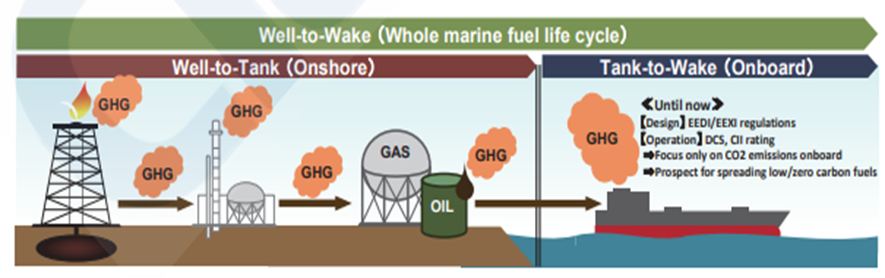
Source: Internet- ClassNK Journal
Alternative Compliance Mechanisms in FuelEU Maritime
FuelEU Maritime provides several alternative compliance mechanisms for ships that do not meet the required greenhouse gas (GHG) intensity levels. A key component of these mechanisms is the compliance balance, which must be calculated for each ship as part of its annual reporting.
Compliance Balance Definition:
Positive Compliance Balance: Achieved when a ship’s actual GHG intensity is below the required level, indicating emissions are better than the standard.
Negative Compliance Balance: Occurs when a ship’s actual GHG intensity exceeds the required level, indicating non-compliance.
Alternative Compliance Mechanisms:
Banking and Borrowing: Ships can carry forward a positive compliance balance to the following year or borrow from future balances to address shortfalls.
Pooling: Ships may combine their compliance balances with other vessels to collectively meet the required GHG intensity standards.
IMO Regulatory Developments and Alignment with FuelEU Maritime
The International Maritime Organization (IMO) is advancing regulations to reduce GHG emissions from international shipping. As of April 2025, the IMO has established the 'IMO net-zero framework', which outlines the necessary amendments to MARPOL Annex VI.
The IMO Net-zero Framework is a world first, combining a mandatory GHG fuel intensity (GFI) standard and a GHG pricing mechanism across an entire industry sector. The framework will apply to large ocean-going ships over 5,000 GT. This mechanism is due to be formally adopted by the MEPC committee in the future.
The new framework defines “Surplus Units” (SUs) for over-performing ships, and deficits for under-performing ships that can be resolved with priced “Remedial Units” (RUs) or transfer of SUs. The system will include two tiers of annual GFI compliance:
Tier 1: a Direct Compliance target, with lower RU pricing
Tier 2: a Base Target, with higher RU pricing
IMO will publish guidelines to further detail the framework, including details on its functioning – IMO GFI Registry, IMO Net-Zero Fund, Zero and Near-Zero (ZNZ) technologies – and on the certification of fuels.
There has been geopolitical resistance, which delayed voting and formal adoption in late 2025.
IMO Mid-term measure- at a glance
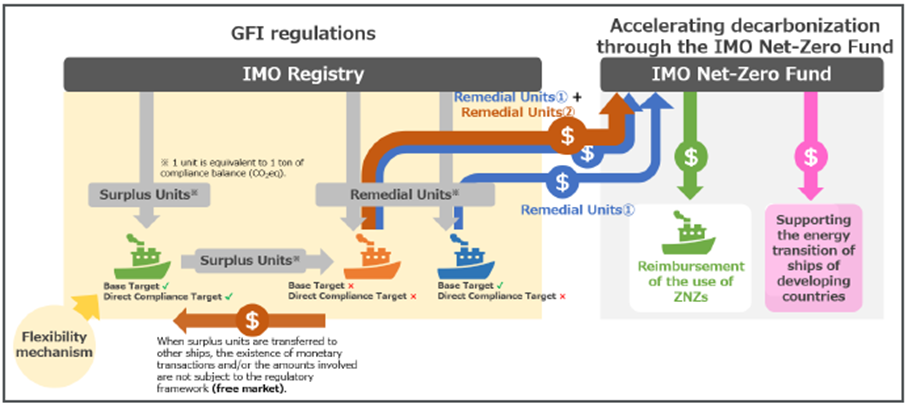
Source: ClassNKjournal: What is the IMO’s Mid-term measures and how it works.
Operational Measures: Carbon Intensity Indicator (CII) and Enhanced SEEMP
The Carbon Intensity Indicator (CII) is an operational measure applicable to ships of 5,000 GT and above, aligning with the IMO’s Data Collection System (IMO-DCS) for fuel consumption.
CII Requirements (from 2023):
Annual Calculation: The attained operational CII is calculated over a calendar year (1 January to 31 December).
Annual Reductions: Ships must demonstrate progressive reductions in carbon intensity from 2023 to 2030, achieving at least a 40% reduction by 2030 compared to 2008 levels.
CII Ratings:
Ships receive an annual CII rating (A to E), with A being the best. The rating is based on the Annual Efficiency Ratio (AER) and emissions data submitted through IMO-DCS.
Ships rated D for three consecutive years or E for one year must develop a corrective action plan to improve efficiency to at least C.
Enhanced SEEMP (SEEMP-III):
As per MARPOL Annex VI, all ships must update their Ship Energy Efficiency Management Plan (SEEMP-III) by December 2025, which includes:
The ship’s CII rating and the methodology for calculating the attained operational CII.
The required CII for the next five years.
An implementation plan detailing how the required CII will be achieved.
Reporting processes to the Flag State for verification.
PSL Fleet Compliance:
The enhanced SEEMP-III has been certified by the vessel’s Class and placed onboard.
From 1 January 2024, all our ships received a Statement of Compliance (SoC) covering verified fuel consumption, attained CII, and annual ratings.
Verification and Audits:
Periodic audits will ensure compliance with SEEMP and corrective action plans for ships rated E in any year or D for three consecutive years.
Phased Carbon Intensity Reductions
Under MEPC-83, a phased reduction approach was approved, targeting:
The framework mandates a 2% annual carbon intensity reduction (relative to the 2019 reference line) for the period 2023-2026, followed by an increased annual reduction rate of 2.625% from 2027 to 2030.
The combination of technical (EEXI) and operational (CII, SEEMP-III) measures ensures that the shipping industry progresses toward IMO’s decarbonization targets while enhancing energy efficiency and sustainability.
Year | Annual reduction factor (from 2019 reference) |
2023 | 5% |
2024 | 7% |
2025 | 9% |
2026 | 11% |
2027 | 13.265% |
2028 | 16.250% |
2029 | 18.875% |
2030 | 21.500% |
Failure to make regular improvements can result in a ship's CII rating declining over time, as the targets become progressively stricter each year. This could lead to significant consequences, including loss of earnings and restrictions on trading, providing a strong incentive to enhance energy efficiency.
The table below shows the average CII ratings for each vessel type in PSL’s fleet, as verified by the Recognized Organization (NKK for PSL’s fleet).
VESSEL TYPES | 2023 | 2024 | 2025 | ||||||
NO.OF VSLS | CO2 EMITTED - MT | AVE CII- GMS/TON-MILE | NO.OF VSLS | CO2 EMITTED - MT | AVE CII- GMS/TON-MILE | NO.OF VSLS | CO2 EMITTED - MT | AVE CII- GMS/TON-MILE | |
CEMENT CARRIERS | 4 | 44,718.23 | 15.27 | 4 | 41,808.28 | 13.10 | 4 | 42,223.52 | 13.72 |
HANDY-SIZE | 17 | 210,967.64 | 6.71 | 20 | 190,408.45 | 6.141 | 20 | 210,482.90 | 6.24 |
SUPRAMAXES | 9 | 152,163.23 | 5.45 | 8 | 126,926.74 | 5.52 | 8 | 105,210.79 | 5.80 |
ULTRAMAXES | 8 | 117,742.69 | 4.25 | 8 | 120,062.92 | 4.29 | 11 | 134,958.22 | 4.28 |
TOTAL | 38 | 525,591.79 | 6.80 | 40 | 479,206.39 | 6.03 | 43 | 492,875.44 | 6.35 |
The table indicates that the average CII for PSL’s fleet of vessels in 2025 was 6.35 grams of CO2 emitted per tonne-mile.
Other Industry Developments and Emerging Technologies
The maritime finance and chartering sectors have acknowledged their critical role in promoting greener shipping practices. Initiatives such as the Poseidon Principles and the Sea Cargo Charter have been established as frameworks to align the interests of financial institutions, charterers, and cargo owners with the IMO's greenhouse gas (GHG) reduction strategy. These initiatives aim to ensure that investments and operational decisions in the maritime industry support global decarbonization goals.
Norway’s More Sjo orders hydrogen-powered bulk carrier duo (Source: Offshore Energy)
Norwegian shipping company More Sjo is placing its bets on hydrogen as an alternative marine fuel with an order for the construction of two emission-free hydrogen-powered bulk carriers at Gelibolu Shipyard in Turkiye. The company also secured bunker supplies from hydrogen producer GreenH.
The newbuilds, which will have a length of 85 meters and a deadweight of 4,000 tons, will mainly operate in northern and northwestern Norway, transporting sand, stone, and asphalt. As disclosed, one of the ships has already been leased to Nordasfalt.
Marine engineering company Naval Dynamics designed the ships, while German technology company e-Cap Marine was selected to provide onboard hydrogen solutions.
The ships, which are said to be “the world’s first hydrogen-powered bulk carriers”, are slated for delivery in 2027, renewing and doubling More Sjo’s fleet. The total price for the two ships was not revealed.
The company has received investment support from ENOVA and the NOx Fund, as well as financial assistance from NRP and technical assistance from the Green Shipping Program for this project.
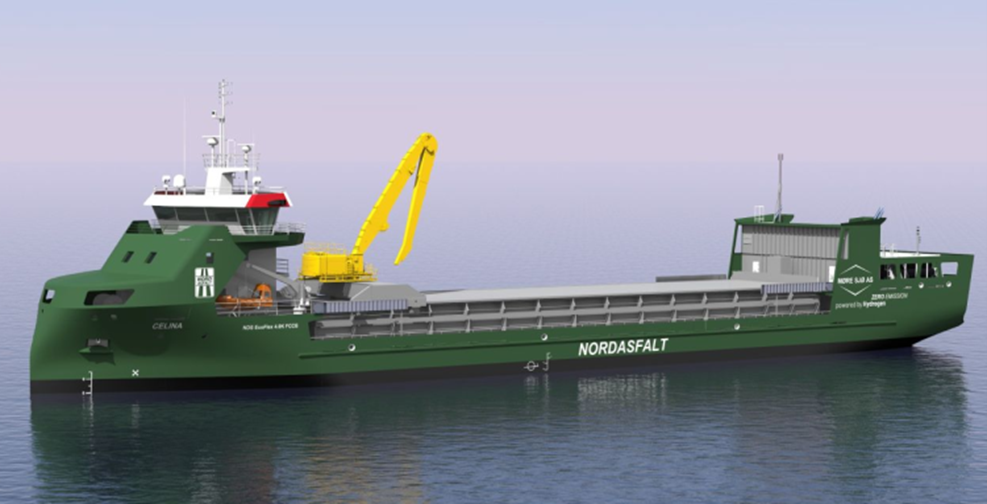
Source: OFFSHORE ENERGY
The Nuclear Option: ABS Grants AIP for 15K TEU Nuclear-Propelled Vessel Design
A nuclear-propelled containership designed by HD Korea Shipbuilding & Offshore Engineering (HD KSOE) received approval in principle from ABS.
The design for a 15k TEU vessel uses a propulsion system comprised of a molten salt reactor (MSR) for heat and a supercritical carbon dioxide (SCO2) system for power generation.
Unlike conventional ships, nuclear-powered vessels do not require engine exhaust systems or fuel tanks. HD KSOE has optimized the space previously occupied by large engine room equipment to accommodate additional containers, enhancing economic efficiency. The company has also applied a marine radiation shielding system using a double-tank method with stainless steel and light water to ensure safety. In collaboration with Baker Hughes, HD KSOE has applied a supercritical carbon dioxide-based propulsion system, improving thermal efficiency by approximately 5% compared to existing steam-based propulsion systems.
HD KSOE plans to establish a marine nuclear demonstration facility at its Future Technology Test Center in Yongin, Gyeonggi Province, to verify safety designs.
ABS completed design reviews based on class requirements. ABS published the industry’s first comprehensive requirements for floating nuclear power in October last year.

Source: HD Korea Shipbuilding Premieres Nuclear-Powered Ship Design
LNG (Liquefied Natural Gas) remains the dominant alternative fuel in 2025 ship orders of 188 (roughly 68% of the alternative fuelled tonnage new builds), especially in container ships, accounting for the majority of new alternative-fuel vessels.
Methanol dual-fuel ships orders decreased from 149 in 2024 to 61 in 2025.
Ammonia and hydrogen-ready vessels also appear in the orderbooks. Five ammonia-capable and four hydrogen capable vessels were also ordered during the year 2025. One ammonia-capable vessel was delivered in 2025, taking the number of such vessels in operation to three. A further 46 ammonia-capable vessels are currently on order, with deliveries scheduled through 2029.
There are now 846 LNG-capable vessels in operation, and another 642 on order for deliveries by 2033. The methanol-capable fleet comprises 106 vessels in operation and an additional 344 on order for delivery towards 2030.
Overall alternative-fuel ship orders in 2025 are significant but down from the record levels of 2024, with LNG ships dominating the newbuild market. Container ships lead the way, making up a large share of alternative-fuel orders.
The total alternative fuel capable orderbook now stands at 1,942 ships with 1,259 set to use LNG, 385 to use methanol, 139 using LPG, 53 vessels equipped to use hydrogen, 55 ethane, 45 ammonia, 22 biofuel and 4 nuclear-capable (Lloyds news).
PSL’s Training Department
Introduction
PSL management prioritizes investment in training to maintain competitiveness and address evolving challenges in the maritime industry. The PSL Training Department reflects this commitment through its in-house training programs, designed to enhance the skills and competencies of the company’s seafaring staff. These initiatives empower employees while driving organizational growth and ensuring long-term success.
As an autonomous unit, the PSL Training Department focuses on developing the expertise of seafarers across PSL’s fleet. This dedication to continuous learning and professional development ensures that the workforce is equipped to handle the diverse and complex responsibilities of modern shipping operations.
Courses Conducted by PSL Training
PSL Training provides a wide array of programs, including licensing courses and tailored training sessions.
Flagship Course: Maritime Resource Management (MRM)
Objective: Enhance safety, teamwork, and resource management by addressing human capabilities and limitations.
Target Audience: Ship officers, engineers, pilots, and shore-based personnel.
Accreditation: Licensed by ALL Academy International AB, a leading training provider in human factors and resource management.
Impact: Recognized as one of the most effective methods to improve crew cooperation and minimize risks from human error.
Additional Courses
Bridge Team Management and Competency (BTM)
fficer of the Watch (OOW)
Chief Mate Course (CMC)
Command Course
Electronic Chart Display and Information System (ECDIS): Includes mandatory familiarization training.
Shipboard Safety Course (SSC)
Maritime Professional Briefing (MPB)
Maritime English Training: Offered across five proficiency levels for deck and engine departments.
RCA Ocean Watcher for Marine Mamals
Maritime Occupational Safety & Health (M-OSH)
Mental Health Awareness for Seafarers
Specialized Training
Vessel Traffic Separation (VTS) and Standard Marine Communication Phrases (SMCP): Integrated into BTM and MRM courses to improve communication skills through VTS officer simulations.
Advanced courses on fuel-efficient engines, stern tube sealing systems, hydraulic cargo gear, and ballast water treatment systems, in collaboration with PSL’s Technical and New Projects Departments.
Engineer-Specific Programs
Engine Room Management and Competency Enhancement (EMC) for senior engineers.
Engineer on Watch (EOW) for junior engineers.
Specialized training for Electrical Officers, Technical Superintendents, and engineers on advanced electronic systems and regulatory compliance (e.g., low sulfur caps and CO2 emissions).
Training Highlights for 2025
2025 marked a significant year for PSL’s professional development programs, combining online and onsite training. Key achievements include 21 courses conducted, attended by 1,809 seagoing officers and crew members.
Summary of courses conducted in 2025:
Course Name | No. of Participantsin 2025 | Man/day in 2025 |
Maritime Resources Management | 133 | 399 |
Bridge Team Competency - I | 33 | 99 |
Bridge Team Management and Competency | 67 | 201 |
Maritime Professional Briefing | 127 | 127 |
Officer of The Watch | 26 | 78 |
Chief Mate Course | 56 | 168 |
COMMAND | 25 | 50 |
ECDIS | 71 | 213 |
It’s my ship | 58 | 290 |
Log Lashing | 143 | 143 |
Mental Health Training | 122 | 244 |
MOSH | 284 | 568 |
RT – Flex | 79 | 395 |
RT Flex Operation & Practical Advanced | 40 | 200 |
ME Course | 97 | 485 |
ME Engine Advance Troubleshooting | 57 | 285 |
ME – B Control System Standard Ops | 145 | 580 |
Basic English | 83 | 830 |
Elementary English | 111 | 1110 |
Intermediate Eng – I | 37 | 370 |
Intermediate Eng – II | 15 | 150 |
Total | 1,809 | 7,366 |
Continual Improvement Project
In 2025, PSL Training initiated the English Continual Improvement Pilot Project as a pilot initiative to strengthen English communication skills among senior staff from the Deck and Engine departments. The project involves 20 participants at Elementary and Intermediate levels, selected from regular attendees who have shown limited progress. It adopts a dual learning approach—teacher-led instruction via Line Group with structured weekly content, complemented by self-paced learning through the VOXY application. English proficiency will be evaluated through pre- and post-assessments over a 9–12 months period, providing measurable outcomes to assess effectiveness and inform potential wider implementation.
Social Media Attraction Project
The outcomes from the skills development of ship officers
Skills development leads to increased proficiency in ship handling, equipment operation, and cargo management, resulting in more efficient and streamlined day-to-day operations. Additionally, improved skills in navigation, communication, and emergency response contribute to a safer maritime environment, reducing the risk of accidents and incidents at sea.
Challenges for 2026
Looking ahead to 2026, PSL Training anticipates several strategic challenges arising from the evolving characteristics and expectations of the new generation of seafarers. A key priority is positioning PSL Training as an attractive and engaging learning environment for younger seafarers, who increasingly value modern, flexible, and technology-enabled development opportunities. At the same time, sustaining motivation for lifelong learning among seagoing officers and crew remains challenging due to operational demands and limited learning time. PSL Training must therefore continue to adapt its training methodologies, leveraging digital platforms and social media to deliver relevant, engaging, and impactful learning content. Strengthening early engagement with cadets and clearly demonstrating the effectiveness and value of training initiatives will be essential to ensuring continuous improvement, workforce readiness, and long-term organizational sustainability.
Commitment to Excellence
We are dedicated to refining our training methodologies to:
Equip seagoing staff with enhanced knowledge and skills.
Help them excel in their roles.
Ensure adaptability to meet the evolving demands of the maritime industry.
By embracing these initiatives and addressing the needs of the younger generation, PSL Training aims to remain a leader in professional development and a preferred partner for aspiring seafarers.
In Conclusion
Demand:
The environment for 2026 is going to be characterized by extreme volatility, as it was for 2021-2025, for the same reason, that demand-supply came into near perfect balance during 2021. Downside risks for 2026 will include, amongst others, geopolitical tension hot spots like Ukraine, Israel, and Taiwan; China importing lower quantities of coal and iron ore; real estate, steel production, cement and aluminum manufacturing slowing down and negatively impacting GDP rates in China; tariffs in USA hurting their economy; interest rate changes in USA, and other major economies, not dropping quickly enough, or God forbid rising; higher oil prices negatively impacting world economic growth rates; and protectionism increasing. But it is not all doom and gloom. The upside potential for 2026 consists of, amongst others, fiscal and monetary stimulus by governments; China lowering interest rates, increasing their fiscal deficit to 4%, the highest in the last three decades; lowering reserve ratio requirements of their banks, lowering mortgage rates, and providing steel intensive stimulus; China importing more high-grade iron ore as they maintain steel production; China importing more coal to reduce pollution, to dampen higher prices for domestic coal, and to supply the increased electricity demand from their AI industry; slower ordering of new ships due to challenging regulations covering fuels of the future, lack of traditional finance sources for ‘new fuel burning ships that could become stranded assets’; the US economy may continue to outperform expectations and grow more strongly than forecast; and weaker currencies in the Euro zone and Japan helping them to export their economies out of trouble. Most importantly, with geopolitical tensions around Ukraine, Israel, and Taiwan; China rescinding its unofficial ban on coal imports from Australia; and the Chinese government adding as much stimulus as needed to keep their economy chugging along at a brisk pace, should all assist the demand side of the equation at a time when the supply side shows no signs of growing at anything but the slowest pace on record this century.
Supply:
Under the current conditions, approximately 20.70% (246.59 MDWT) of the existing world fleet would be over 20 years of age by the end of 2029 if no ships are recycled between 2026-2029. These ships would come under tremendous financial pressure due to the existing and future regulatory requirements. Depending on how challenging the freight markets turn out to be and the increasing regulatory pressure on older ships in the period 2025-2029 many of these ships would be forced to take the decision to head to the recycling yards in Asia.
With respect to the 12.24% of new ships (129.89 MDWT) scheduled to be delivered to the end of 2029, slippage in deliveries at shipyards would help slow down their arrivals into the freight market.
Financing:
It was a tale of two halves for the dry-bulk market in 2025. The year began with optimism, although it was soon replaced by the cloud of tariffs imposed by the world’s largest economy on each and every one of its trading partners. Macroeconomic forecasters were aghast. After all, for decades, the US had proselytized the virtues of free trade, while vilifying countries that protected their economies through the imposition of tariffs and non-tariff barriers.
The melancholic forecasts of macroeconomists precipitated boardrooms at major commodity players and their financiers, who were notably cautious in their trading activities during the first half of the year. Dry-bulk shipping suffered collateral damage from these somber outlooks, as rates crashed to levels not seen since the Covid-19 pandemic! PSL reported its first quarterly loss in five years.
While the macroeconomists were directionally correct in their forecast, fortuitously for us, they overestimated the degree of decline that was to follow from the McKinley inspired tariffs. Even the much-exalted IMF, which downgraded the global GDP forecast for 2025 to 2.8% in the immediate aftermath of the tariff imposition in April 2025, later revised it up to 3% in July and then to 3.2% in October.
Among the major economies, the United States is expected to record a more moderate yet still resilient ~2.0% GDP growth in 2025, reflecting a gradual normalization of activity. China’s GDP growth is forecast at approximately 4.8%, signaling continued but structurally slower expansion, while India is expected to remain the standout performer, with growth of about 6.6%, cementing its position as the fastest-growing major economy. Europe, meanwhile, continues to lag as the outlier, with growth stuck near 1%, weighed down by lingering geopolitical tensions and the enduring aftereffects of the Russia–Ukraine conflict, particularly the elevated energy costs.
2025 remained an active year for the shipbuilding industry, with orders totaling 56.4m CGT and $181bn, down 27% from the 15-year peak of 2024. The year was defined by record container and cruise vessel contracting, a sharp contrast to the pronounced slowdown in bulk carrier and gas carrier orders. Tanker contracting revived in the second half, resulting in 327 tankers totaling 34.7m dwt, while bulk carrier ordering fell steeply to 281 vessels (25.5m dwt), down 55% YoY, highlighting the divergence between segments. China further entrenched its leadership position, capturing 61% of global orderbook share, followed by South Korea at 21%, while shipyard output rose 6% YoY to 43.8m CGT, supported by expanding Chinese capacity. Meanwhile, newbuilding prices softened slightly, with the Clarkson index declining 3%, although levels remained historically elevated. Uncertainty over future fuels continued, and progress on decarbonization effectively stalled after strong U.S. opposition led to the postponement of the IMO’s net-zero framework. This overall environment, characterized by high prices, limited berths, and lingering uncertainty over fuel technologies, reinforced the need for disciplined fleet renewal across the industry as owners balanced aging fleets with the long lead times and rising technical complexity of newbuildings.
In 2025, shipping capital-market activity was dominated by debt issuances and secondary equity offerings, as IPO activity fell from five deals raising $447m in 2024 to just two IPOs raising $380m, a 60% drop in volume and 15% decline in proceeds. In contrast, secondary equity offerings surged dramatically, jumping from nine deals and $369m in 2024 to 17 deals raising $2.38bn in 2025, an increase of 89% in deal count and more than six-fold in capital raised, as public companies tapped the market for fleet renewal and regulatory driven investments. Shipping bonds remained the most resilient funding channel, with issuance values rising from $14.53bn in 2024 to $16.20bn in 2025 (+12%), despite a slight reduction in the number of transactions (45 to 42), highlighting a continued institutional preference for debt even as primary equity markets grew more selective.
In 2025, we entered into several financing agreements to strengthen liquidity and support fleet renewal. On 18 March 2025, we executed a USD 30 million term loan facility with Krung Thai Bank. On 1 October 2025, we executed an amendment to increase the loan by an additional USD 6.37 million (bringing the total to USD 36.37 million) to partially finance the acquisition of M.V. Napha Naree and M.V. Urairat Naree. On 16 July 2025 we entered into a USD 13.58 million loan agreement with Bangkok Bank’s Singapore Branch to finance the acquisition of M.V. Nitaya Naree. On 10 December 2025, we borrowed USD 6 million from THE IYO BANK, LTD., Singapore Branch to refinance M.V. Ananya Naree, and a day later, we entered into a USD 50 million term loan with KfW IPEX-Bank GmbH to fund pre- and post-delivery costs of two 63,500 DWT newbuildings scheduled for 2026 delivery. On 30 December 2025, we signed a USD 52.00 million term loan agreement with Bank SinoPac Company Limited to partially finance the purchase of two newbuilding resale 66,000 DWT bulk carriers, which were delivered in January 2026.
The Company was notably active on the investment front in 2025, expanding its operational footprint and fleet capabilities through new subsidiaries, vessel acquisitions, and strategic equity investments. Early in the year, it incorporated Precious Shipping (Labuan) Limited (28 February 2025) and subsequently PSL Tug & Towage Sdn. Bhd. (11 March 2025) under its Labuan entity. Between March and October 2025, the Group acquired multiple secondhand vessels, including M.V. Western Singapore (renamed M.V. Uma Naree), M.V. Jal Kalpavriksh (renamed M.V. Usanee Naree), M.V. Jal Kalpataru (renamed M.V. Urairat Naree). It further expanded into Malaysia through a Joint Venture Agreement signed on 21 March 2025 and the subsequent incorporation of Nusantara Maritime Sdn. Bhd. on 28 April 2025. Beyond fleet and subsidiary expansion, the Company has made a strategic capital markets investment by acquiring 4,686,900 shares (5.96%) of Uni-Asia Group Limited for SGD 3.90 million (THB 101.17 million) through open-market transactions. The Company also added two newbuilding resale vessels (M.V. Ubon Naree and M.V. Uthita Naree) in November 2025 through its Singapore subsidiaries, Precious Sakura Pte. Ltd. and Precious Gardenia Pte. Ltd.
In 2025, the Company actively executed capital-return initiatives through both share repurchases and dividends. On 10 February 2025, the Board approved a share repurchase program of up to THB 675 million, authorizing the buyback of up to 155.9 million shares (10% of paid-up capital) between 3 March and 29 August 2025. By the program’s conclusion, the Company had repurchased 74,587,400 shares, representing 4.78% of paid-up capital, at a total cost of THB 451.9 million. In parallel, the Company distributed four dividends during the year: a final dividend for FY2024 of THB 0.10 per share (paid 2 May 2025), followed by Interim Dividend No. 1/2025 of THB 0.10 per share (paid 6 June 2025), Interim Dividend No. 2/2025 of THB 0.10 per share (paid 5 September 2025), and Interim Dividend No. 3/2025 of THB 0.10 per share (paid 4 December 2025), underscoring the Company’s commitment to consistent shareholder returns throughout 2025.
Concluding Remark:
The dry bulk markets will be higher than what we had in 2023-2025 for all the reasons stated in our Crystal Ball Gazing section, with greater risks to a breakout on the upside should one or all the factors given therein work in favor of ship owners.
Considering all the above, we are taking advantage of the opportunities that are present in the market. We hope to deliver to all our stakeholders the promise of this potential. This will, in no small measure, be due to the very dedicated and hardworking professionals that make up the office, as well as the floating staff at PSL.
For and on behalf of the Board of Directors of
Precious Shipping Public Company Limited

Chaipatr Srivisarvacha Khalid Moinuddin Hashim
Chairman of the Board of Directors Managing Director
13 February 2026
Safe Harbour Statement: This document contains certain forward-looking statements reflecting current views on future events, market conditions, and business performance. Due to various factors involved, these statements carry risks and uncertainties that could cause actual results to differ materially. Readers are advised to exercise caution when considering such statements. These statements are based on information available as of the date of this report and are not guarantees of future.
Sources: For the convenience of readers, this report includes links to publicly available news sources, including but not limited to Bloomberg, Reuters, Fortune, Business Insider, The Wall Street Journal, and CNN. All rights to such content remain with their respective owners.
Vision
To be the most distinguished Shipping Company in the world, providing an exemplary level of services and solutions to facilitate global trade.
Objectives
To be the most distinguished Shipping Company in the world, providing an exemplary level of services and solutions to facilitate global trade.
Core Values
Integrity, Innovation, Sustainability, Tradition and Safety
Goals
To achieve sustainable long-term growth through the provision of reliable, safe and environmentally responsible maritime shipping services to the global trading community.
Build resilience by embracing cutting-edge technologies and enhancing human capital.
Contribute positively to community development and global environmental initiatives.
Create enduring value for shareholders, stakeholders, and society.
Business Strategies
Focus on people, operations, and technology
PSL recognizes the importance of human capital in the growth and success of its business. Therefore, we strive to enhance the competence and skills of our employees by conducting a range of in-house training and development programs for employees across the organization. PSL is committed to continuous advancement and automation of its operations to ensure the highest level of operational efficiency. Further, we are committed to implementing latest technologies to improve operational efficiencies and reduce our environmental impact.
Concern for society
Community development is in our DNA. Over the years, we have made significant donations to community schools as well as provided scholarships to deserving students at the Merchant Marine Training Centre and various such activities since 1995.
Concern for the environment
We take our obligation to reduce the environmental impact of our business very seriously. We have measurably reduced emissions by replacing our fleet of older vessels with modern fuel-efficient vessels. In addition, we have undertaken a number of fuel-saving measures such as installing mewis ducts on the propellor of ships, regular cleaning of the external underwater hull and propeller so that frictional losses are kept to a minimum; usage of efficient hull coatings (anti-fouling paints), avoiding wastage of electric power on board and implementation of active weather routing on voyages to increase efficiency. We are committed to burning only low sulphur fuel while avoiding equipment such as scrubbers that cause acidification of the ocean.
Concern for information security
Our company places the highest importance on the security of information entrusted to us. We are committed to protecting both our own information assets and the confidential data of our clients, customers, and business partners.
With the achievement of ISO/IEC 27001:2022 certification, we have established and continually maintain a robust Information Security Management System (ISMS) to ensure the confidentiality, integrity, and availability of information. Our approach to information security is based on risk management, clear governance, employee awareness, and continuous improvement.
We recognize that information security is fundamental to operational reliability, regulatory compliance, and long-term trust. Accordingly, we remain dedicated to safeguarding information against unauthorized access, misuse, loss, or disruption across all our operations.
Material Changes & Developments
Material Changes & Developments
| Year | Description |
|---|---|
| 2,023 |
On 6 January 2023, the Company notified the SET that a Handysize vessel in its fleet, M.V. Latika Naree, was fixed on a 10-14 month charter to Dampskibsselskabet Norden A/S, Denmark commencing 5 January 2023 at a gross variable rate equivalent to 92.5% of the Baltic Exchange Handysize Index (BHSI) weighted time charter average value over the previous 15 days.
On 7 March 2023, the Company notified the SET that a Handysize vessel in its fleet, M.V. Rattana Naree, was fixed on a 10-12 month charter to Transcend Marine Pte Ltd., Singapore commencing 4 March 2023 at a gross variable rate equivalent to 89.5% of the Baltic Exchange Handysize Index (BHSI) weighted time charter average value over the previous 15 days.
On 15 March 2023, the Company notified the SET that the long term charter of M.V. Savita Naree with Umang Shipping Services Ltd. has been extended for another 11-13 month commencing 15 March 2023 at a gross variable rate equivalent to 117% of the Baltic Exchange Supramax Index (BSI) weighted time charter average value over the previous 15 days.
On 3 April 2023, the Company notified the SET that an Ultramax vessel in its fleet, M.V. Savitree Naree, was fixed on a 11-13 month charter to Umang Shipping Services Ltd. commencing 2 April 2023 at a gross variable rate equivalent to 117% of the Baltic Exchange Supramax Index (BSI) weighted time charter average value over the previous 15 days.
At the Annual General Meeting of Shareholders of the Company No. 1/2023 held on Monday, 10 April 2023, at 10:30 hours by electronic means (“E-AGM”), the Shareholders passed a resolution approving a final dividend for the year 2022 based on the retained earnings as of 31 December 2022 of Baht 0.25 per share. The Record Date for the right to receive the dividend was 24 April 2023. The payment was made on 9 May 2023.
The Annual General Meeting of Shareholders of the Company No. 1/2023 held on Monday, 10 April 2023, at 10:30 hours by electronic means (“E-AGM”), the Shareholders passed a resolution approving the appointment of Ms. Qiyu (Jackie) Wang as a new Independent Director.
On 26 April 2023, the Company notified the SET that on 25 April 2023, a wholly owned Singapore subsidiary of the Company, namely Precious Visions Pte. Ltd. (the “Subsidiary”) as the Borrower and the Company as the Guarantor have executed a USD 9,000,000 Senior Secured Amortizing Term Loan Agreement (“Agreement”) with the IYO Bank Ltd., Singapore Branch, to refinance the Supramax Dry Bulk Vessel, i.e. M.V. Chayanee Naree.
With reference to the appointment of Ms. Qiyu (Jackie) Wang as a new Independent Director on the Board of Directors, at the Meeting of the Board of Directors of the Company No. 3/2023 held on Monday, 15 May 2023, the Board has resolved to reorganize certain sub-committees for better efficiency, as follows: The combination of the Nomination Committee and the Remuneration Committee into one committee, namely the Nomination and Remuneration Committee, which comprises the following members:
The revised structure of the Sustainability and Risk Management Committee is as follows:
On 31 May 2023, the Company notified the SET that a Handysize vessel in its fleet, M.V. Pavida Naree, was fixed on a 10-12 month charter to Navision Shipping A/S, Denmark commencing 30 May 2023 at a gross variable rate equivalent to 101.5% of the Baltic Exchange Handysize Index (BHSI) weighted time charter average value over the previous 15 days.
On 20 June 2023, the Company notified the SET that on 15 June 2023, certain wholly-owned Singapore subsidiaries of the Company, namely Precious Grace Pte. Ltd., Precious Skies Pte. Ltd., and Precious Tides Pte. Ltd. (collectively the “Subsidiaries”) as the Borrowers and the Company as the Guarantor have executed a first amendment and restatement agreement (“Amendment Agreement”) in relation to the USD 17.10 million Senior Secured Amortizing Term Loan Agreement with Bangkok Bank Public Company Limited, Singapore Branch. The aforesaid Amendment Agreement is mainly to upsize the original Loan by an additional loan amount of up to USD 31.80 million. As such, the aggregate loan amount has been increased to USD 48.90 million.
On 8 August 2023, the Company notified the SET about the incorporation of the following 9 (nine) wholly owned subsidiaries of our Singaporean subsidiary, Precious Shipping (Singapore) Pte. Ltd.:
On 11 August 2023, the Board passed a resolution approving an Interim Dividend No. 2 for the year 2023 based on the retained earnings as of 30 June 2023 of Baht 0.05 per share. The Record Date for the right to receive the dividend was 25 August 2023. The payment was made on 8 September 2023.
On 15 August 2023, the Company notified the SET that a Handysize vessel in its fleet, M.V. Phatra Naree, was fixed on a 11-13 month charter to Navision Shipping A/S, Denmark commencing 12 August 2023 at a gross variable rate equivalent to 101.5% of the Baltic Exchange Handysize Index (BHSI) weighted time charter average value over the previous 15 days.
On 15 August 2023, the Company notified the SET that on 11 August 2023, the Company and certain subsidiaries of the Company executed a USD 26.25 million term loan facility agreement with Export-Import Bank of Thailand. The purposes of the Loan Facility are to reimburse the acquisition expenses of M.V. Phatra Naree and to support the Borrowers’ operations.
On 25 September 2023, the Company notified the SET of the following recent extensions of long-term charters:
On 25 October 2023, certain wholly-owned Singapore subsidiaries of the Company, namely Precious Waves Pte. Ltd., Precious Breeze Pte. Ltd., Precious Topaz Pte. Ltd., Precious Jade Pte. Ltd., Precious Violets Pte. Ltd., and Precious Tulips Pte. Ltd. (collectively the “Subsidiaries”) as the Borrowers have executed the relevant agreements in relation to a USD 105,000,000 Senior Secured Amortizing Term Loan Facility (“Loan Facility”) with International Finance Corporation, Export-Import Bank of Thailand and Credit Agricole Corporate and Investment Bank, mainly to finance the acquisition of up to six (6) dry bulk carriers.
On 6 November 2023, certain wholly-owned Singapore subsidiaries of the Company, namely Precious Glories Pte. Ltd., Precious Wisdom Pte. Ltd., Precious Bridges Pte. Ltd., and Precious Sparks Pte. Ltd. (collectively the “Subsidiaries”) as the Borrowers executed a USD 37,500,000 Senior Secured Amortizing Term Loan Agreement (“Loan Agreement”) with Credit Agricole Corporate and Investment Bank mainly to refinance the Existing Loan Agreement.
On 14 December 2023, the Company notified the SET of the recent incorporation of Bongkot Holdings Limited, a wholly owned Thai subsidiary of the Company.
On 10 November 2023, the Board passed a resolution approving an Interim Dividend No. 3 for the year 2023 based on the retained earnings as of 30 September 2023 of Baht 0.05 per share. The Record Date for the right to receive the dividend was 24 November 2023. The payment was made on 8 December 2023.
On 27 December 2023, the Company notified the Stock Exchange of Thailand that on 26 December 2023, certain wholly-owned Singapore subsidiaries of the Company, namely Precious Daisies Pte. Ltd. and Precious Marigold Pte. Ltd. (collectively the “Subsidiaries”) as the Borrowers have executed the relevant agreements in relation to a USD 18,000,000 Senior Secured Amortizing Term Loan Facility (“Loan Facility”) with SinoPac Capital International (HK) Limited, mainly to refinance two Handysize dry bulk carriers, i.e., M.V. Chamchuri Naree and M.V. Charana Naree. |
| 2,024 |
On 22 January 2024, the Company notified the SET that a Ultramax vessel in its fleet, M.V. Sarika Naree, was fixed on a 12-14 month charter to Global Chartering Limited commencing 19 January 2024 at a gross variable rate equivalent to 117% of the Baltic Exchange Supramax Index (BSI) weighted time charter average value over the previous 15 days.
On 12 February 2024, the Board passed a resolution approving an Interim Dividend No. 4 for the year 2023 based on the retained earnings as of 31 December 2023 of Baht 0.05 per share. The Record Date for the right to receive the dividend was 27 February 2024. The payment was made on 11 March 2024.
On 16 February 2024, the Company notified the SET that the disposal of one Handysize Bulk Carrier, viz. M.V. Rattana Naree by Precious Stones Shipping Limited, a wholly-owned Thai subsidiary of the Company.
On 7 March 2024, the Company notified the SET that the acquisition of one secondhand vessel, viz. M.V. INTERLINK AMENITY (currently known as M.V. Hansa Naree) by Precious Waves Pte. Ltd., a wholly-owned Singapore subsidiary of the Company.
On 8 March 2024, the Company notified the SET about the incorporation of a new wholly owned subsidiary of our Singaporean subsidiary, Precious Hibiscus Pte. Ltd
On 8 March 2024, the Company and certain wholly-owned Thai subsidiaries of the Company, namely Precious Rubies Limited and Precious Opals Limited as the Borrowers executed a USD 25,500,000 term loan facility (“Loan Facility”) with Export-Import Bank of Thailand. The purpose of the Loan Facility is to support the Borrowers’ operations.
On 28 March 2024, the Company notified the SET that the disposal of one Supramax Bulk Carrier, viz. M.V. Wikanda Naree by Precious Ornaments Limited, a wholly-owned Thai subsidiary of the Company.
At the Annual General Meeting of Shareholders of the Company No. 1/2024 held on Friday, 5 April 2024, at 10:30 hours by electronic means (“E-AGM”), the Shareholders passed a resolution approving a final dividend for the year 2023 based on the retained earnings as of 31 December 2023 of Baht 0.25 per share. The Record Date for the right to receive the dividend was 22 April 2024. The payment was made on 3 May 2024.
On 11 April 2024, the Company notified the SET that the Company’s wholly-owned Singapore subsidiary had taken delivery of M.V. Hansa Naree, which is registered in Singapore.
On 10 May 2024, the Board passed a resolution approving an Interim Dividend No. 1 for the year 2024 based on the retained earnings as of 31 March 2024 of Baht 0.10 per share. The Record Date for the right to receive the dividend was 24 May 2024. The payment was made on 7 June 2024.
On 29 May 2024, the Company notified the SET of its entry into four Shipbuilding Contracts for four 63,500 DWT Bulk Carriers with Taizhou Sanfu Ship Engineering Co., Ltd. as the Seller.
On 11 June 2024, the Company notified the SET that the acquisition of one secondhand vessel, viz. M.V. WESTERN PANAMA (currently known as M.V.Hatthaya Naree) by Precious Marigold Pte. Ltd., a wholly-owned Singapore subsidiary of the Company.
On 18 June 2024, the Company notified the SET that the disposal of one Handysize Bulk Carrier, viz. M.V. Charana Naree by Precious Marigold Pte. Ltd., a wholly-owned Singapore subsidiary of the Company.
On 17 July 2024, the Company notified the SET that a Handysize vessel in its fleet, M.V. Hansa Naree, was fixed on a 11-13 month charter to Oldendorff Carriers Gmbh & Co.Kg., Germany, commencing 16 July 2024 at a gross variable rate equivalent to 112% of the Baltic Exchange Handysize Index (BHSI) weighted time charter average value over the previous 15 days.
On 23 July 2024, the Company notified the SET about the acquisition of four secondhand Vessels, viz. M.V. WESTERN DURBAN, M.V. WESTERN LIMA, M.V. WESTERN MIAMI, and M.V. WESTERN PARIS by the Company.
On 25 July 2024, the Company notified the SET that its wholly-owned Singapore subsidiary had taken delivery of M.V. Hatthaya Naree (formerly known as M.V. Western Panama), which is registered in Singapore.
On 31 July 2024, the Company notified the SET that a Ultramax vessel in its fleet, M.V. Savita Naree, was fixed on a 19-21 month charter to Global Chartering Limited commencing 27 July 2024 at a gross variable rate equivalent to 117% of the Baltic Exchange Supramax Index (BSI) weighted time charter average value over the previous 15 days.
On 9 August 2024, the Board passed a resolution approving an Interim Dividend No. 2 for the year 2024 based on the retained earnings as of 30 June 2024 of Baht 0.10 per share. The Record Date for the right to receive the dividend was 23 August 2024. The payment was made on 6 September 2024.
On 20 August 2024, the Company notified the SET about the incorporation of a new wholly owned subsidiary of our Singaporean subsidiary, Precious Roses Pte. Ltd.
On 22 August 2024, a wholly-owned Singapore subsidiary of the Company, Precious Marigold Pte. Ltd. as the Borrower executed the relevant agreements in relation to a USD 18,000,000 Secured Amortizing Term Loan Facility with SinoPac Capital International (HK) Limited, mainly to finance one Handysize dry bulk carrier, i.e., M.V. Hatthaya Naree.
On 9 September 2024, the Company notified the SET that its wholly-owned Singapore subsidiary had taken delivery of M.V. Nitaya Naree (ex-Western Durban), which is registered in Singapore.
On 16 September 2024, the Company notified the SET that a Ultramax vessel in its fleet, M.V. Savitree Naree, was fixed on a 11-13 month Oceana Bulk SA, Switzerland, commencing 15 September 2024 at a gross variable rate equivalent to 118% of the Baltic Exchange Supramax Index (BSI-58) weighted time charter average value over the previous 15 days.
On 27 September 2024, the Company and a wholly-owned Thai subsidiary of the Company, namely Precious Stones Shipping Limited as the Borrower executed a USD 13,580,000 term loan facility with Export-Import Bank of Thailand. The purpose of the Loan Facility is to finance one second-hand dry bulk carrier.
On 11 October 2024, a wholly-owned Singapore subsidiary of the Company, namely Precious Hibiscus Pte. Ltd., as the Borrower and the Company as the Guarantor executed a USD 13.50 million Senior Secured Amortizing Term Loan Agreement with THE IYO BANK, LTD. Singapore Branch to finance one second-hand 39,260 DWT dry bulk carrier, M.V. Western Lima (currently known as M.V. Nisa Naree).
On 18 October 2024, the Company notified the SET that its wholly-owned Thai subsidiary had taken delivery of M.V. Napha Naree (ex-Western Paris), which is registered in Thailand.
On 18 October 2024, the Company notified the SET that the Company has successfully issued “The Guaranteed Sustainability-Linked Bonds of Precious Shipping Public Company Limited No. 1/2567 (2024) Series 1 Due B.E. 2572 (2029)” (the “Series 1 Bonds”) and “The Guaranteed Sustainability-Linked Bonds of Precious Shipping Public Company Limited No. 1/2567 (2024) Series 2 Due B.E. 2577 (2034) With Call Option” (the “Series 2 Bonds”), by way of a Private Placement to Institutional Investors and/or High Net Worth Investors (“PP-II & HNW”). The Company accordingly received the aggregate proceeds of Baht 1,360 million.
On 30 October 2024, the Company notified the SET that its wholly-owned Singapore subsidiary, Precious Hibiscus Pte. Ltd., had taken delivery of M.V. Nisa Naree (ex-Western Lima), which is registered in Singapore.
On 1 November 2024, the Company notified the SET of the incorporation of two new wholly-owned subsidiaries under its Singaporean subsidiary, Precious Shipping (Singapore) Pte. Ltd.: Precious Lilac Pte. Ltd. and Precious Lotus Pte. Ltd.
On 8 November 2024, the Board passed a resolution approving an Interim Dividend No. 3 for the year 2024 based on the retained earnings as of 30 September 2024 of Baht 0.10 per share. The Record Date for the right to receive the dividend was 22 November 2024. The payment was made on 6 December 2024.
On 8 November 2024, the Board of Directors’ Meeting No. 4/2024 of the Company approved the acquisition of all ordinary shares of V.L. Enterprise Public Company Limited (“VL”) through a Conditional Voluntary Tender Offer by the Company’s wholly-owned Thai subsidiary, Bongkot Holdings Limited. The offering price was set at Baht 1.24 per share.
On 11 December 2024, the Company notified the SET that our Handysize vessel, M.V. Hatthaya Naree, was fixed on a 11-13 month charter to Lauritzen Bulkers A/S, Denmark, commencing 9 December 2024 at a gross variable rate equivalent to 106.5% of the Baltic Exchange Handysize Index (BHSI) weighted time charter average value over the previous 15 days.
On 13 December 2024, the Company notified the SET that the fourth vessel in this acquisition, M.V. WESTERN MIAMI, encountered a delay beyond the agreed cancellation date stipulated in the Memorandum of Agreement signed with the Seller. Consequently, on 9 December 2024, the MOA was cancelled due to the excessive delay in delivery.
On 23 December 2024, the Company notified the SET that the Offeror has submitted the Result of Tender Offer Report of VL to the Office of the Securities and Exchange Commission. As of 18 December 2024, a total of 57,992,023 shares of VL, representing 4.90% of the company’s total issued shares, were successfully tendered during the offer period. When combined with Bongkot’s existing shareholding of 150,403,300 shares, equivalent to 12.71% of VL’s total issued shares, the aggregate shareholding has increased to 208,395,323 shares, corresponding to a 17.61% ownership stake.
On 23 December 2024, the Company notified the SET of the following extensions of four long-term charters: 1. Our Supramax vessel, M.V. Baranee Naree, extended her charter to Intergis Co., Ltd., South Korea, for further 12-15 months. The charter extension commences on 31 December 2024 at a gross variable rate equivalent to 99.5% of the Baltic Exchange Supramax Index (BSI-58K) weighted time charter average value over the previous 15 days. 2. Our Ultramax vessel, M.V. Issara Naree, extended her charter to Intergis Co., Ltd., South Korea, for further 12-15 months. The charter extension commences on 2 January 2025 at a gross variable rate equivalent to 102% of the Baltic Exchange Supramax Index (BSI-63K) weighted time charter average value over the previous 15 days. 3. Our Ultramax vessel, M.V. Sunisa Naree, extended her charter to Intergis Co., Ltd., South Korea, for further for another 12-15 months. The charter extension commences on 8 January 2025 at a gross variable rate equivalent to 102% of the Baltic Exchange Supramax Index (BSI-63K) weighted time charter average value over the previous 15 days. 4. Our Supramax vessel, M.V. Chayanee Naree, extended her charter to Intergis Co., Ltd., South Korea, for further 12-15 months. The charter extension commences on 21 January 2025 at a gross variable rate equivalent to 99.5% of the Baltic Exchange Supramax Index (BSI-58K) weighted time charter average value over the previous 15 days. |
| 2,025 |
On 14 January 2025, the Company notified the SET that the disposal of one Handysize Bulk Carrier, viz. M.V. Rojarek Naree by Precious Jasmines Limited, a wholly-owned Thai subsidiary of the Company.
On 10 February 2025, the Company notified the SET that the Board of Directors, in the Board Meeting of the Company No. 1/2025 held on 10 February 2025, has resolved to approve the share repurchase program for financial management purposes with a maximum amount not exceeding Baht 675.00 million with the amount of share repurchase not exceeding 155,929,186 shares of par value of Baht 1 per share or equal to 10% of the total paid-up capital. The share repurchase will be conducted through the main board of the Stock Exchange of Thailand during the period from 3 March 2025 to 29 August 2025.
On 28 February 2025, the Company notified the SET of the incorporation of Precious Shipping (Labuan) Limited, a wholly-owned Federal territory of Labuan, Malaysia subsidiary of the Company.
On 11 March 2025, the Company notified the SET about the incorporation of a new wholly-owned subsidiary of its Malaysian subsidiary, Precious Shipping (Labuan) Limited: PSL TUG & TOWAGE SDN. BHD.
On 18 March 2025, the Company and a wholly-owned Thai subsidiaries of the Company, namely Precious Wishes Limited as the Borrowers executed a USD 30 million term loan facility with Krung Thai Bank Public Company Limited mainly to reimburse for a portion of the purchase price of M.V. Napha Naree, a second-hand dry bulk carrier previously acquired and in part, to finance the future acquisition of a yet to be identified second-hand dry bulk carrier to be acquired by another wholly-owned Thai subsidiary of the Company.
On 21 March 2025, the Company notified the SET about the acquisition of one secondhand vessel, viz. M.V. WESTERN SINGAPORE (currently known as M.V. Uma Naree) by Precious Jade Pte. Ltd., a wholly-owned Singapore subsidiary of the Company.
On 21 March 2025, the Company notified the SET that Precious Shipping (Singapore) Pte. Limited (“PSSP”), a wholly owned Singapore subsidiary of the Company, has entered into a Joint Venture Agreement with Emstraits Navigation Sdn. Bhd. (“ENSB”) and Lianson Fleet Group Berhad (“LFG”), both of which are incorporated in Malaysia. ENSB and LFG have no other relationship with the Company.
On 2 April 2025, the Company notified the SET that Precious Shipping (Singapore) Pte. Limited and Unity Ventures Pte. Limited, both wholly-owned subsidiaries of the Company incorporated in Singapore, have invested in UniAsia Group Limited (“Uni-Asia”), a company incorporated in Singapore and listed on the Singapore Exchange (SGX) since July 2023. As of 1 April 2025, the investment was made through the acquisition of 3,953,400 common shares, representing approximately 5.03% of the total shares of Uni-Asia. This share acquisition was conducted via market transactions with a total consideration of SGD 3,316,074 or THB 84,984,350.
At the Annual General Meeting of Shareholders of the Company No. 1/2025 held on Friday, 4 April 2025, at 10:30 hours by electronic means (“E-AGM”), the Shareholders passed a resolution approving a final dividend for the year 2024 based on the retained earnings as of 31 December 2024 of Baht 0.10 per share. The Record Date for the right to receive the dividend was 18 April 2025. The payment was made on 2 May 2025.
On 8 April 2025, the Company notified the SET that the Company’s wholly-owned Singapore subsidiary had taken delivery of M.V. Uma Naree, which is registered in Singapore.
On 28 April 2025, refers to the execution of a Joint Venture Agreement between Precious Shipping (Singapore) Pte. Limited (“PSSP”), a wholly-owned Singapore subsidiary of the Company, Emstraits Navigation Sdn. Bhd. (“ENSB”), and Lianson Fleet Group Berhad (“LFG”), for the establishment of a joint venture company in Malaysia. The incorporation of Nusantara Maritime Sdn. Bhd., a private limited company under the laws of Malaysia, was successfully completed on 28 April 2025.
On 9 May 2025, the Board passed a resolution approving an Interim Dividend No. 1 for the year 2025 based on the retained earnings as of 31 March 2025 of Baht 0.10 per share. The Record Date for the right to receive the dividend was 23 May 2025. The payment was made on 6 June 2025.
On 19 May 2025, the Company notified the SET that an Ultramax vessel in its fleet, M.V. Sarocha Naree, was fixed on a 12-15 month charter to Intergis Co., Ltd., South Korea, commences on 19 May 2025 at a gross variable rate equivalent to 102% of the Baltic Exchange Supramax Index (BSI-63K) weighted time charter average value over the previous 15 days.
On 27 May 2025, the Company notified the SET with reference to its previous disclosures regarding the case in Nigeria involving the M.V. Chayanee Naree (“the Vessel”) and ten of its crew members who had been detained since October 2021 on drug-trafficking charges brought by the Nigerian National Drug Law Enforcement Agency (“NDLEA”). The Company informed the SET that the crew members safely returned to Thailand on 23 May 2025, following a court order releasing them from detention. The Company further informed the SET that on 15 May 2025, the Federal High Court in Lagos approved plea bargain agreements with the NDLEA, resulting in reduced charges and non-custodial sentences. Under the terms of the agreements, the crew members – who had protested their innocence throughout – paid a fine totalling Naira 1,000,000 (approximately US$ 630) and restitution payments totalling US$360,000, all covered by the Company. The Vessel paid a fine of US$4 million which was covered by insurance. The plea bargain agreements were entered into following legal consultation to bring closure to the matter and enable the crew’s safe return.
On 27 June 2025, the Company notified the SET that the long term charter of M.V. Hansa Naree with Oldendorff GmbH & Co. KG. been extended for an indefinite period, subject to a minimum term of 13 months. Upon completion of the minimum period, either party has the option to terminate the time charter by giving three months’ notice commencing 21 June 2025 at a gross variable rate equivalent to 112% of the Baltic Exchange Handysize Index (BHSI) weighted time charter average value over the previous 15 days.
On 16 July 2025, a wholly-owned Singapore subsidiary of the Company, namely Precious Roses Pte. Ltd. as the Borrower executed a USD 13.58 million term loan facility agreement with Bangkok Bank Public Company Limited, Singapore Branch mainly to reimbursing or refinancing any shareholder’s loan and/or to support the Borrower's vessel acquisition plans.
On 4 August 2025, the Company notified the SET that a Handysize vessel in its fleet, M.V. Vipha Naree, was fixed on a 12-15 month charter to Louis Dreyfus Company Freight Asia Pte Ltd, Singapore, commencing 1 August 2025 at a gross variable rate equivalent to 106% of the Baltic Exchange Handysize Index (BHSI-38K) weighted time charter average value over the previous 15 days.
On 8 August 2025, the Board passed a resolution approving an Interim Dividend No. 2 for the year 2025 based on the retained earnings as of 30 June 2025 of Baht 0.10 per share. The Record Date for the right to receive the dividend was 22 August 2025. The payment was made on 5 September 2025.
On 29 August 2025, the Company notified the SET that as of 29 August 2025 (the due date of the share repurchase program), the total number of shares repurchased under this program was 74,587,400 shares or 4.78% of the total paid-up capital, with a total payment of THB 450,905,990. In compliance with the applicable regulations, the Company may resell the repurchased shares after a period of three months but no later than three years from the completion date of the Share Repurchase Program. If the Company is unable to resell the repurchased shares, either in whole or in part, within the specified period, the Company shall reduce its paid-up capital by writing off all unsold repurchased shares. The Board of Directors of the Company will determine the appropriate resale period of the repurchased shares and will disclose any resolutions accordingly.
On 3 September 2025, the Company notified the SET about the acquisition of two secondhand Vessels, viz. M.V. JAL KALPAVRIKSH (currently known as M.V. Usanee Naree) by Precious Violets Pte. Ltd., a wholly-owned Singapore subsidiary of the Company and M.V. JAL KALPATARU (currently known as M.V. Urairat Naree) by Precious Ventures Limited, a wholly-owned Thai subsidiary of the Company.
On 22 September 2025, the Company notified the SET about the incorporation of a new wholly wholly-owned Singapore subsidiary of the Company, PSL ENERGY Pte. Limited and its subsidiary Precious Horizon Pte., Ltd.
On 7 October 2025, the Company notified the SET that the Company’s wholly-owned Singapore subsidiary had taken delivery of M.V. Usanee Naree, which is registered in Singapore.
On 8 October 2025, the Company notified the SET that an Ultramax vessel in its fleet, M.V. Usanee Naree, was fixed on a 23 - 25 month charter to Jaldhi Overseas Pte Ltd., Singapore, commencing 7 October 2025 at the gross rate of USD 16,500 per day.
On 15 October 2025, the Company notified the SET that the Company’s wholly-owned Thai subsidiary has taken delivery of M.V. Urairat Naree, which is registered in Thailand.
On 20 October 2025, the Company notified the SET that an Ultramax vessel in its fleet, M.V. Urairat Naree, was fixed on a 23 - 25 month charter to Jaldhi Overseas Pte Ltd., Singapore, commencing 19 October 2025 at a gross rate of USD 16,500 per day.
On 24 October 2025, the Company notified the SET about the incorporation of two new wholly owned subsidiary under its Singaporean subsidiary, Precious Shipping (Singapore) Pte. Limited.: Precious Sakura Pte., Ltd. and Precious Gardenia Pte., Ltd.
On 31 October 2025 the Company notified the SET that the disposal of one Handysize Bulk Carrier, viz. M.V. Chamchuri Naree by Preciou Daisies Limited, a wholly-owned Singapore subsidiary of the Company.
On 7 November 2025, the Board passed a resolution approving an Interim Dividend No. 3 for the year 2025 based on the retained earnings as of 30 September 2025 of Baht 0.10 per share. The Record Date for the right to receive the dividend was 21 November 2025. The payment was made on 4 December 2025.
On 14 November 2025, the Company notified the SET about the acquisition two newbuilding resale Vessels, which are being constructed at Jiangsu Yangzi-Mitsui Shipbuilding Co., Ltd., China., viz. Hull Nos. YZJ2022-1447 by Precious Sakura Pte. Ltd., a wholly-owned Singapore subsidiary of the Company and Hull Nos. YZJ2022-1448 by Precious Gardenia Pte. Ltd., a wholly-owned Singapore subsidiary of the Company.
On 21 November 2025, the Company notified the SET that the disposal of one Supramax Bulk Carrier, viz. M.V. Warisa Naree by Precious Ponds Limited, a wholly-owned Thai subsidiary of the Company.
On 9 December 2025, the Company notified the SET that the disposal of one Supramax Bulk Carrier, viz. M.V. Wariya Naree by Precious Comets Limited, a wholly-owned Thai subsidiary of the Company.
On 10 December 2025, a wholly-owned Singapore subsidiary of the Company, namely Precious Forests Pte. Ltd., as the Borrower and the Company as the Guarantor have signed a USD 6 Million Senior Secured Amortizing Term Loan Agreement with THE IYO BANK, LTD. Singapore Branch mainly to refinance the Handysize Dry Bulk Vessel (M.V. Ananya Naree).
On 11 December 2025, the Company and certain wholly-owned Singapore subsidiaries of the Company, namely Precious Lilac Pte. Ltd. and Precious Lotus Pte. Ltd., as the Borrowers have signed a USD 50 Million Senior Secured Amortizing Term Loan Agreement with KfW IPEX-Bank GmbH to finance the pre-delivery and post-delivery acquisition costs of two 63,500 DWT bulk carriers previously ordered by the Company, bearing Hull Number SF240101 and Hull Number SF240103 (collectively, the “Vessels”). The Vessels are currently under construction by Taizhou Sanfu Ship Engineering Co., Ltd. in China and are scheduled for delivery in 2026.
On 24 December 2025, the Company notified the SET that disposal of one Handysize Bulk Carrier, viz. M.V. Nalinee Naree (the “Vessel”) by Precious Wishes Limited, a wholly-owned Thai subsidiary of the Company (the “Seller”). |
Use of Proceeds from Securities Offerings
Is There Money Raised from a Securities Offering Still to Report On?
Yes
Offerings
| Type of Securities | Amount Raised Given As | Amount Raised (Million Baht) | Uses of the Money | Used as Declared? |
|---|---|---|---|---|
| Debt Instruments | 2873 | 680 | 2025-12 · Objective: Capital expenditure or Business expansion which is related to the Shipping business as follows -To rejuvenate the Company’s fleet through the acquisition of younger and more fuel efficient vessels. Acquisitions to comprise both newbuilding vessels as well as modern second-hand vessels. -To invest in projects to expand its business such that revenues are enhanced, and earnings volatility is reduced. · Period type: 2871 · Start period: 2025-12 · Spent amount type: 2873 · Start spent amount: 680.0 · Expected amount type: 2873 · Start expected amount range: 680.0 | Y |
| Debt Instruments | 2873 | 680 | 2025-12 · Objective: Capital expenditure or Business expansion which is related to the Shipping business as follows -To rejuvenate the Company’s fleet through the acquisition of younger and more fuel efficient vessels. Acquisitions to comprise both newbuilding vessels as well as modern second-hand vessels. -To invest in projects to expand its business such that revenues are enhanced, and earnings volatility is reduced. · Period type: 2871 · Start period: 2025-12 · Spent amount type: 2873 · Start spent amount: 680.0 · Expected amount type: 2873 · Start expected amount range: 680.0 | Y |
Law Governing the Debt Securities
Thailand's law
Commitments Made in the Registration Statement
Are There Commitments or Conditions from an Offering or Listing?
Yes
Commitments and How They Were Met
The debentures are linked to sustainability KPIs and SPTs; if the Company achieves the targets on the specified observation dates, no additional obligations will apply.
If the targets are not achieved, the Company is required to purchase carbon credits or Energy Attribute Certificates (EACs), totaling Baht 340,000 each for Series 1 and Series 2 Bonds at the first observation date, and up to Baht 1,020,000 for Series 2 Bonds at the second observation date.
Such purchases must be completed according to defined installment schedules and supported by evidence submitted to the Bondholders’ Representative within the prescribed timeframe. Failure to comply with these requirements will constitute non-compliance with the sustainability performance obligations under the debenture terms.
Group Operating-Structure Policy
Description
recious Shipping Public Company Limited (PSL or the Company), established in 1989 and listed on
the Stock Exchange of Thailand in 1993, owns and operates dry bulk ships on a tramp shipping basis. The
corporate structure of PSL, similar to other global shipping companies, comprises separate subsidiaries owning each vessel (sometimes 2 or 3 vessels).
Companies Where the Company Holds ≥10%
Companies (≥10% Holding)
| Company Name | Address | Province | Zip Code | Telephone | Fax | Business Type | Security Type | Shares | Paid-up Shares |
|---|---|---|---|---|---|---|---|---|---|
| 1. Precious Metals Limited | 8/27-28, 7th Floor, Cathay House, North Sathorn Road, Silom, Bangrak | Bangkok | 10500 | 66-2 696-8800 | 66-2 236-7654, 633-8460 | Shipowner | Common shares | 2,749,998 | 2,750,000 |
| 2. Precious Wishes Limited | 8/27-28, 7th Floor, Cathay House, North Sathorn Road, Silom, Bangrak | Bangkok | 10500 | 66-2 696-8800 | 66-2 2367654, 633-8460 | Shipowner | Common shares | 2,299,998 | 2,300,000 |
| 3. Precious Stones Shipping Limited | 8/27-28, 7th Floor, Cathay House, North Sathorn Road, Silom, Bangrak | Bangkok | 10500 | 66-2 696-8800 | 66-2 2367654, 633-8460 | Shipowner | Common shares | 2,599,998 | 2,600,000 |
| 4. Precious Land Limited | 8/27-28, 7th Floor, Cathay House, North Sathorn Road, Silom, Bangrak | Bangkok | 10500 | 66-2 696-8800 | 66-2 2367654, 633-8460 | Shipowner | Common shares | 3,059,998 | 3,060,000 |
| 5. Precious Lakes Limited | 8/27-28, 7th Floor, Cathay House, North Sathorn Road, Silom, Bangrak | Bangkok | 10500 | 66-2 696-8800 | 66-2 2367654, 633-8460 | Shipowner | Common shares | 1,839,998 | 1,840,000 |
| 6. Precious Oceans Limited | 8/27-28, 7th Floor, Cathay House, North Sathorn Road, Silom, Bangrak | Bangkok | 10500 | 66-2 696-8800 | 66-2 2367654, 633-8460 | Shipowner | Common shares | 1,499,998 | 1,500,000 |
| 7. Precious Planets Limited | 8/27-28, 7th Floor, Cathay House, North Sathorn Road, Silom, Bangrak | Bangkok | 10500 | 66-2 696-8800 | 66-2 2367654, 633-8460 | Shipowner | Common shares | 2,699,998 | 2,700,000 |
| 8. Precious Sapphires Limited | 8/27-28, 7th Floor, Cathay House, North Sathorn Road, Silom, Bangrak | Bangkok | 10500 | 66-2 696-8800 | 66-2 2367654, 633-8460 | Shipowner | Common shares | 1,439,998 | 1,440,000 |
| 9. Precious Emeralds LImited | 8/27-28, 7th Floor, Cathay House, North Sathorn Road, Silom, Bangrak | Bangkok | 10500 | 66-2 696-8800 | 66-2 2367654, 633-8460 | Shipowner | Common shares | 3,659,998 | 3,660,000 |
| 10. Precious Rubies Limited | 8/27-28, 7th Floor, Cathay House, North Sathorn Road, Silom, Bangrak | Bangkok | 10500 | 66-2 696-8800 | 66-2 2367654, 633-8460 | Shipowner | Common shares | 2,593,598 | 2,593,600 |
| 11. Precious Opals Limited | 8/27-28, 7th Floor, Cathay House, North Sathorn Road, Silom, Bangrak | Bangkok | 10500 | 66-2 696-8800 | 66-2 2367654, 633-8460 | Shipowner | Common shares | 2,493,598 | 2,493,600 |
| 12. Precious Pearls Limited | 8/27-28, 7th Floor, Cathay House, North Sathorn Road, Silom, Bangrak | Bangkok | 10500 | 66-2 696-8800 | 66-2 2367654, 633-8460 | Shipowner | Common shares | 1,729,998 | 1,730,000 |
| 13. Precious Flowers Limited | 8/27-28, 7th Floor, Cathay House, North Sathorn Road, Silom, Bangrak | Bangkok | 10500 | 66-2 696-8800 | 66-2 2367654, 633-8460 | Shipowner | Common shares | 3,359,998 | 3,360,000 |
| 14. Precious Forest Limited | 8/27-28, 7th Floor, Cathay House, North Sathorn Road, Silom, Bangrak | Bangkok | 10500 | 66-2 696-8800 | 66-2 2367654, 633-8460 | Shipowner | Common shares | 2,859,998 | 2,860,000 |
| 15. Precious Trees Limited | 8/27-28, 7th Floor, Cathay House, North Sathorn Road, Silom, Bangrak | Bangkok | 10500 | 66-2 696-8800 | 66-2 2367654, 633-8460 | Shipowner | Common shares | 2,019,998 | 2,020,000 |
| 16. Precious Ponds Limited | 8/27-28, 7th Floor, Cathay House, North Sathorn Road, Silom, Bangrak | Bangkok | 10500 | 66-2 696-8800 | 66-2 2367654, 633-8460 | Shipowner | Common shares | 1,239,998 | 1,240,000 |
| 17. Precious Ventures Limited | 8/27-28, 7th Floor, Cathay House, North Sathorn Road, Silom, Bangrak | Bangkok | 10500 | 66-2 696-8800 | 66-2 2367654, 633-8460 | Shipowner | Common shares | 3,519,998 | 3,520,000 |
| 18. Precious Jasmines Limited | 8/27-28, 7th Floor, Cathay House, North Sathorn Road, Silom, Bangrak | Bangkok | 10500 | 66-2 696-8800 | 66-2 2367654, 633-8460 | Shipowner | Common shares | 5,669,998 | 5,670,000 |
| 19. Precious Orchids Limited | 8/27-28, 7th Floor, Cathay House, North Sathorn Road, Silom, Bangrak | Bangkok | 10500 | 66-2 696-8800 | 66-2 2367654, 633-8460 | Shipowner | Common shares | 2,169,998 | 2,170,000 |
| 20. Precious Lagoons Limited | 8/27-28, 7th Floor, Cathay House, North Sathorn Road, Silom, Bangrak | Bangkok | 10500 | 66-2 696-8800 | 66-2 2367654, 633-8460 | Shipowner | Common shares | 1,399,998 | 1,400,000 |
| 21. Precious Comets Limited | 8/27-28, 7th Floor, Cathay House, North Sathorn Road, Silom, Bangrak | Bangkok | 10500 | 66-2 696-8800 | 66-2 2367654, 633-8460 | Shipowner | Common shares | 1,409,998 | 1,410,000 |
| 22. Precious Ornaments Limited | 8/27-28, 7th Floor, Cathay House, North Sathorn Road, Silom, Bangrak | Bangkok | 10500 | 66-2 696-8800 | 66-2 2367654, 633-8460 | Shipowner | Common shares | 1,559,998 | 1,560,000 |
| 23. Precious Venus Limited | 8/27-28, 7th Floor, Cathay House, North Sathorn Road, Silom, Bangrak | Bangkok | 10500 | 66-2 696-8800 | 66-2 2367654, 633-8460 | Shipowner | Common shares | 2,987,998 | 2,988,000 |
| 24. Precious Neptunes Limited | 8/27-28, 7th Floor, Cathay House, North Sathorn Road, Silom, Bangrak | Bangkok | 10500 | 66-2 696-8800 | 66-2 2367654, 633-8460 | Shipowner | Common shares | 2,987,998 | 2,988,000 |
| 25. Bongkot Holdings Limited | 8/27-28, 7th Floor, Pibuldham Building, North Sathorn Road, Silom, Bangrak | Bangkok | 10500 | 66-2 696-8800 | 66-2 236-7654, 633-8460 | Holding company/ Investment | Common shares | 2,499,999 | 2,500,000 |
| 26. Great Circle Shipping Agency Limited | 8/35 Cathay House, North Sathorn Road, Silom, Bangrak | Bangkok | 10500 | 66-2 696-8900 | 66-2 237-7842, 633-8468 | Manager of Ships | Common shares | 2,099,998 | 2,100,000 |
| 27. Precious Shipping (Singapore) Pte. Limited | 20 McCallum Street, #19-01 Tokio Marine Centre, 069046 Republic of Singapore | +65-6227 6324 | +65-6722 8442 | Holding Company/ Chartering | Common shares | 15,000,000 | 15,000,000 | ||
| 28. Precious Comforts Pte. Ltd. | 20 McCallum Street, #19-01 Tokio Marine Centre, 069046 Republic of Singapore | +65-6227 6324 | +65-6722 8442 | Shipowner | Preferred shares | 100,000 | 150,000 | ||
| 29. Precious Sparks Pte. Ltd. | 20 McCallum Street, #19-01 Tokio Marine Centre, 069046 Republic of Singapore | +65-6227 6324 | +65-6722 8442 | Shipowner | Preferred shares | 100,000 | 150,000 | ||
| 30. Precious Visions Pte. Ltd. | 20 McCallum Street, #19-01 Tokio Marine Centre, 069046 Republic of Singapore | +65-6227 6324 | +65-6722 8442 | Shipowner | Preferred shares | 100,000 | 280,000 | ||
| 31. Precious Bridges Pte. Ltd. | 20 McCallum Street, #19-01 Tokio Marine Centre, 069046 Republic of Singapore | +65-6227 6324 | +65-6722 8442 | Shipowner | Preferred shares | 100,000 | 150,000 | ||
| 32. Precious Forests Pte. Ltd. | 20 McCallum Street, #19-01 Tokio Marine Centre, 069046 Republic of Singapore | +65-6227 6324 | +65-6722 8442 | Shipowner | Preferred shares | 100,000 | 150,000 | ||
| 33. Precious Fragrance Pte. Ltd. | 20 McCallum Street, #19-01 Tokio Marine Centre, 069046 Republic of Singapore | +65-6227 6324 | +65-6722 8442 | Shipowner | Preferred shares | 100,000 | 150,000 | ||
| 34. Precious Thoughts Pte. Ltd. | 20 McCallum Street, #19-01 Tokio Marine Centre, 069046 Republic of Singapore | +65-6227 6324 | +65-6722 8442 | Shipowner | Preferred shares | 100,000 | 150,000 | ||
| 35. Precious Tides Pte. Ltd. | 20 McCallum Street, #19-01 Tokio Marine Centre, 069046 Republic of Singapore | +65-6227 6324 | +65-6722 8442 | Shipowner | Preferred shares | 100,000 | 150,000 | ||
| 36. Precious Skies Pte. Ltd. | 20 McCallum Street, #19-01 Tokio Marine Centre, 069046 Republic of Singapore | +65-6227 6324 | +65-6722 8442 | Shipowner | Preferred shares | 100,000 | 150,000 | ||
| 37. Precious Glories Pte. Ltd. | 20 McCallum Street, #19-01 Tokio Marine Centre, 069046 Republic of Singapore | +65-6227 6324 | +65-6722 8442 | Shipowner | Preferred shares | 100,000 | 150,000 | ||
| 38. Precious Wisdom Pte. Ltd. | 20 McCallum Street, #19-01 Tokio Marine Centre, 069046 Republic of Singapore | +65-6227 6324 | +65-6722 8442 | Shipowner | Preferred shares | 100,000 | 150,000 | ||
| 39. Precious Grace Pte. Ltd. | 20 McCallum Street, #19-01 Tokio Marine Centre, 069046 Republic of Singapore | +65-6227 6324 | +65-6722 8442 | Shipowner | Preferred shares | 100,000 | 150,000 | ||
| 40. Precious Breeze Pte. Ltd. | 20 McCallum Street, #19-01 Tokio Marine Centre, 069046 Republic of Singapore | +65-6227 6324 | +65-6722 8442 | Shipowner | Preferred shares | 100,000 | 150,000 | ||
| 41. Precious Waves Pte. Ltd. | 20 McCallum Street, #19-01 Tokio Marine Centre, 069046 Republic of Singapore | +65-6227 6324 | +65-6722 8442 | Shipowner | Preferred shares | 100,000 | 150,000 | ||
| 42. Precious Jade Pte. Ltd. | 20 McCallum Street, #19-01 Tokio Marine Centre, 069046 Republic of Singapore | +65-6227 6324 | +65-6722 8442 | Shipowner | Preferred shares | 100,000 | 150,000 | ||
| 43. Precious Violets Pte. Ltd. | 20 McCallum Street, #19-01 Tokio Marine Centre, 069046 Republic of Singapore | +65-6227 6324 | +65-6722 8442 | Shipowner | Preferred shares | 100,000 | 150,000 | ||
| 44. Precious Daisies Pte. Ltd. | 20 McCallum Street, #19-01 Tokio Marine Centre, 069046 Republic of Singapore | +65-6227 6324 | +65-6722 8442 | Shipowner | Preferred shares | 120,000 | 180,000 | ||
| 45. Precious Marigold Pte. Ltd. | 20 McCallum Street, #19-01 Tokio Marine Centre, 069046 Republic of Singapore | +65-6227 6324 | +65-6722 8442 | Shipowner | Preferred shares | 120,000 | 180,000 | ||
| 46. Precious Roses Pte. Ltd. | 20 McCallum Street, #19-01 Tokio Marine Centre, 069046 Republic of Singapore | +65-6227 6324 | +65-6722 8442 | Shipowner | Preferred shares | 100,000 | 150,000 | ||
| 47. Precious Lilac Pte. Ltd. | 20 McCallum Street, #19-01 Tokio Marine Centre, 069046 Republic of Singapore | +65-6227 6324 | +65-6722 8442 | Shipowner | Preferred shares | 100,000 | 100,000 | ||
| 48. Precious Lotus Pte. Ltd. | 20 McCallum Street, #19-01 Tokio Marine Centre, 069046 Republic of Singapore | +65-6227 6324 | +65-6722 8442 | Shipowner | Preferred shares | 100,000 | 150,000 | ||
| 49. Precious Sakura Pte. Ltd. | 20 McCallum Street, #19-01 Tokio Marine Centre, 069046 Republic of Singapore | +65-6227 6324 | +65-6722 8442 | Shipowner | Preferred shares | 80,000 | 120,000 | ||
| 50. Precious Gardenia Pte. Ltd. | 20 McCallum Street, #19-01 Tokio Marine Centre, 069046 Republic of Singapore | +65-6227 6324 | +65-6722 8442 | Shipowner | Preferred shares | 80,000 | 120,000 | ||
| 51. PSL Energy Pte. Ltd. | 20 McCallum Street, #19-01 Tokio Marine Centre, 069046 Republic of Singapore | +65-6227 6324 | +65-6722 8442 | Holding Company in energy transportation sector | Common shares | 1 | 1 | ||
| 52. Associated Bulk Carriers Pte. Ltd. | 20 McCallum Street, #19-01 Tokio Marine Centre, 069046 Republic of Singapore | +65-6227 6324 | +65-6722 8442 | Holding company | Common shares | 2 | 2 | ||
| 53. ABC ONE Pte. Ltd. | 20 McCallum Street, #19-01 Tokio Marine Centre, 069046 Republic of Singapore | +65-6227 6324 | +65-6722 8442 | Shipowner | Preferred shares | 100,000 | 150,000 | ||
| 54. ABC TWO Pte. Ltd. | 20 McCallum Street, #19-01 Tokio Marine Centre, 069046 Republic of Singapore | +65-6227 6324 | +65-6722 8442 | Shipowner | Preferred shares | 100,000 | 150,000 | ||
| 55. ABC THREE Pte. Ltd. | 20 McCallum Street, #19-01 Tokio Marine Centre, 069046 Republic of Singapore | +65-6227 6324 | +65-6722 8442 | Shipowner | Preferred shares | 100,000 | 150,000 | ||
| 56. ABC FOUR Pte. Ltd. | 20 McCallum Street, #19-01 Tokio Marine Centre, 069046 Republic of Singapore | +65-6227 6324 | +65-6722 8442 | Shipowner | Preferred shares | 100,000 | 150,000 | ||
| 57. Precious Shipping (Panama) S.A. | c/o ADR Building, 13th Floor, Samuel Lewis Avenue, Republic of Panama | - | Shipowner/ Chartering | Common shares | 9,999 | 10,000 | |||
| 58. Precious Shipping (UK) Limited | 130 Shaftesbury Avenue, 2nd Floor London W1D 5EU United Kingdom | - | Chartering | Common shares | 10,000 | 10,000 | |||
| 59. Precious Shipping (Labuan) Limited | U0065, 3rd Floor, Jalan OKK Awang Besar, Federal Territory of Labuan, 87000, Malaysia | - | Holding Company/ Investment | Common shares | 1 | 1 | |||
| International Seaports (Haldia) Private Limited | 105, Park Street, Flat No. 27 Kohinoor Building, 5th Floor, Kolkata - 700 016, West Bengal, India | - | Berth Operator | Common shares | 9,868,287 | 445,000,000 |
Income Structure
Product / Service Income
| Category | Description | This Year | This Year % | Last Year | Last Year % | 2 Years Ago | 2 Years Ago % |
|---|---|---|---|---|---|---|---|
| Total revenue from operations | Total revenue from operations | 5,335,622.4 | 100 | 6,267,153.09 | 100 | 5,192,976.19 | 100 |
| Maritime Industry | 5,242,360.9 | 98.25 | 5,980,105.32 | 95.42 | 5,094,656.26 | 98.11 | |
| Other | Other | 93,261.5 | 1.75 | 287,047.77 | 4.58 | 98,319.93 | 1.89 |
Export Income
| Category | Description | This Year | This Year % | Last Year | Last Year % | 2 Years Ago | 2 Years Ago % |
|---|---|---|---|---|---|---|---|
| Total revenue | Total revenue from operations | 5,335,622.4 | 100 | 6,267,153.09 | 100 | 5,192,976.19 | 100 |
| Domestic | Domestic | 10,624.83 | 0.2 | 40,734.06 | 0.65 | 14,311.98 | 0.28 |
| International | International | 5,324,997.57 | 99.8 | 6,226,419.03 | 99.35 | 5,178,664.21 | 99.72 |
Other Income
| Operating Other Income | Non-Operating Other Income | Share of Profit |
|---|---|---|
| 1710 · As of year: 93261.5 · Description: Total other income · As of yesteryear: 287047.77 · As of year before yesteryear: 98319.93 · 1711 · As of year: 6028.05 · Description: Other income from operations · As of yesteryear: 5249.59 · As of year before yesteryear: 4853.33 | 1712 · As of year: 87233.45 · Description: Other income not from operations · As of yesteryear: 281798.18 · As of year before yesteryear: 93466.6 | 1713 · As of year: 20931.91 · Description: Share of profit · As of yesteryear: 20287.12 · As of year before yesteryear: 21218.26 |
Product / Service Characteristics
Business Type
3115
Business Groups
| Business Group | Description |
|---|---|
| Owns and operates dry bulk ships on a tramp shipping basis. | Nature of business PSL operates its fleet on a tramp-shipping basis, which is to say that the vessels do not have a predetermined schedule for the ports that they call. Principal cargoes handled by PSL are cement, agricultural products, steel, fertilizers, ores and concentrates, coal, and logs. Geographically, PSL estimates its business to be divided evenly across five regions: i) North America ii) Europe, iii) Latin and South America - Africa, iv) Indian sub-continent - Middle East, and v) South East & Far East Asia. PSL operates the majority of its ships in ports that have restricted draft and limited infrastructure (PSL ships have equipment for self-loading & unloading) where larger ships cannot operate. This distinction provides a competitive advantage and allows PSL to enjoy stable charter rates compared to other operators. PSL’s geared ships are therefore preferred over larger, gearless ships, despite the latter’s economies of scale. Each ship sails across the globe, depending on the requirements of PSL’s charterers. The Fleet is hired on both time charters as well as voyage charters, with a typical duration of 1 - 3 months. Until 2004, the mix between the two types of businesses had historically been equal. Thereafter, time charter contracts constituted roughly 90% of vessel employment. The time charters were either fixed rate trip time charters or fixed rate period charters. Since 2022, a significant proportion of our fleet has been fixed on index linked time charter contracts of about 12 months duration. The variable rates under this type of time charter allow us to fully capture the upside in the market, although it also exposes us to the risk of a fall in market rates. The diversified nature of its operations (global dry bulk shipping in the geared sectors carrying ‘essential’ basic commodities) allows PSL to minimize the impact of risks in terms of regions or commodities covered as well as economic cycles. |
Research & Development
Has R&D Policy (Y/N)
No
R&D Cost — Label
Research and development (R&D) expenses over the past 3 years (Million Baht)
Assets Used in the Business
Permanent Assets — Description
The Company’s fleet consists of 40 vessels (as of December 31, 2025).
No. | Vessel Name | Flag | Year Built | Dead Weight Tonnes (DWT) | Net Book Value* (Million US$) | Insured Value** (Million US$) |
1 | Nalinee Naree *** | Thai | 2005 | 31,699 | 7.57 | 8.70 |
2 | Mookda Naree | Thai | 2009 | 30,163 | 9.31 | 10.30 |
3 | Mayuree Naree | Thai | 2008 | 30,193 | 9.43 | 9.50 |
4 | Mallika Naree | Thai | 2008 | 30,195 | 8.72 | 9.80 |
5 | Lanna Naree | Thai | 2012 | 33,843 | 12.45 | 12.90 |
6 | Latika Naree | Thai | 2012 | 33,869 | 12.49 | 13.60 |
7 | Ananya Naree | Singapore | 2011 | 33,857 | 15.52 | 16.60 |
8 | Benjamas Naree | Singapore | 2012 | 33,780 | 16.84 | 18.20 |
9 | Chintana Naree | Singapore | 2013 | 33,946 | 14.71 | 15.80 |
10 | Vipha Naree | Singapore | 2015 | 38,851 | 15.45 | 18.80 |
11 | Viyada Naree | Singapore | 2016 | 38,716 | 15.36 | 19.80 |
12 | Phatra Naree | Thai | 2017 | 35,883 | 22.80 | 22.70 |
13 | Pavida Naree | Thai | 2018 | 35,340 | 23.74 | 24.70 |
14 | Hansa Naree | Singapore | 2018 | 39,989 | 23.95 | 25.30 |
15 | Hatthaya Naree | Singapore | 2015 | 39,266 | 19.04 | 20.40 |
16 | Nitaya Naree | Singapore | 2015 | 39,266 | 19.14 | 20.30 |
17 | Napha Naree | Thai | 2015 | 38,737 | 19.36 | 19.30 |
18 | Nisa Naree | Singapore | 2015 | 39,248 | 19.38 | 20.60 |
Handysize 18 Vessels | Total | 636,841 | 285.26 | 307.30 | ||
Average | 35,380 | 15.85 | 17.07 | |||
19 | Kanchana Naree | Thai | 2011 | 56,920 | 15.27 | 16.60 |
20 | Kirana Naree | Thai | 2011 | 56,823 | 15.40 | 16.70 |
21 | Wariya Naree *** | Thai | 2011 | 53,833 | 9.34 | 10.50 |
22 | Apiradee Naree | Singapore | 2012 | 56,512 | 16.96 | 17.60 |
23 | Baranee Naree | Singapore | 2012 | 56,441 | 17.26 | 16.70 |
24 | Chayanee Naree | Singapore | 2012 | 56,548 | 17.62 | 18.20 |
25 | Daranee Naree | Singapore | 2012 | 56,588 | 16.76 | 17.30 |
Supramax 7 Vessels | Total | 393,665 | 108.61 | 113.60 | ||
Average | 56,238 | 15.51 | 16.23 | |||
26 | Inthira Naree | Thai | 2014 | 63,456 | 18.16 | 21.50 |
27 | Issara Naree | Thai | 2014 | 63,516 | 18.06 | 21.50 |
28 | Sarita Naree | Thai | 2015 | 62,964 | 18.60 | 22.80 |
29 | Sarika Naree | Thai | 2015 | 63,023 | 18.63 | 22.80 |
30 | Savitree Naree | Singapore | 2016 | 63,016 | 17.88 | 24.00 |
31 | Savita Naree | Singapore | 2016 | 62,970 | 18.25 | 24.20 |
32 | Sunisa Naree | Thai | 2016 | 63,007 | 18.47 | 24.30 |
33 | Sarocha Naree | Singapore | 2017 | 63,046 | 19.91 | 25.80 |
34 | Uma Naree | Singapore | 2020 | 63,688 | 28.04 | 30.50 |
35 | Usanee Naree | Singapore | 2021 | 66,337 | 32.23 | 33.50 |
36 | Urairat Naree | Thai | 2021 | 66,264 | 32.26 | 33.50 |
Ultramax 11 Vessels | Total | 701,287 | 240.49 | 284.40 | ||
Average | 63,753 | 21.86 | 25.85 | |||
37 | Apinya Naree | Singapore | 2014 | 21,136 | 15.17 | 21.90 |
38 | Boonya Naree | Singapore | 2014 | 21,159 | 15.50 | 21.90 |
39 | Chanya Naree | Singapore | 2014 | 21,113 | 15.42 | 21.90 |
40 | Danaya Naree | Singapore | 2015 | 21,150 | 16.12 | 23.00 |
Cement Carriers 4 Vessels | Total | 84,558 | 62.21 | 88.70 | ||
Average | 21,140 | 15.55 | 22.18 | |||
40 Vessels | Total | 1,816,351 | 696.57 | 794.00 | ||
Average | 45,409 | 17.41 | 19.85 | |||
Remarks * Net Book Value is as per US Dollars (functional currency) financial statements as on 31 December 2025.
** Insured Value means agreed value to be received from the insurer in case of total loss of the Vessel.
*** The vessels were sold under the Memorandum of Agreements signed in the fourth quarter of 2025, Nalinee Naree was delivered to the buyer on 8 January 2026 and Wariya Naree was delivered to the buyer on 27 January 2026
Intangible Assets — Description
Intangible assets for the year ended December 31, 2025, consist of: Computer software amount baht 1.229 millions and European Union Allowance amount baht 31.150 millions.
Has Subsidiaries Investment Policy (Y/N)
No
Marketing Policy & Competition
Reporting Mode
3116
Per-Business-Group Breakdown
| Marketing Policy | Industry & Competition | ||||||||||||||||||||||||||||||||||||||||||||||||||||||||||||||||||||||||||||||||||||||||||||||||||||||||||||||||||||||||||||
|---|---|---|---|---|---|---|---|---|---|---|---|---|---|---|---|---|---|---|---|---|---|---|---|---|---|---|---|---|---|---|---|---|---|---|---|---|---|---|---|---|---|---|---|---|---|---|---|---|---|---|---|---|---|---|---|---|---|---|---|---|---|---|---|---|---|---|---|---|---|---|---|---|---|---|---|---|---|---|---|---|---|---|---|---|---|---|---|---|---|---|---|---|---|---|---|---|---|---|---|---|---|---|---|---|---|---|---|---|---|---|---|---|---|---|---|---|---|---|---|---|---|---|---|---|---|
Business Operations PSL’s revenues are well diversified in terms of its business mix, as can be seen from the following tables: i Commodities/Cargoes Carried
ii Voyage Charters v/s Time Charters
iii Vessel Trading Areas for the year 2025 Iv Marketing network and major broker locations
From the graphs above, it is evident that PSL has access to a wide range of opportunities through its global marketing network. | INDUSTRY STRUCTURE Broadly, the Shipping Industry is classified as under:
1. Dry Bulk Market Dry Bulk Commodities are divided into 2 categories, viz. Major Bulk and Minor Bulk. Major Bulk commodities are iron ore, coal, and certain grains. Minor Bulk commodities are agricultural commodities, cement, steel, fertilisers, specialized ores, forest products, etc. PSL’s fleet is in the geared ships sector. Demand for this sector is fragmented because of the broad cargo base and multitude of ports serviced by this market segment. As a result, earnings are also less volatile compared to the earnings of gearless vessels. The vessel supply picture is also very fragmented. As of 31 December 2025, there were 9,425 ships with DWT of between 10,000 and 69,999. The largest shipowner in this sub-group has a fleet of only about 105 ships or about 1.24% market share of capacity in DWT terms. The majority of the owners are private companies with a small number of vessels. PSL has 40 ships or about 0.47% market share of capacity in DWT terms. Historically, the Shipping Industry has been a very cyclical industry with two to three years of declining charter rates needed to stabilise supply and demand before freight rates begin to increase. For instance, it took three years for demand to recover following the “down cycle” triggered by the “Asian Financial Crisis” in 1997. With the gradual increase in economic growth in all regions of the world, dry bulk commodity demand improved in 2000 and the improvement continued till the first half of 2001. Also helping the bullish freight rates were increased scrap prices, which incentivized the demolition of older vessels. From 2001, the market witnessed a downturn due to various factors which were of a rather limited duration. The market then witnessed an unprecedented upward trend starting in the third/fourth quarter of 2003, and remained firm throughout 2004 till the first half of 2005, after which the market again experienced a small downturn which experts attributed to an upsurge in supply of vessels, coupled with a decline in scrapping of older vessels. However, contrary to expectations and conventional wisdom, the market turned north from the end of the second quarter of 2006. During 2007, the market continued heading north and reached a peak indicated by the Baltic Dry Index (BDI - as described in 3.3 hereunder) touching 11,039 points on 13 November 2007, before starting to drift lower till the end of January 2008. The market then again headed north till it reached its highest level ever, with the BDI reaching 11,793 points on 20 May 2008, after which, with the onset of the Global Financial Crisis (GFC) and the threat of sustained global recessionary conditions, it fell consistently, reaching 663 points on 5 December 2008, and was at 774 points at the end of the year 2008. As the net annual increase in the supply of vessels was very high during the 2009 to 2012 period, the dry bulk market had to face a protracted period of low BDI from 2011 to 2016. The BDI hit the lowest level in its history at 290 points on 10 February 2016 and the average BDI for the year 2016 was at 673 points, which was the lowest average BDI in dry bulk history. Since 2016, the BDI has been on a gradual uptrend as supply pressures eased due to a decline in the new vessel orderbook. In the first half of 2019, an accident at a Vale mine in Brazil, adverse weather conditions in Australia and African swine fever in China had a debilitating impact on freight rates. Fortunately, the recovery in the second half was very strong, with the BDI touching a ten-year high in September 2019. This was followed by the mother of all black swan events, the COVID-19 pandemic, which annihilated ship earnings between February and May of 2020. From June 2020 onward, however, there was a gradual resumption in demand as economies around the world reopened. In addition, China’s USD 667 Billion steel-intensive stimulus package accentuated the demand for commodities. Recovering demand and tightening vessel supply have kept freight rates buoyant in late 2020 and through the year 2021. In 2021, the dry-bulk freight markets continued their uptrend driven by further economic expansion in major economies as well as a benign orderbook. The BDI hit 5,650 points, a 13 year high, on 7 October 2021, following which it declined to close the year at 2,217 points. In 2022, the dry-bulk freight markets continued their uptrend, however rates softened in the latter half of the year due to the increase in US interest rates, the worsening property sector in China, and lower cargo flows out of Ukraine due to the Russia-Ukraine war. The BDI closed the year at 1,515 points. 2023 was an unusually volatile year due to disruption caused by Covid-19, weather and geopolitical factors. We began the year in despair but ended it on a high. The BDI closed the year at 2,094 points. In 2024, due to the demand and supply balance, the BDI was improved from 2023. However, the BDI began to decline after mid-November due to seasonal factors. The BDI closed the year at 997 points. In 2025, the BDI followed a volatile trend and experienced weakness in the first half of the year due to subdued shipping demand. However, the BDI rebounded during the second half of 2025, supported by higher commodity shipments and restocking activity. The BDI closed the year at 1,877 points. 2. Demand – Supply While the composition and the age of a company’s fleet does have an effect on its earnings and expenses, the following table illustrates the various external factors governing demand and supply that drive the Shipping Industry and create the business cycle.
3. Shipping Market Index The Baltic Dry Index (“BDI”) is the leading indicator of spot dry bulk cargo freight rates, calculated by the London-based Baltic Exchange. A description of the BDI and its computation method is provided hereunder. The Baltic Dry Index The BDI is the successor to the Baltic Freight Index (BFI) and came into operation on 1 November 1999. From 1 July 2009 to 28 February 2018, the BDI was a composite average of Capesize, Panamax, Supramax and Handysize vessel time charter rates (TC). In January 2018, the Baltic Exchange announced that it will be implementing changes to the Baltic Dry Index (BDI). From 1 March 2018, the BDI was re-weighted to the following ratios of time charter assessments: 40% Capesize, 30% Panamax and 30% Supramax. Handysize vessels were no longer included in computing the BDI. A multiplier of 0.1 was applied to the assessed daily time charter rate. The BDI is computed by applying the following formula. ((Average Capesize TC X 40%) + (Average Panamax TC X 30%) + (Average Supramax TC X 30%)) X 0.1. Baltic Supramax Index (BSI63) BSI for Tess 63 design has been published commencing on 2 September 2024, and the transition from BSI Tess 58 design to BSI Tess 63 design was completed as of 1 September 2024, when the Baltic Exchange stopped publishing BSI for Tess 58. BSI Tess 63 vessel for time charter routes is a non-scrubber fitted vessel based on the following type of vessel as described below: Standard “Tess 63” type vessel with grabs as follows:
Route definitions Route 1B: Delivery of the ship within Canakkale range for one trip time charter via Mediterrenean or Black Sea. Duration of the time charter about 40/50 days. Redelivery of the ship within China/South Korea range. Weighting applied: 5 percent. Route 1C: Delivery of the ship within US Gulf range for one trip time charter. Duration of the time charter about 50/55 days. Redelivery of the ship within China/South Japan range. Weighting applied: 5 percent. Route 2: Delivery of the ship within North China range for one trip time charter. Duration of the time charter about 35/40 days. Redelivery of the ship within one Australian or Pacific round voyage range. Weighting applied: 15 percent. Route 3: Delivery of the ship within North China range for one trip time charter. Duration of the time charter about 55/65 days. Redelivery of the ship within West Africa range. Weighting applied: 15 percent. Route 4A: Delivery of the ship within US Gulf range for one trip time charter. Duration of the time charter about 25/30 days. Redelivery of the ship within Skaw/Passero range. Weighting applied: 7.5 percent. Route 4B: Delivery of the ship within Skaw/Passero range for one trip time charter. Duration of the time charter about 25/30 days. Redelivery of the ship within US Gulf range. Weighting applied: 10 percent. Route 5: Delivery of the ship within West Africa range for one single time charter via East Coast South America. Duration of the time charter about 60/65 days. Redelivery of the ship within North China. Weightage applied: 5 percent. Route 8: Delivery of the ship within South China range for one trip time charter via Indonesia. Duration of the time charter about 20/25 days. Redelivery of the ship within East Coast India range. Weighting applied: 10 percent. Route 9: Delivery of the ship within West Africa range for one trip time charter via East Coast South America. Duration of the time charter about 45/50 days. Redelivery of the ship within Skaw/Passero range. Weighting applied: 7.5 percent. Route 10: Delivery of the ship within South China range for one trip time charter via Indonesia. Duration of the time charter about 20/25 days. Redelivery of the ship within South China range. Weighting applied: 10 percent. Route 15: Delivery of the ship within Indian Ocean for one trip time charter via South Africa. Duration of the time charter about 40/50 days. Redelivery of the ship within Far East range. Weighting applied: 10 percent. In all the above, it is assumed that 5% total commission on the Gross Time Charter Hire would be payable and business is done within 5/10 days in advance of the ship being free of her last cargo. Baltic Handysize Index (BHSI) BHSI for Tess 28 design has been published commencing in 2007, and the transition from BHSI Tess 28 design to BHSI Tess 38 design was completed as of 31 December 2019. Since 2 January 2020, the Baltic Handysize Index is based on the following type of vessel as described below:
Route definitions Route 1: Delivery of the ship within Skaw/Passero range for one trip time charter. Duration of the time charter about 35/45 days. Redelivery of the ship within Recalada/Rio de Janeiro range. Weighting applied: 12.5 percent. Route 2: Delivery of the ship within Skaw/Passero range for one trip time charter. Duration of the time charter about 35/45 days. Redelivery of the ship within Boston/Galveston range. Weighting applied: 12.5 percent. Route 3: Delivery of the ship within Recalada/Rio de Janeiro range for one trip time charter. Duration of the time charter about 35/45 days. Redelivery of the ship within Skaw/Passero range. Weighting applied: 12.5 percent. Route 4: Delivery of the ship within US Gulf for one trip time charter. Duration of the time charter about 35/45 days via US Gulf or North Coast South America. Redelivery of the ship within Skaw/Passero range. Weighting applied: 12.5 percent. Route 5: Delivery of the ship within South East Asia for one trip time charter . Duration of the time charter about 30/45 days. Redelivery of the ship within Singapore/Japan range including China. Weighting applied: 20 percent. Route 6: Delivery of the ship within North China/South Korea/Japan range for one trip time charter Duration of the time charter about 40/45 days. Redelivery of the ship within North China/South Korea/Japan range. Weighting applied: 20 percent. Route 7: Delivery of the ship within North China/South Korea/Japan range for one trip time charter Duration of the time charter about 25/30 days. Redelivery of the ship within South East Asia range. Weighting applied: 10 percent. In all the above, it is assumed that 5% total commission on the Gross Time Charter Hire would be payable and business is done within 5/10 days in advance of the ship being free of her last cargo. The following graph shows the movement of the BDI, BSI and BHSI from 2006 until the end of 2025.
| ||||||||||||||||||||||||||||||||||||||||||||||||||||||||||||||||||||||||||||||||||||||||||||||||||||||||||||||||||||||||||||
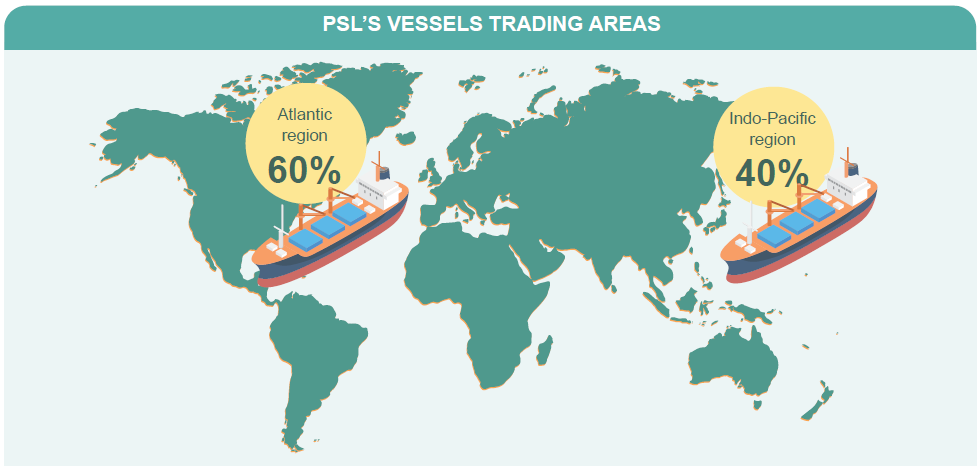
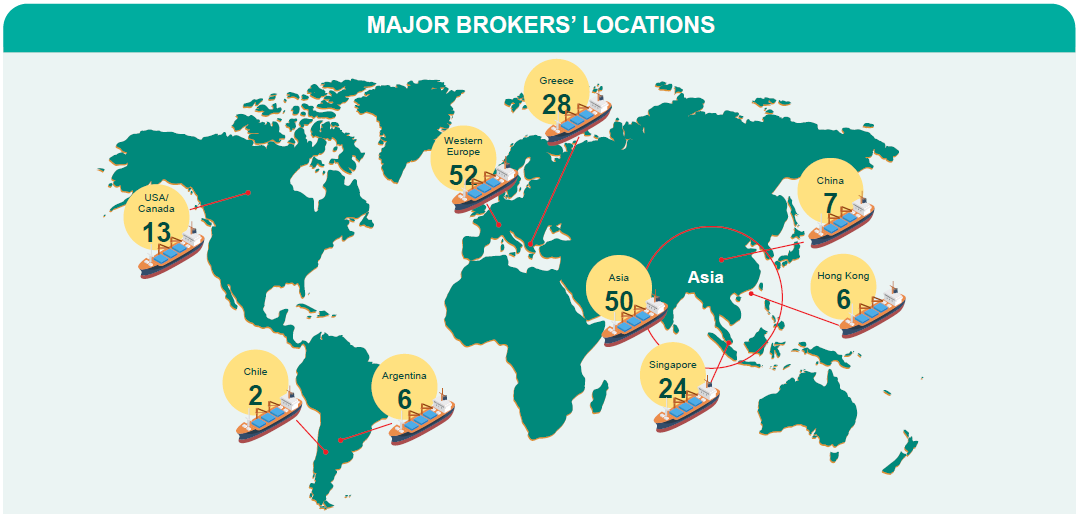
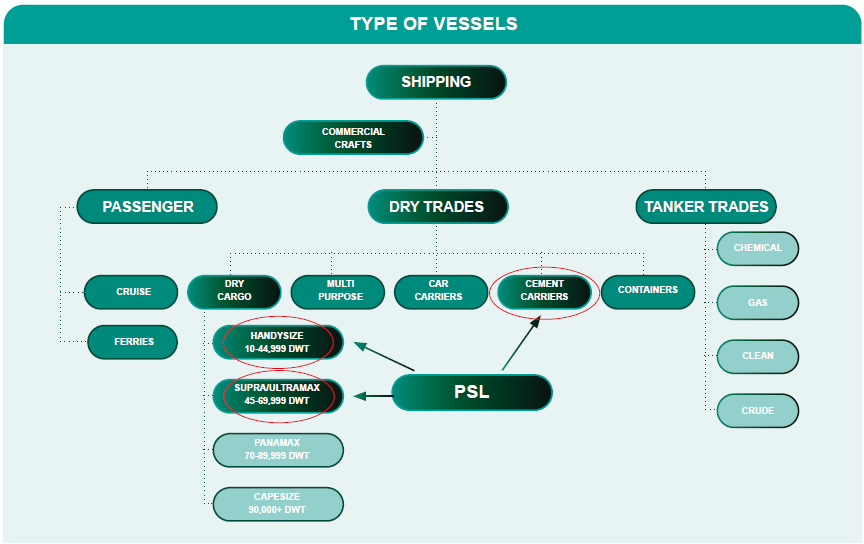
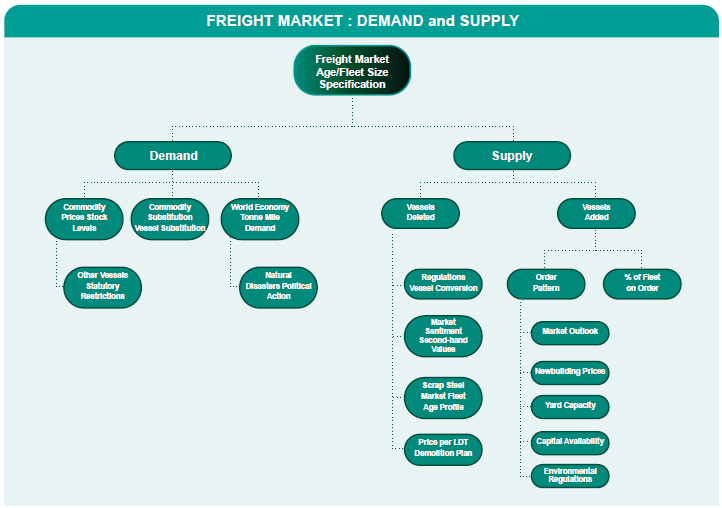
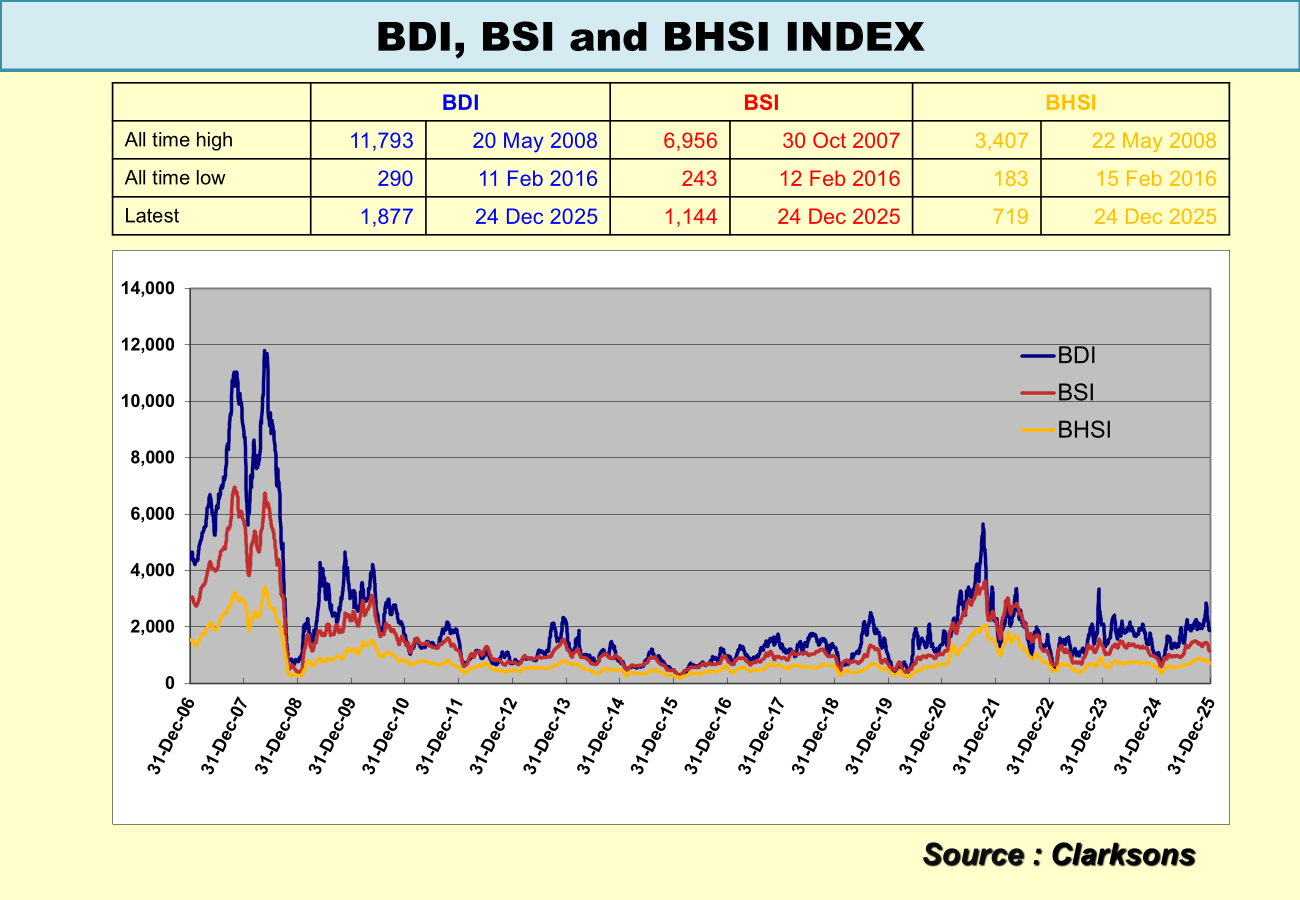
Procurement of Products & Services
Reporting Mode
3116
Per-Business-Group Breakdown
| Procurement |
|---|
PSL Ships are employed principally under a Time Charter or Voyage Charter Contract: 1. Time Charter: Under this type of charter, the Charterer pays Charter Hire to PSL to operate the vessel for an agreed time period. The Charterer bears all voyage costs, including the cost of bunker fuels and port dues. It may be noted in this case that PSL (or the Shipowning Company) is not the Lessor of the ship, but rather a service-provider, since PSL retains full control with physical and legal possession of the ship. 2. Voyage Charter: Under this charter, the Charterer pays Freight to PSL to transport a particular cargo between two or more designated ports (usually paid on a dollar per ton basis). In this case, PSL bears all the voyage costs, including the cost of bunker fuels and port dues. |
Projects Under Construction
Has Projects Under Construction (Y/N)
No
Debentures & Bills of Exchange
Has Debentures (Y/N)
Yes
Debentures
| Debenture Name | Description / Rating | Interest Rate (%) | Outstanding | Maturity Date | Term | Types |
|---|---|---|---|---|---|---|
| The Guaranteed Sustainability-Linked Bonds of Precious Shipping Public Company Limited No. 1/2567 (2024) Series 1 Due B.E. 2572 (2029) | Issue Rating: AAA/Stable rating by TRIS Rating Co., Ltd., announced on 28 August 2024 | 3.52 | 680,000,000 | 18 October 2029 | 5 | 2789 · Description: Senior Debenture · 2790 · Description: Secured Debenture |
| The Guaranteed Sustainability-Linked Bonds of Precious Shipping Public Company Limited No. 1/2567 (2024) Series 2 Due B.E. 2577 (2034) With Call Option | Issue Rating: AAA/Stable rating by TRIS Rating Co., Ltd., announced on 28 August 2024 | 3.97 | 680,000,000 | 18 October 2037 | 10 | 2789 · Description: Senior Debenture · 2790 · Description: Secured Debenture |
Convertible Securities
Has Convertible Securities (Y/N)
No